There's a particular kind of patient we see regularly in our General Medicine OPD at Felix Hospital. They're in their early forties. They work in one of the IT parks off the Expressway. They came in for something else entirely , a routine health check before a new job, a persistent headache they've been blaming on screen time, a visa medical. We check their blood pressure as part of the workup. The reading comes back: 158/96.
We ask when they last had it checked. They say they haven't, really. Maybe once, a few years ago, at a camp in their office. It was "a little high" then too. They were told to reduce salt and come back. They reduced the salt. They didn't come back.
That gap , between a first abnormal reading and actual treatment , is where strokes happen. Where heart attacks happen. Where kidneys quietly fail over years while the person feels, by every subjective measure, completely fine.
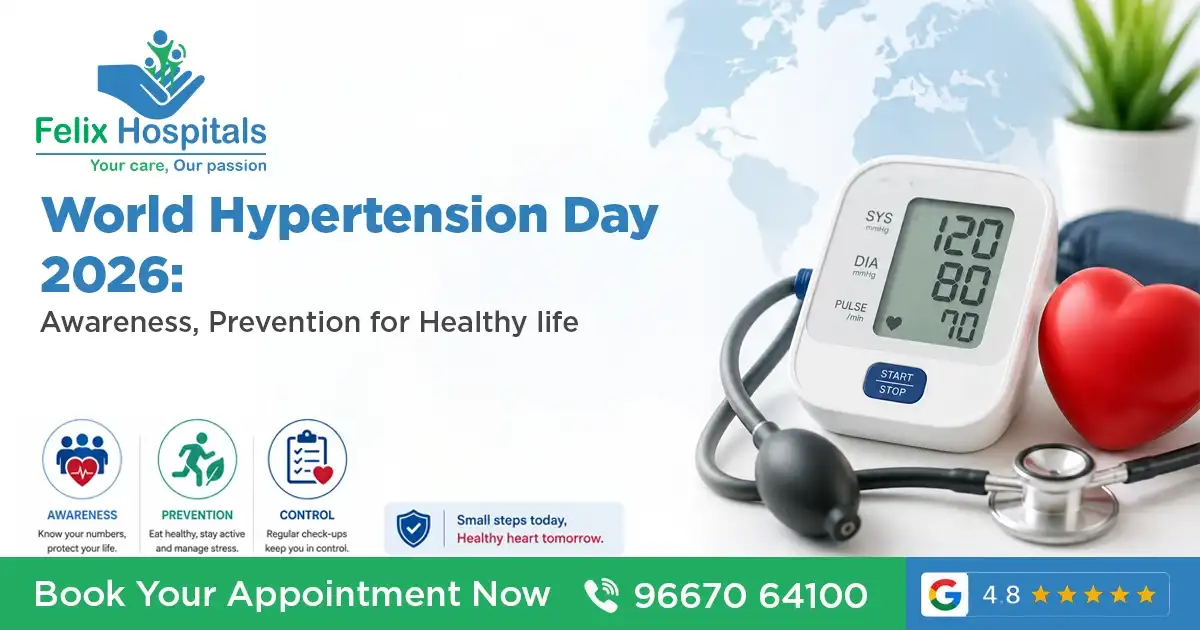
World Hypertension Day falls on May 17th every year. In 2026, as cardiovascular disease continues to be the leading cause of death in urban India, it is less a celebration and more a clinical warning.
Why This Day Has Become Necessary
The importance of World Hypertension Day 2026 comes down to one statistic that should be uncomfortable for every urban Indian to read: according to the Indian Council of Medical Research, nearly 1 in 3 adults in Indian cities has hypertension. Of those, almost half don't know it. In Noida specifically, the combination of sedentary work culture, high-sodium diets from frequent cafeteria and delivery meals, chronic work stress, and poor sleep in a city that genuinely never fully quiets down , creates conditions where hypertension doesn't just develop, it accelerates.
World Hypertension Day exists to close that gap between the unread number and the conversation with a doctor.
What Hypertension Actually Is , and Why "Silent Killer" Is Not an Exaggeration
Blood pressure is the force your blood exerts against your artery walls as your heart pumps. A normal reading sits at or below 120/80 mmHg. Hypertension is diagnosed when that pressure is consistently at or above 140/90 mmHg , though we now treat readings between 130 and 139 as a serious warning zone, not a "you're fine" category.
The reason hypertension is called the silent killer is precise, not dramatic. Elevated blood pressure causes no pain. It produces no obvious warning. While it is quietly damaging the inner lining of your arteries, straining your heart muscle, and increasing the fragility of blood vessels in your brain and kidneys , you feel nothing. No alarm. No signal. Just a normal Tuesday in your Sector 137 apartment, until it isn't.
The first symptom of uncontrolled hypertension is, for many patients, a stroke or a heart attack. That is not a metaphor for severity. That is literally the clinical presentation.
Why Are So Many People in Noida Developing It Young?
We are seeing hypertension in patients in their thirties now with a frequency that was uncommon a decade ago. The causes aren't mysterious.
Chronic stress without recovery , a twelve-hour workday in a Sector 62 tech firm, a two-hour commute each way, deadlines that follow you onto your phone at 11pm , this isn't stress in the temporary sense. It is sustained activation of the body's stress response, which keeps cortisol and adrenaline elevated, which keeps blood vessels constricted, which keeps blood pressure up. The body was not designed to be on high alert indefinitely.
Diet in a delivery-app city , The average Noida professional eats a significant proportion of their meals from aggregators. Restaurant and packaged food in India is sodium-dense by design , salt is a preservative, a flavour enhancer, and a texture modifier. The recommended daily sodium intake is under 2,300mg. A single meal from most popular delivery chains can exceed that alone.
Disrupted sleep hypertension and sleep deprivation have a well-documented bidirectional relationship. Poor sleep raises blood pressure. Elevated blood pressure disrupts sleep architecture. In a city where late-night screen exposure, irregular work shifts, and urban noise are normal, this cycle is running constantly in millions of people.
Unmanaged diabetes and obesity Both are independent risk factors for hypertension and are themselves rising rapidly in urban NCR. They don't just coexist; they amplify each other's cardiovascular damage.
Family history If either of your parents has hypertension, your lifetime risk is substantially elevated. This is not fate, but it is a reason to start monitoring in your thirties rather than your fifties.
The Symptoms That Are Easy to Dismiss
Most of the time, hypertension produces nothing. That is the entire problem.
When it does produce symptoms, they are the kind that get rationalized away. A headache at the back of the head, usually in the morning , is due to dehydration or bad sleep. Blurred vision that comes and goes , put down to screen fatigue. A vague dizziness when standing up quickly , put down to skipping breakfast. Occasional nosebleeds , put down to the dry Delhi winter air.
None of these are reliable early warning signs in the way a fever signals infection. They tend to appear when pressure has already been elevated for some time. The more honest statement is this: if you are over 30, living an urban professional life in Noida, and you have not had your blood pressure checked in the last year , the symptom you should be paying attention to is the absence of information.
Lifestyle Changes That Actually Move the Number
We are careful at Felix Hospital not to use lifestyle advice as a substitute for medication when medication is needed. Telling a patient with a BP of 170/100 to "try yoga first" is not conservative medicine , it is delayed treatment with consequences.
That said, for patients in the pre-hypertension range or as adjuncts to medication, the following interventions have genuine, measurable impact:
Sodium reduction , specifically , Not "eat less salt" as a vague instruction, but a concrete target: under 5 grams of total sodium per day. Read labels. Papad, pickle, packaged namkeen, instant noodles, and most restaurant curries are the primary contributors in the average NCR diet. Reducing these specifically , not just putting down the salt shaker at the dinner table , produces meaningful BP reduction within weeks.
Thirty minutes of moderate aerobic activity, five days a week , Walking, cycling, swimming. Not high-intensity training, which can temporarily spike pressure. Consistency matters far more than intensity. A thirty-minute walk in Noida's sectors is genuinely sufficient if done regularly.
Alcohol in actual moderation , Not "moderate drinking is fine" as a reassurance. More than two standard drinks per day is an independent cause of elevated blood pressure. For patients already hypertensive, less is measurably better.
Weight , specifically the waist , Central obesity, measured by waist circumference rather than BMI alone, is strongly associated with hypertension. Every kilogram of weight lost in the abdomen produces a corresponding reduction in systolic blood pressure.
Sleep as treatment , Seven to eight hours of uninterrupted sleep is not a luxury or a productivity hack. It is a cardiovascular intervention. If you are sleeping less than six hours regularly, no amount of dietary adjustment will fully compensate.
When a Doctor Is Not Optional
See a physician if your blood pressure reads above 130/80 on two separate measurements taken on different days.
See one urgently , the same day , if your reading exceeds 180/120, if you have a severe headache alongside an elevated reading, if you experience sudden vision changes, chest pain, or difficulty speaking. These are hypertensive urgency and emergency presentations, and they require immediate medical attention, not a wait-and-watch approach.
Many patients ask whether they need medication or whether lifestyle changes alone are sufficient. The honest answer depends on your specific numbers, your cardiovascular risk profile, whether you have diabetes, kidney disease, or a family history of early heart attacks. There is no universal answer. What is universal is that the decision should be made with a physician who knows your full picture , not based on a WhatsApp forward about apple cider vinegar.
What Our General Medicine Team Offers
Felix Hospital's general physicians are, among other things, Noida's hypertension clinic in practical terms. A significant proportion of our daily OPD involves blood pressure management , newly diagnosed patients, patients on medication whose control is inadequate, and patients who have been managing it on their own with inconsistent results.
What makes a difference here is continuity. Hypertension is not a condition you treat once. It is managed over years, with medication adjustments, lifestyle monitoring, and periodic screening for end-organ damage , the kidneys, the eyes, the heart. Our team maintains that longitudinal relationship with patients in a way that a one-time urgent care visit cannot.
We also run full cardiovascular risk assessments , lipid panels, fasting glucose, ECG, kidney function , because in most patients with hypertension, there are other risk factors present that need to be addressed simultaneously. Treating blood pressure in isolation while ignoring a borderline HbA1c is incomplete medicine. Call us at +91 9667064100
 WhatsApp
 Emergency:
  WhatsApp



























 +(91)9667064100
 Emergency : +(91)9667064100