Your Health, Our Priority

Request Call Back

Request an Appointment

CAPTCHA
Solve this simple math problem and enter the result. E.g. for 1+3, enter 4.
* By clicking on the above button you agree to receive updates on WhatsApp

How to Maintain Kidney Health: What to Sip, What to Skip & Expert Tips

Your kidneys do something remarkable every single day  without any conscious effort on your part. Your kidneys filter about 50 gallons of blood every single day. They regulate your blood pressure, balance your electrolytes, produce hormones that control red blood cell production, and remove waste that would otherwise accumulate to toxic levels in your body.


And yet, most people only think about their kidneys when something goes wrong.


At Felix Hospital's nephrology department in Sector 137, Noida, we see this pattern repeatedly. Patients arrive with significantly reduced kidney function  sometimes already at stage 3 or 4 chronic kidney disease  having had no symptoms for years. No pain. No warning. Just a blood test result that changes everything.


The good news is that kidney disease is largely preventable  and even when early damage exists, its progression can be significantly slowed with the right choices. Those choices begin, more often than not, in your kitchen and your daily habits.


This guide is your practical, clinical roadmap to kidney health  what to eat, what to drink, what to avoid, and when to come in for a check-up before the damage becomes irreversible.


The Silent Crisis: Why Kidney Health Matters in Noida

Before we get to the what-to-eat and what-to-avoid, it is worth understanding exactly what is at stake.

The kidneys sit quietly at the back of your abdomen  two fist-sized, bean-shaped organs that perform functions no other organ can replicate. When they fail, the consequences are profound: fluid accumulates in the lungs, toxins build up in the blood, blood pressure becomes uncontrollable, and the only options that remain are dialysis or a kidney transplant.


Chronic Kidney Disease (CKD) is classified in five stages based on eGFR  estimated Glomerular Filtration Rate  the measure of how well your kidneys are filtering blood. The burden of chronic kidney disease is increasing worldwide. In India, the situation is particularly concerning  with diabetes and hypertension being the two leading causes of CKD, and both of these conditions now affecting tens of millions of Indians.


Most people with early kidney disease do not have symptoms. That is why it is important to be tested.


This is the central challenge of kidney health: the kidneys lose function silently. By the time a patient notices swelling in the legs, fatigue, or reduced urine output, the damage is often already significant. Early testing and early action  guided by the nephrology team at Felix Hospital  are what prevent that journey from progressing further.


The "Sip vs. Skip" Guide for Healthy Kidneys

What to Sip (Include):


  • Water  2 to 3 litres daily: The ultimate kidney filter. In Noida's heat and humidity, adequate hydration is critical  dehydration concentrates the urine and increases the risk of stone formation. Use your urine colour as a guide: pale yellow is ideal, dark yellow means drink more.

  • Herbal Teas : Ginger, Tulsi, and Chamomile: Anti-inflammatory, calming, and completely free of the sugar and phosphorus that harm kidney function. Far better than packaged drinks or colas.

  • Berry-based options :  Low-potassium choices: Strawberries, blueberries, and cranberries are low in potassium and phosphorus, rich in antioxidants and Vitamin C, and have documented anti-inflammatory effects. Apples are another low-potassium, high-fibre daily option.


What to Skip (Avoid):


  • Dark Colas: Made with phosphoric acid for preservation and taste. Phosphoric acid may cause kidney damage, especially in those who already have kidney disease. Two or more servings per day are associated with significantly higher kidney disease risk.

  • Energy Drinks: A concentrated hit of caffeine, sugar, phosphorus, and sodium  all in one serving. Among the most kidney-hostile beverages available.

  • Packaged Juices: Hidden sugar, hidden sodium, and preservatives  all of which drive insulin resistance and weight gain that harm kidney function over time. Commercial sweetened drinks carry the same risks as cola.


8 Kidney-Friendly Foods for the Indian Kitchen


Cauliflower  A Kidney Superstar

Cauliflower is low in potassium, low in phosphorus, high in Vitamin C and folate, and extremely versatile in Indian cooking. Gobi sabzi, gobi paratha made with whole wheat, and cauliflower soup are all kidney-friendly. It is one of the most consistently recommended vegetables across all major renal diet guidelines.


Cabbage and Leafy Greens

Cabbage is another low-potassium, low-phosphorus vegetable that supports kidney health. For patients already diagnosed with CKD and high potassium levels, leafy greens like spinach and methi should be consumed in moderation and after boiling  which reduces their potassium content.


Dals and Lentils  Plant Protein Done Right

Moong, masoor, and toor dal are excellent plant-based protein sources that are gentler on the kidneys than animal protein. They also provide fibre that supports blood sugar and blood pressure control. There is convincing evidence that a healthy dietary pattern including plant-based foods may lower CKD risk.


Egg Whites

High in protein, low in phosphorus, and free from the saturated fats that come with the yolk. For patients who need high-quality protein with minimal phosphorus load, egg whites are a frequently recommended choice.


Garlic and Onion  Flavour Without the Sodium

Replacing salt with garlic, onion, and herbs is one of the most practical kidney health tips. Garlic contains allicin, which has blood pressure-lowering and anti-inflammatory properties  both directly relevant to kidney health since hypertension is the second leading cause of CKD.


Berries and Apples

Low in potassium, rich in antioxidants and anti-inflammatory compounds. Both make easy daily snacks that support kidney and gut health simultaneously.


Olive Oil and Mustard Oil

Healthier fat choices that support cardiovascular health  and a healthy heart is a prerequisite for healthy kidneys, as the two organs are deeply interlinked. Cold-pressed mustard oil is a kidney-friendly Indian kitchen staple rich in monounsaturated fats and omega-3 fatty acids.


Cauliflower Soup and Gobi Sabzi (Bonus Practical Option)

Worth highlighting again as a meal-ready, kidney-friendly choice that fits naturally into the Indian daily diet  no substitutions or special ingredients required.


Leaching  How to Reduce Potassium in Vegetables at Home

Leaching is a simple technique that significantly reduces the potassium content of high-potassium vegetables  an important step for patients with advanced CKD. To leach vegetables: peel and slice them thinly, soak in warm water for two to four hours (or overnight for potatoes), drain the water completely, rinse under fresh water, and then cook in fresh water. This can reduce potassium content by 30–50% depending on the vegetable. Boiling and discarding the water rather than steaming or pressure-cooking achieves the same effect. This technique makes vegetables like potatoes, carrots, and beetroot more manageable for CKD patients who need to limit potassium.


The Hidden Danger: OTC Painkillers and Herbal "Tonics"

One of the most commonly overlooked causes of kidney damage is regular use of NSAIDs  non-steroidal anti-inflammatory drugs  including ibuprofen, diclofenac, and naproxen. These are available without a prescription across India and are routinely taken for headaches, back pain, and joint pain.


Prolonged or frequent use of NSAIDs reduces blood flow to the kidneys and can cause both acute kidney injury and, over time, chronic damage. Always consult your Felix Hospital physician before taking any painkiller regularly.


The risk does not stop at pharmacy shelves. In India, a significant number of CKD cases are caused or worsened by herbal remedies consumed without medical supervision. Certain traditional preparations  including some containing aristolochic acid  are directly nephrotoxic and can cause irreversible kidney damage. Before taking any herbal supplement, Ayurvedic medicine, or "kidney tonic," consult your Felix Hospital physician. Natural does not automatically mean safe.


This combination  freely available painkillers taken habitually, and herbal tonics assumed to be harmless  represents one of the most preventable causes of kidney damage seen in Felix Hospital's nephrology department. Awareness of these risks is itself a form of kidney protection.


Know Your Numbers: eGFR and uACR Testing

Most kidney disease is found not through symptoms but through blood and urine tests. Understanding which tests matter and what they mean puts you in control.


eGFR  Estimated Glomerular Filtration Rate

The eGFR test measures your filtration rate according to your protein levels, age, sex, height, and weight. An eGFR between 60 and 100 means mild kidney damage but kidneys continue to function well. An eGFR below 60 may indicate chronic kidney disease. Monitoring eGFR is crucial for detecting kidney disease early and managing existing kidney disease.


uACR  Urine Albumin-to-Creatinine Ratio

A normal uACR is less than 30 mg/g. A uACR of 30–300 mg/g may indicate kidney disease or increased cardiovascular risk. A uACR above 300 mg/g indicates significant kidney damage and a high risk of progression. Critically, you can have kidney damage even with a normal eGFR if your uACR is elevated. Both tests together give the complete picture.


Additional Tests

Serum creatinine measures a waste product from normal muscle breakdown  elevated levels suggest kidney dysfunction. BUN (blood urea nitrogen) measures waste from protein metabolism and is reviewed alongside eGFR and creatinine. Urinalysis evaluates urine for blood, protein, acidity, and the presence of casts and crystals  important early warning signs.


How Often Should You Get Tested?


Risk Profile

Recommended Testing Frequency

Healthy adult with no risk factors

Every 2–3 years from age 40

Diabetic patient

Every year  eGFR and uACR both

Hypertensive patient

Every year

Known CKD (any stage)

Every 3–6 months as advised by nephrologist

Family history of kidney disease

Every year from age 30

Obese or overweight adult

Every year


At Felix Hospital, a comprehensive kidney function panel  including serum creatinine, eGFR, BUN, urine routine, and uACR  can be done in a single visit through our in-house pathology lab, with results available the same day.


When to Consult a Doctor for Kidney Concerns

The following symptoms should prompt an immediate or urgent visit to Felix Hospital's nephrology department:


Significantly reduced urine output, foamy or frothy urine suggesting protein leakage, blood in the urine, or frequent nighttime urination that is new or worsening. Puffiness around the eyes in the morning, or swelling in the ankles, feet, or legs indicating fluid retention. Persistent fatigue disproportionate to activity levels  a sign that toxins are accumulating in the blood. Blood pressure that refuses to come down despite multiple medications. Persistent pain in the lower back or sides, particularly with fever and urinary symptoms. Nausea, loss of appetite, or a metallic taste  signs of uraemia indicating advanced kidney disease requiring urgent evaluation.


Call +91 9667064100 or come directly to Felix Hospital without delay if you experience any of the above.


Conclusion

Your kidneys work in silence  and that silence is both their strength and their vulnerability. They can lose more than half their function before producing a single symptom. By the time the body signals that something is wrong, the damage is often significant.


The strategies in this guide  staying hydrated, reducing salt and sugar, choosing plant-based proteins, exercising regularly, controlling blood pressure and diabetes, and getting your kidney numbers checked annually  are not complicated. They are the quiet, consistent choices that keep your kidneys filtering for decades.


At Felix Hospital, Sector 137, Noida, our nephrology and internal medicine teams are experienced in both the prevention and management of kidney disease  from early-stage CKD to complex cases requiring specialist intervention. .

To book a kidney health consultation or get your kidney function tests done, call +91 9667064100.

Written and verified by:
Dr. Udit Gupta

Dr. Udit Gupta

MBBS, Md, DrNB | Exp: 10 Yr
Nephrology

Dr. Udit Gupta is an experienced Nephrologist with 10+ years of expertise in chronic kidney disease, kidney stones, dialysis, kidney transplantation, and hypertension-related renal disorders.

Your Health, Our Priority

Request Call Back

Request an Appointment

CAPTCHA
Solve this simple math problem and enter the result. E.g. for 1+3, enter 4.
* By clicking on the above button you agree to receive updates on WhatsApp

What Are Triglycerides? Causes, Health Risks, and Prevention Tips

Every day at Felix Hospital's, patients come in holding a lipid profile report  pointing to their cholesterol numbers, asking about statins, and worrying about their heart. And then the doctor points to another number on the same report. One that is often overlooked. One that is, in many cases, more elevated than cholesterol.


That number is triglycerides.


Most people have heard of cholesterol. Far fewer understand what triglycerides are, why they matter, or that persistently high levels are a significant and independent risk factor for heart disease, pancreatitis, and fatty liver disease. Yet in a country where refined carbohydrates, white rice, sugar, and deep-fried foods are dietary staples  India has a serious triglyceride problem.


This guide explains everything you need to know  what triglycerides are, what makes them go up, what happens to your body when they stay elevated, and what you can do about it.


What Are Triglycerides?

Triglycerides transport fatty acids and store energy. They are naturally found in fats and mainly get into your body through the food you eat. But your body can also make them itself. Measuring the triglyceride levels in your blood can help assess your individual risk of cardiovascular disease.


Triglycerides are lipids that provide energy to your body. You get some triglycerides from foods you eat, like butter and oils. Plus, when you consume more calories than you need, your body converts them into triglycerides. Your body can access these triglycerides later on when you need energy.


In other words, triglycerides are your body's primary system for storing excess energy. When you eat more than you burn  whether those excess calories come from fat, carbohydrates, or alcohol  the surplus is packaged into triglycerides and stored in fat cells throughout the body. Between meals, hormones signal the release of these triglycerides to provide fuel.


This system works perfectly well at normal levels. The problem begins when triglycerides consistently remain elevated in the bloodstream, a condition called hypertriglyceridaemia.


Triglyceride Levels  What the Numbers Mean

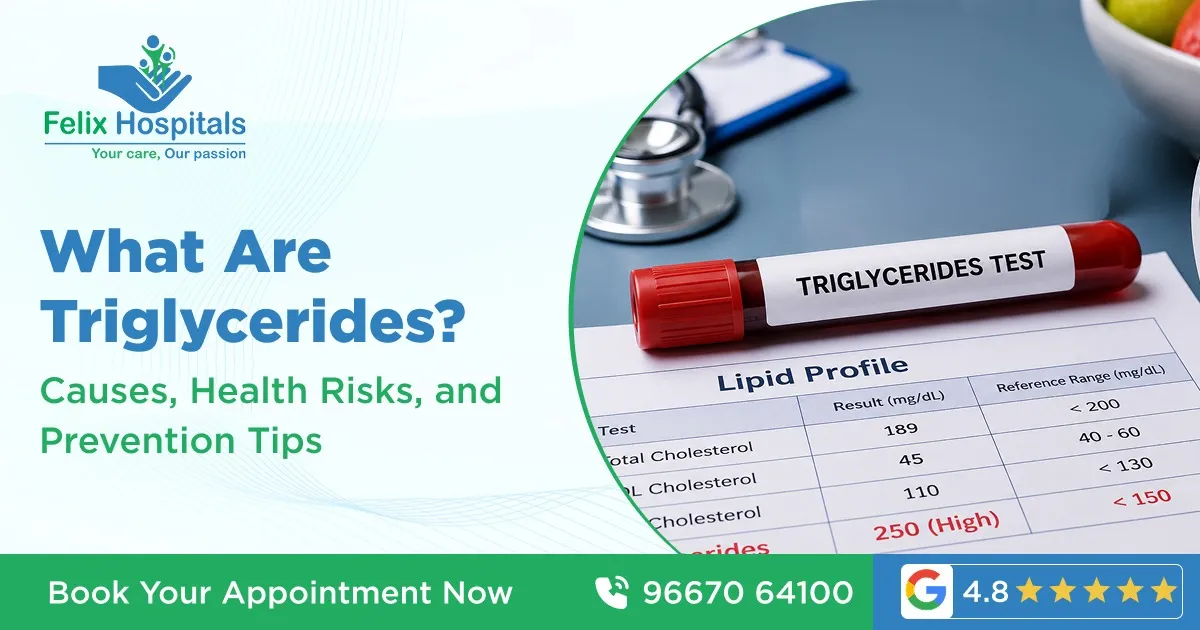
A normal triglyceride level in adults is below 150 milligrams per deciliter (mg/dL). A triglyceride level below 100 mg/dL is ideal. It is important that triglycerides are measured while you are fasting. Hypertriglyceridaemia means your triglyceride level is 150 mg/dL or higher. Severe hypertriglyceridaemia means your triglycerides are 500 mg/dL or higher.


Triglyceride Level

Classification

Clinical Implication

Below 100 mg/dL

Optimal

Ideal for cardiovascular health

100 – 149 mg/dL

Near optimal

Acceptable  continue healthy habits

150 – 199 mg/dL

Borderline High

Lifestyle changes recommended

200 – 499 mg/dL

High

Medical evaluation and treatment needed

500 mg/dL and above

Very High

Urgent intervention  pancreatitis risk


When your doctor orders a lipid profile at Felix Hospital, triglycerides are measured as part of the panel  alongside total cholesterol, LDL, and HDL. The test requires fasting for 9–12 hours beforehand, as eating  particularly carbohydrate- or fat-rich food  causes a temporary spike in triglyceride levels that can make the result inaccurate.


Causes of High Triglycerides

Understanding what drives triglycerides up is the first step toward managing them. The causes fall into two broad categories: lifestyle-related and medical.


Dietary Causes

Excess Sugar and Refined Carbohydrates This is the single most important dietary driver of high triglycerides  and it is especially relevant in the Indian context. The specific strategies that move the needle most are cutting back on sugar and refined carbohydrates, getting regular aerobic exercise, losing even a modest amount of weight, and limiting alcohol.


When you eat refined carbohydrates  white rice, maida, white bread, biscuits, sweets, sweetened beverages  your blood glucose spikes rapidly. The liver converts this excess glucose directly into triglycerides. This is why someone eating a seemingly "low-fat" diet but consuming large amounts of refined carbohydrates can still have dramatically elevated triglycerides.


Excess Calorie Intake If someone consumes more calories than they can burn, they may develop hypertriglyceridaemia. One of the most prevalent risk factors for cardiovascular disease, coronary heart disease, and stroke is high triglyceride levels.

Alcohol breaks down and rebuilds into cholesterol and triglycerides in the liver. High alcohol intake is strongly linked to elevated triglyceride levels. Even moderate, regular drinking can push triglycerides significantly higher in sensitive individuals.


High-Fat Diet Diets heavy in saturated fats, fried foods, processed meats, and full-fat dairy in excess  contribute to elevated triglycerides, particularly when combined with high carbohydrate intake.


Medical and Metabolic Causes

Type 2 Diabetes and Insulin Resistance Excess triglyceride production and poor diabetes control are often associated with higher levels, commonly seen in overweight individuals and people with type 2 diabetes. When insulin signalling is impaired, the liver produces more triglycerides and releases them into the bloodstream at a higher rate.


  • Hypothyroidism An underactive thyroid slows the body's metabolism of lipids, including triglycerides. Untreated or under-treated hypothyroidism is a common and easily missed cause of elevated triglycerides.

  • Kidney Disease Chronic kidney disease impairs the body's ability to clear triglyceride-rich lipoproteins from the blood, leading to persistently elevated levels.

  • Obesity Excess body fat  Particularly visceral fat around the abdomen  is metabolically active and drives higher triglyceride production. Central obesity and high triglycerides are hallmarks of metabolic syndrome.

  • Increased triglycerides can be a side effect of certain drugs, such as hormone replacement therapy, beta-blockers, corticosteroids, retinoids, and antipsychotic medications. If your triglycerides have risen after starting a new medication, discuss this with your doctor at Felix Hospital before making any changes.

  • Genetic Conditions Some patients have familial hypertriglyceridaemia, a genetic condition where triglyceride levels are elevated regardless of diet and lifestyle. These patients typically require medical treatment in addition to lifestyle modifications.


Symptoms of High Triglycerides

Here is what makes high triglycerides particularly dangerous: most of the time, they cause no symptoms whatsoever.


High triglycerides typically do not cause symptoms. Doctors can advise on how often to check lipid profiles for triglyceride levels. High triglycerides can indicate underlying issues and are a risk factor for several health conditions.


High triglycerides usually do not cause any symptoms. But if they are not treated and you develop heart disease, then you may feel tired as a side effect.


This silent nature is precisely why a routine lipid profile  which Felix Hospital recommends as part of every adult health check-up  is so important. By the time triglycerides cause obvious symptoms, the condition is often already severe.


When symptoms do appear, they are typically associated with very high or extreme levels:


  • Xanthomas Fatty deposits that appear as yellowish, waxy bumps under the skin  particularly on the elbows, knees, buttocks, or tendons. These indicate severely elevated triglycerides and often reflect a genetic lipid disorder.

  • Xanthelasma Similar fatty deposits that form on or around the eyelids. Often noticed by the patient as small yellowish patches that appear gradually.

  • Abdominal Pain Very high triglyceride levels can cause severe abdominal pain, inflammation of the pancreas (acute pancreatitis), and fatty deposits in the skin. Some of these symptoms, specifically acute pancreatitis, can be life-threatening.

  • Lipemia Retinalis At extremely high triglyceride levels (above 2,000 mg/dL), the blood vessels of the retina can take on a milky appearance  visible on examination.


If you have any of these signs, seek immediate medical evaluation. But more importantly  do not wait for symptoms. Get your lipid profile tested.


Health Risks of Elevated Triglycerides

The real danger of high triglycerides is not how they feel  it is what they silently do to your organs over time.


Cardiovascular Disease

Consistently high triglyceride levels may increase the risk of atherosclerosis. In this condition, triglycerides mix with other substances in the blood such as cholesterol and stick to the artery walls, causing the arteries to narrow. Atherosclerosis is a risk factor for heart disease and serious cardiovascular events such as heart attack and stroke.


High triglycerides tend to show up along with other problems such as high blood pressure, diabetes, obesity, high LDL cholesterol, and low HDL cholesterol. Research now shows that increased triglyceride levels are associated with an increased risk of cardiovascular events such as heart attacks and strokes.


When coupled with other risk factors  high cholesterol, high blood glucose, high blood pressure, and obesity  elevated triglycerides further elevate the risk of cardiovascular disease. Such increased levels also interfere with the body's natural blood-clotting mechanism, and a blood clot could lead to a heart attack or stroke.


Acute Pancreatitis

People with severe hypertriglyceridaemia  triglycerides at 500 mg/dL or higher  face an increased risk of acute pancreatitis. This is an inflammation of the pancreas that requires urgent medical care.


Pancreatic inflammation results from triglyceride levels that are extremely high  above 500 mg/dL. Patients develop pancreatitis, a disorder in which the digestive enzymes within the pancreas get activated and begin damaging interior cells. Patients experience intense abdominal pain radiating to the back, as well as nausea, vomiting, fever, and abdominal tenderness.


A 2025 study found that when triglyceride levels increase to more than 150 mg/dL, the severity of acute pancreatitis also tends to increase  suggesting that even moderately elevated levels carry pancreatic risk in susceptible individuals.


Fatty Liver Disease (NAFLD)

Patients who have excessive triglycerides are more likely to develop fatty liver disease. All organs, including the liver, accumulate lipids as a result of unhealthy lifestyles. Although fatty liver may not initially show any symptoms, it has the potential to develop serious complications like cirrhosis and irreversible liver damage.


Metabolic Syndrome

High triglycerides are one of the five defining criteria of metabolic syndrome  a cluster of conditions that dramatically increases the risk of type 2 diabetes and cardiovascular disease. The other criteria are abdominal obesity, elevated blood pressure, high fasting blood glucose, and low HDL cholesterol. If you have three or more of these, you have metabolic syndrome  and your triglyceride level is a key part of the picture.


How to Prevent High Triglycerides

The good news is that triglycerides are among the most responsive of all lipid parameters to lifestyle change. Even modest modifications can produce significant reductions within weeks. Here is what the evidence supports:


Reduce Sugar and Refined Carbohydrates  Immediately

This is the single most impactful dietary change for most patients with high triglycerides. Eliminate or dramatically reduce: white rice in excess, maida-based foods (bread, biscuits, samosas, parathas), packaged sweets and mithai, sugary beverages including fruit juices and soft drinks, and added sugar in tea and coffee.

Replace these with: whole grains, oats, daliya, brown rice in moderate portions, and dals and legumes  all of which have a lower glycaemic impact and provide fibre that slows fat absorption.


Increase Dietary Fibre

Fibres such as chia, flax, psyllium, or bran help lower triglycerides through mechanisms similar to fibrate medications.

Oats contain beta-glucan, a soluble fibre that reduces cholesterol and triglycerides by improving lipid metabolism. Lentils contain plant-based protein and fibre that stabilise blood sugar levels and reduce lipid accumulation. Chickpeas are full of soluble fibre that helps in fat digestion and controlling triglyceride build-up.


Include Omega-3 Rich Foods

Research suggests that omega-3 fatty acids may help lower triglyceride levels significantly.

Omega-3 fatty acids are found in fish oil, salmon, sardines, mackerel, and herring. Choosing these over leaner fish and meat can help reduce triglycerides.

For vegetarians in India: flaxseeds contain omega-3 fatty acids in high amounts which help maintain healthy lipid levels and reduce inflammation. Walnuts, chia seeds, and mustard oil are other accessible Indian sources.


Exercise Regularly

Exercise can have a significant impact on triglyceride levels. Experts advise that everyone should get at least 30 minutes of exercise five times a week.


Aerobic exercise lowers triglycerides by acting on apolipoprotein C3 in individuals with coronary heart disease. Brisk walking, cycling, swimming, and dancing all count. The key is consistency, not intensity. Three months of regular moderate exercise will produce a meaningful reduction in triglyceride levels.


Lose Weight if Overweight

Mild cases of high triglycerides can respond to a structured diet and weight loss of 5–10% of body weight. Even losing 4–5 kg in an overweight patient can produce a dramatic drop in triglyceride levels  often more than medication alone.


Limit Alcohol

Limiting alcohol is one of the specific strategies that moves triglyceride levels most effectively. If your triglycerides are elevated, even a temporary period of abstinence followed by a repeat lipid profile will often show a striking improvement.


Choose the Right Cooking Oils

Mustard oil is rich in monounsaturated fats and omega-3 that are good for the heart. Ghee in moderation can improve digestion and provides healthy fats that keep lipid levels in check. Avoid repeated use of the same deep-frying oil  repeated heating creates trans fats that raise triglycerides significantly.


The Indian Kitchen as Medicine

The good news for patients across Noida and Greater Noida is that traditional Indian ingredients  when used correctly  are genuinely triglyceride-friendly:


  • Methi (fenugreek seeds)  soluble fibre and compounds that improve insulin sensitivity

  • Amla (Indian gooseberry)  rich in Vitamin C and antioxidants that support lipid metabolism

  • Garlic  contains allicin, which has modest but documented lipid-lowering effects

  • Turmeric  curcumin has anti-inflammatory properties that benefit metabolic health

  • Dal and legumes  high-fibre, high-protein, low-glycaemic staples that actively help lower triglycerides

  • Flaxseeds (alsi)  one of the richest plant sources of omega-3 in the Indian diet


Treatment Options for High Triglycerides

When lifestyle changes are not sufficient  or when triglyceride levels are very high  medical treatment is indicated. Your Felix Hospital physician will determine the appropriate approach based on your level, symptoms, and overall cardiovascular risk profile.


Treating the Underlying Cause First

Before prescribing triglyceride-specific medication, your doctor will look for and treat reversible causes of uncontrolled diabetes, hypothyroidism, kidney disease, or a contributing medication. Correcting these can normalise triglycerides without additional lipid therapy.


Statins

For people in the 150 to 499 mg/dL range, statins remain the primary medication because they reduce the broader risk of heart disease. Statins are primarily LDL-lowering agents, but they also produce a modest reduction in triglycerides as a secondary benefit. For patients whose primary concern is cardiovascular risk reduction, a statin is the first pharmacological choice.


Fibrates

Fibrates make it harder for your body to bundle up triglycerides and carry them through your blood. They are specifically effective at lowering triglycerides  often by 30–50%. If triglycerides remain at or above 500 mg/dL after ruling out other causes like uncontrolled diabetes or thyroid disorders, fibrates become reasonable additions specifically to prevent pancreatitis.


Prescription Omega-3 Fatty Acids

High-dose prescription omega-3  significantly higher than over-the-counter fish oil supplements  is an evidence-based treatment for very high triglycerides. Concentrated omega-3 fatty acids are among the medications used alongside fibrates for patients with severely elevated triglycerides.


Niacin (Nicotinic Acid)

Niacin reduces the liver's production of triglyceride-rich VLDL particles and can lower triglycerides substantially. It is used selectively due to its side effect profile and is always prescribed under medical supervision.


Dietary Management Under Medical Supervision

For patients with very high triglycerides  above 500 mg/dL  a strict low-fat diet (less than 15% of calories from fat) is sometimes required in addition to medication to prevent recurrent pancreatitis. This level of dietary restriction requires guidance from Felix Hospital's nutrition team, not simply general dietary advice.


When to Consult a Doctor at Felix Hospital

Many people discover elevated triglycerides incidentally  on a routine health check-up or a lipid profile done before an insurance policy. Others come in after a first episode of chest pain or abdominal pain that turns out to be related to their lipid levels.


Come to Felix Hospital's internal medicine or cardiology department for a triglyceride assessment if you:


  • Have not had a lipid profile done in the last year  especially if you are over 35

  • Have a family history of heart disease, diabetes, or high cholesterol

  • Are overweight, physically inactive, or consume a diet high in refined carbohydrates or alcohol

  • Have already been diagnosed with diabetes, hypertension, or fatty liver

  • Have had a previous abnormal lipid test and have not followed up

  • Experience unexplained abdominal pain  which in some patients is the first sign of triglyceride-induced pancreatitis

  • Notice yellowish deposits on or around your skin or eyelids

Hypertriglyceridaemia is important and needs treatment. But in most cases it is not a medical emergency. Your healthcare provider will work with you to help lower your numbers. Doing so can help you avoid complications that affect your heart or pancreas.


Conclusion

Triglycerides are not the cholesterol story's footnote, they are a central chapter in your cardiovascular health. High triglycerides are common, largely driven by lifestyle factors that are within your control, and highly responsive to the right combination of dietary changes, physical activity, and  where needed  medical treatment.


The challenge is that they cause no symptoms until damage is done. Which is why the lipid profile, a simple, affordable blood test  remains one of the most powerful tools in preventive medicine. A number on a report, caught early, can be the difference between a preventable heart attack and one that happens.


At Felix Hospital, Sector 137, Noida, our internal medicine, cardiology, and nutrition teams work together to assess your complete lipid profile, identify the root cause of elevated triglycerides, and design a management plan that is practical, evidence-based, and tailored to your life  not just your lab report.


To book a lipid profile or speak with one of our specialists, call +91 9667064100. Your heart health is a conversation worth having today.

Written and verified by:
Dr. Rahul Arora

Dr. Rahul Arora

MBBS, MD, DM | Exp: 21 Yr
Cardiology

Dr. Rahul Arora is an experienced Interventional Cardiologist with 21+ years of expertise in advanced cardiac care, specializing in personalized, evidence-based treatment for heart diseases and improved patient outcomes.

Your Health, Our Priority

Request Call Back

Request an Appointment

CAPTCHA
Solve this simple math problem and enter the result. E.g. for 1+3, enter 4.
* By clicking on the above button you agree to receive updates on WhatsApp

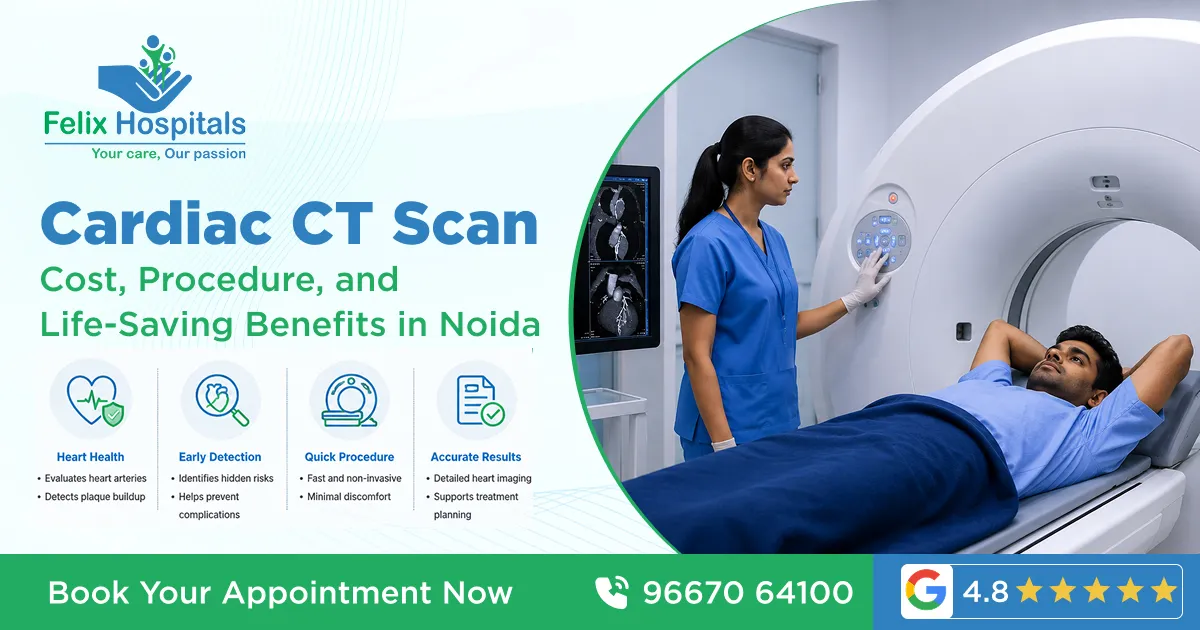
Cardiac CT Scan: Cost, Procedure, and Life-Saving Benefits in Noida

India is in the middle of a quiet cardiac crisis. Heart disease is now the leading cause of death in the country, and what makes it particularly dangerous is how silently it often progresses. Many patients who walk into Felix Hospital's cardiology department after a heart attack had no major warning symptoms in the weeks or months before. Their cholesterol was borderline. Their ECG was normal. They felt fine right up until they didn't.


This is precisely where the cardiac CT scan changes the conversation. It is one of the most powerful tools in preventive cardiology today, a non-invasive imaging test that can detect coronary artery disease, plaque buildup, and structural heart abnormalities years before they cause a clinical event.


If your cardiologist has recommended a cardiac CT scan, or if you are trying to understand whether you need one, this guide covers everything: what it involves, what it costs, and what the results mean for your heart health.


Two Ways to See Your Heart: CAC vs. CTCA

A cardiac CT scan is not a single test. It encompasses two main types of cardiac imaging, and understanding the difference matters for both clinical interpretation and cost planning.


The Calcium Score (CAC): A quick "risk check" that doesn't use needles or dyes.

A non-contrast CT that measures the amount of calcium deposited in the walls of the coronary arteries. It produces a number the calcium score that reflects the burden of atherosclerosis and helps stratify your risk of a future cardiac event. This simple, non-invasive procedure provides information about the coronary arteries without the need for needles, dyes, or medication. It is an effective tool for early detection and risk stratification for coronary artery disease, particularly in individuals who may not yet be experiencing symptoms.


The CT Angiography (CTCA): A detailed 3D map that shows exactly where blockages are.

A contrast-enhanced CT scan that produces detailed three-dimensional images of the coronary arteries, allowing the cardiologist to visualize the lumen of each artery and identify stenosis (narrowing), blockages, and the nature of any plaque present. A crucial strength of coronary CTA lies in its negative predictive value particularly in patients with low to intermediate pre-test probability of coronary artery disease. CTA can confidently exclude the presence of significant coronary artery stenosis, thereby avoiding the need for invasive diagnostic procedures.


Procedure: What Really Happens During the Scan?

We know that "heart tests" sound scary. At Felix Hospital, we make the process as smooth as a routine checkup.


The Setup: You'll lie on a comfortable table. We'll place small stickers (electrodes) on your chest to watch your heart rhythm. Our cardiac imaging team will also review your clinical history, current medications, kidney function, and any known allergies before the scan begins.

The "Beta-Blocker" Step: If your heart is racing, if you're nervous we may give you a small dose of medicine to slow it down. A heart rate below 60–65 beats per minute is the target for optimal image quality. This is the secret to getting those crystal-clear 3D images.

The "Warm" Feeling: If you're having a CTCA, we use a contrast dye injected through a small IV line in your arm. Pro-tip: You might feel a sudden warm flush or a metallic taste in your mouth for a few seconds. Don't worry this is completely normal and passes quickly.

The Breath Hold: The scanner moves fast. You'll be asked to hold your breath for about 10–15 seconds during image capture. This ensures the pictures are sharp and not blurry from your breathing. The actual scan takes under 10 minutes, though the full appointment including preparation runs 45–60 minutes.

After the Scan: You can eat, drink, and go back to your normal day immediately. Your cardiologist at Felix Hospital will review the images and discuss the results with you, typically on the same visit or within 24 hours.


How Much Does a Cardiac CT Scan Cost in Noida?


Scan Type

Cost Range (Noida/Delhi NCR)

Calcium Scoring (CAC)

₹3,000 – ₹6,000

CT Coronary Angiography (CTCA)

₹9,860 – ₹15,000

Cardiac CT with Functional Assessment

₹12,000 – ₹20,000

Cardiac PET-CT

₹14,000 – ₹28,000


Note: Felix Hospital accepts CGHS, ECHS, and Ayushman Bharat. Final costs may vary based on insurance coverage.

Several factors influence where your cost lands within these ranges. The type of CT scanner matters significantly; a 256-slice or 320-slice dedicated cardiac CT produces far better coronary images than a general-purpose 64-slice machine. Whether contrast dye is used also affects the price, as a calcium scoring scan uses no contrast and costs less than a full CTCA. A hospital setting like Felix Hospital provides immediate cardiologist consultation, same-day specialist review, and integrated emergency access which standalone diagnostic centres typically do not offer.


Decoding Your Results: What the Numbers Mean


  • Score of 0: Your risk is very low. Your arteries are "clean." This is particularly reassuring at age 50 or older, and can support the decision to defer preventive medication in intermediate-risk patients.

  • Score 1–100: Mild plaque. It's time to look at your diet and exercise. Early coronary disease is present, but lifestyle modification at this stage can make a meaningful difference.

  • Score 101–400: Moderate plaque. Your cardiologist will likely discuss medication such as statins alongside lifestyle changes.

  • Score 400+: High risk. Aggressive risk management is required to prevent a future cardiac event. At this stage, the focus of treatment shifts to intervention and close monitoring, not just repeating the scan.


For patients undergoing CT Coronary Angiography, the report grades narrowing in each major coronary artery. Less than 50% narrowing is managed medically. Between 50–70% may require further functional testing. Above 70% typically warrants consideration of intervention. The report also describes whether plaque is calcified (more stable) or non-calcified (softer plaque carries a higher short-term rupture risk).


Your Felix Hospital cardiologist will review these findings in the context of your symptoms, risk factors, and overall clinical picture not as isolated numbers.


When Should You Actually Get One?

Consider booking a cardiac CT consultation at Felix Hospital if you are between 40 and 70 years old with one or more of the following: hypertension, diabetes, high cholesterol, a family history of early heart disease, a history of smoking, or obesity. It is also recommended if you experience chest discomfort or tightness particularly with exertion or unexplained breathlessness, palpitations, or dizziness.


Patients who have had a prior cardiac event such as a heart attack, angioplasty, or bypass surgery can use CTCA for non-invasive follow-up imaging. Those scheduled for major elective surgery may also need cardiac CT assessment to evaluate perioperative cardiac risk.


Do not wait for symptoms to seek a cardiac assessment. The defining characteristic of coronary artery disease is that it is often silent until it is not.

Written and verified by:
Dr. Hari Om Prakash

Dr. Hari Om Prakash

MBBS, MD | Exp: 14 Yr
Radiology

Dr. Hari Om Prakash is a highly experienced radiodiagnostic specialist, renowned for his accurate diagnoses across various advanced imaging modalities including MRI, MDCT, angiography, ultrasound, and mammography, significantly aiding in precise treatment planning.

Your Health, Our Priority

Request Call Back

Request an Appointment

CAPTCHA
Solve this simple math problem and enter the result. E.g. for 1+3, enter 4.
* By clicking on the above button you agree to receive updates on WhatsApp

PMDD vs PMS: What Most Articles Get Wrong About Symptoms, Causes & Treatment

Every month, millions of women across India experience the days before their period as something they simply have to "push through"  the bloating, the mood swings, the fatigue, the irritability that arrives like clockwork and disappears just as reliably once the period starts. For most, this is PMS. Uncomfortable, predictable, manageable.


But for a significant number of women including many who visit the gynaecology department at Felix Hospital  what they are experiencing is not PMS. It is something far more disruptive, more distressing, and far too often dismissed by both patients and clinicians as just "bad PMS."


It is called PMDD , Premenstrual Dysphoric Disorder. And the difference between PMS and PMDD is not a matter of degree. It is a matter of clinical significance, daily functioning, and in severe cases, safety. PMDD is not a character flaw; it is a neurobiological condition.


This guide explains both conditions clearly: what they are, how to tell them apart, what causes them, and what treatment actually looks like when done properly.


What is PMS (Premenstrual Syndrome)?

Premenstrual syndrome is characterised by the presence of both physical and behavioural symptoms that occur repetitively in the second half of the menstrual cycle and interfere with some aspects of a woman's life.


PMS is extraordinarily common. PMS occurs in approximately 13 to 18% of women of reproductive age, though broader estimates suggest up to 70 to 90% of menstruating individuals experience at least some premenstrual symptoms during their reproductive years.


The symptoms of PMS are real and can be disruptive  but they are typically manageable and do not prevent a woman from going to work, maintaining her relationships, or carrying out her daily responsibilities. She may feel irritable, tired, or bloated. She may want to cancel plans. But she can usually function.


That distinction, the ability to still function, is central to understanding where PMS ends and PMDD begins.
 

What Is PMDD (Premenstrual Dysphoric Disorder)?

The American Psychiatric Association defines premenstrual dysphoric disorder as a severe form of PMS in which symptoms of anger, irritability, and internal tension are prominent.


PMDD is a much more severe form of PMS. It is a severe and chronic health condition that needs attention and treatment. The exact cause of PMDD is not known. It may be an abnormal reaction to normal hormone changes that happen with each menstrual cycle. The hormone changes can cause a serotonin deficiency  serotonin is a substance found naturally in the brain and intestines that can affect mood and cause physical symptoms.


With PMDD, you might have PMS symptoms along with extreme irritability, anxiety, or depression. These symptoms improve within a few days after your period starts, but they can be severe enough to interfere with your life.


PMDD is officially recognised in the DSM-5  the Diagnostic and Statistical Manual of Mental Disorders  as a distinct psychiatric condition. It is not a personality trait. It is not "being oversensitive." It is a clinically defined disorder with specific diagnostic criteria, and it responds to specific treatment.


Approximately 2 to 6% of women of reproductive age have PMDD  and it is often underdiagnosed. At Felix Hospital, our gynaecology team sees this under diagnosis regularly of women who have spent years being told their symptoms are "just hormones" when they were in fact experiencing a treatable condition.


Key Differences Between PMS and PMDD

The most important thing to understand is this: both PMS and PMDD are cyclical, hormonally linked, and real. But they are not in the same condition.


In contrast to PMS, PMDD causes symptoms that are severe enough to interfere with routine daily activities or overall functioning. PMDD is severely distressing, disabling, and often underdiagnosed.


Feature

PMS

PMDD

Prevalence

70–90% of menstruating women

2–6% of menstruating women

Mood symptoms

Mild to moderate irritability, mood changes

Severe depression, anxiety, rage, hopelessness

Physical symptoms

Bloating, cramps, breast tenderness

Same  but typically more intense

Impact on daily life

Manageable  can still function

Significant impairment at work, home, relationships

Suicidal thoughts

Rare

Can occur in severe cases

DSM-5 diagnosis

No formal criteria

Formally recognised diagnosis

Treatment required

Lifestyle changes usually sufficient

Often requires medical treatment

Duration of symptoms

Days before period

1–2 weeks before period (luteal phase)


Symptoms: How to Tell the Difference

While PMS and PMDD share many of the same symptoms, the key differentiator is the timing, duration, and intensity.
PMS symptoms typically begin 7 days before menstruation and resolve within 1–2 days of the period starting.


PMDD symptoms are more prolonged, often starting 10–14 days before a period (the luteal phase) and are severe enough to cause functional impairment.


Physical Symptoms

Physical symptoms are often the first sign of premenstrual distress. While uncomfortable in PMS, they can become debilitating in cases of PMDD.


In Premenstrual Syndrome (PMS):


  • Bloating & Cramps: Abdominal discomfort and mild pelvic cramping.
     

  • Breast Changes: Tenderness or swelling.
     

  • Energy Levels: General fatigue and low energy.
     

  • Appetite: Cravings for carbohydrates or sweets.
     

  • Skin & Joints: Hormonal acne, skin changes, and joint or muscle discomfort.
     

  • Sleep: Difficulty falling asleep or sleeping slightly more than usual.
     

In Premenstrual Dysphoric Disorder (PMDD):

Physical symptoms of PMDD mirror those of PMS but are typically more intense and longer-lasting.
 

  • PMDD Exhaustion: Fatigue so severe it makes it difficult to concentrate or carry out daily tasks.
     

  • Intense Pain: Significant headaches, migraines, or severe joint pain.
     

  • Chronic Bloating: Marked abdominal discomfort that impacts clothing fit and physical mobility.
     

  • Severe Sleep Disturbances: Chronic insomnia or excessive oversleeping (hypersomnia) that disrupts work schedules.
     

Emotional and Psychological Symptoms

The emotional shift is where the distinction between "manageable" and "disabling" becomes most clear.
 

In Premenstrual Syndrome (PMS):


  • Mood Fluctuations: Mild irritability, short temper, or tearfulness.
     

  • Social Impact: A desire to cancel plans or mild withdrawal from social activities.
     

  • Cognition: Slightly reduced concentration or "brain fog."
     

  • Anxiety: Mild feelings of tension or being "on edge."

Note: These symptoms do not typically prevent a woman from carrying out her daily responsibilities.
 

In Premenstrual Dysphoric Disorder (PMDD):

PMDD brings intense psychological distress that can disrupt work, relationships, and safety.
 

  • Severe Depression: Persistent low mood, feelings of worthlessness, or hopelessness.
     

  • Intense Anxiety: Panic attacks or a constant state of internal tension.
     

  • Rage & Irritability: Extreme anger that feels "out of proportion" to the situation.
     

  • Emotional Lability: Sudden, uncontrollable crying and marked mood swings, feeling fine one moment and devastated the next.
     

  • Loss of Control: Feeling overwhelmed or as if the brain has been "hijacked."
     

  • Clinical Warning Sign: In severe cases, thoughts of self-harm or suicide.
     

Important: Untreated PMDD can lead to clinical depression and, in severe cases, suicide. If you feel like a "different person" for two weeks every month, it is not a character flaw ,it is a medical condition that requires professional intervention.
 

Causes and Risk Factors of PMS and PMDD

Contrary to common belief, PMS and PMDD are not caused by abnormal hormone levels. Most women with PMDD have completely normal oestrogen and progesterone levels throughout their cycle. The problem is not the hormones themselves, it is how the brain responds to normal hormonal fluctuations.


Serotonin levels drop during the mid-to-late luteal phase, and the lower density of serotonin transporters results in abnormal serotonergic transmission. In women with PMDD, the brain appears to be unusually sensitive to these normal hormonal shifts  and that sensitivity triggers a cascade of mood and physical symptoms.


Brain areas that regulate emotion and behaviour are studded with receptors for oestrogen, progesterone, and other sex hormones. These hormones affect the functioning of neurotransmitter systems that influence mood and thinking  and in this way may trigger PMDD. Genetic vulnerability likely contributes. Other risk factors for developing PMDD include stress, being overweight or obese, and a past history of trauma or sexual abuse.


Known Risk Factors

Anyone can develop PMDD, but the following people may be at increased risk: those with a personal or family history of depression, postpartum depression, or other mood disorders, and those with less access to education about the management and treatment of PMDD.


  • Additional risk factors include a personal history of trauma, abuse, or other highly stressful events, as well as a family history of PMS or PMDD.
     

  • In clinical terms  PMDD is a condition where the brain's sensitivity to normal hormonal changes, combined with genetic predisposition and life history, produces symptoms that are disproportionately severe.


Diagnosis of PMS and PMDD

Diagnosis of these premenstrual disorders is by exclusion  before making a diagnosis, other possible causes of symptoms must be ruled out, such as other mood disorders or medical conditions including thyroid disorders, anaemia, depression, anxiety, and substance use. In addition, the patient should have experienced symptoms during most of their menstrual cycles over the past year, ideally confirmed with at least two months of prospective monitoring with a symptom diary or calendar.


For PMS: PMS lacks formal DSM diagnostic criteria and is typically diagnosed based on symptom history alone. Your gynaecologist at Felix Hospital will review the pattern, timing, and severity of symptoms alongside a physical examination to confirm the diagnosis.

For PMDD: In general, to diagnose PMDD the following criteria must be met: over the course of a year, during most menstrual cycles, you must have 5 or more PMDD symptoms that have been present during the week before your period and stopping within a few days after your period starts.
 

The first stage of diagnosis involves monitoring symptoms over at least two menstrual cycles. This helps identify the cyclical pattern that defines PMDD  symptoms that appear during the luteal phase and improve within a few days of menstruation starting. You can use a paper diary or a PMDD tracker app to log daily mood changes, sleep patterns, physical symptoms, and energy levels.
 

At Felix Hospital, our gynaecology team will conduct a thorough assessment that includes:
 

  • Detailed menstrual and symptom history
     

  • Review of a prospective symptom diary (at least two cycles)
     

  • Blood tests to rule out thyroid dysfunction, anaemia, and hormonal imbalances
     

  • Screening for underlying depression or anxiety disorder
     

  • Pelvic examination where clinically indicated

The diagnosis is the foundation of the right treatment. Jumping straight to hormonal contraception without a proper assessment  which happens more often than it should  often leads to inadequate relief and continued suffering.


Treatment Options for PMS and PMDD

No single treatment has proven efficacy for all women, and few women have complete relief with any single type of treatment. Treatment can thus require trial and error, as well as patience. Treatment is symptomatic and includes diet, complementary and alternative medicine, medications, cognitive behavioural therapy, and counselling.

At Felix Hospital, our approach to treatment is staged  starting with the least invasive options and escalating based on symptom severity and response.


Lifestyle and Dietary Changes (First Line for PMS)

For most women with PMS, and as a foundation for PMDD treatment, the following lifestyle modifications make a measurable difference:
 

  • Regular aerobic exercise  reduces overall severity of both physical and mood symptoms; 30 minutes most days is the clinical recommendation
     

  • Dietary adjustments  reducing salt, refined sugar, caffeine, and alcohol in the luteal phase significantly reduces bloating, breast tenderness, and mood volatility
     

  • Sleep hygiene  consistent sleep and wake times stabilize mood and reduce fatigue-driven emotional reactivity.
     

  • Stress management  yoga, mindfulness, and structured relaxation have documented benefit for both PMS and PMDD symptoms.
     

  • Nutritional supplementation  vitamins such as B-6 and magnesium may also reduce symptoms; calcium supplementation at 1,200mg daily has the strongest evidence base among supplements
     

Psychological Therapy

Cognitive behavioral therapy and counselling are established treatment options for both PMS and PMDD. CBT is particularly effective when symptoms have a strong psychological component, severe anxiety, disproportionate anger, or catastrophic thinking in the premenstrual phase. Our clinical team at Felix Hospital can coordinate a referral when this is part of the recommended treatment plan.


Medical Treatment  SSRIs

Selective serotonin reuptake inhibitors are the gold standard for pharmacological treatment of PMS and PMDD.
 

Hormonal Treatment  Oral Contraceptives

The first-line treatments for PMDD are typically either antidepressant medications such as SSRIs, or oral contraceptives. Specifically, combined oral contraceptives containing drospirenone and ethinyl estradiol have the strongest evidence for PMDD. These work by suppressing ovulation and stabilising hormonal fluctuations  removing the trigger that causes symptoms in the first place.

However, not all oral contraceptives work equally well for PMDD, and some progestin-containing pills can worsen mood symptoms in sensitive individuals. Your Felix Hospital gynaecologist will guide the selection carefully based on your specific profile.
 

Second-Line and Specialist Treatments

For patients who do not respond to SSRIs or oral contraceptives after several cycles, more intensive options include:


  • GnRH agonists  suppress the menstrual cycle entirely, eliminating the hormonal trigger. Used for severe, refractory PMDD but carry side effects requiring careful management

  • Oophorectomy  surgical removal of the ovaries is reserved for the most severe cases, where no other treatment has provided relief and the condition is significantly affecting quality of life

  • These interventions are only considered after a thorough assessment by a specialist  which is why the correct diagnosis and a structured treatment pathway matter so much from the outset.
     

When Should You Seek Medical Help?

Many women with PMDD spend years, sometimes more than a decade  managing severe symptoms alone, assuming that what they experience is normal, or that nothing can be done. This is one of the most common and most damaging misconceptions our gynaecology team encounters.
 

Come to Felix Hospital for an assessment if:


  • Your premenstrual symptoms are significantly affecting your work, relationships, or daily functioning.
     

  • You feel like a "different person" in the days before your period  in ways that feel frightening or out of control.
     

  • You are experiencing severe depression, hopelessness, or panic in the premenstrual phase.
     

  • You have thoughts of self-harm or suicide  even fleetingly  before your period.
     

  • Your symptoms have not improved with lifestyle changes after two to three cycles.
     

  • You have been managing with painkillers or self-medicating and the relief is inadequate.
     

A partner, family member, or colleague has noticed a significant change in your behaviour that correlates with your cycle
 

If symptoms seem severe and disabling, consider premenstrual dysphoric disorder  which is often underdiagnosed. Ask patients to record symptoms for at least two cycles; for a diagnosis of PMDD, clinical criteria must be met.
 

The gynaecology team at Felix Hospital, Sector 137, Noida is experienced in the full assessment and management of premenstrual disorders  from PMS to severe PMDD. We provide a compassionate, non-judgemental clinical environment where symptoms are taken seriously, investigated properly, and treated effectively.


Conclusion

PMS and PMDD share a timeline and some symptoms  but they are fundamentally different in their impact on a woman's life. PMS is common and manageable. PMDD is a recognised clinical disorder that causes real, significant disruption  and it responds to real, evidence-based treatment.


The first step is recognising that what you are experiencing is not something you simply have to accept. The second step is getting a proper diagnosis. The third  and most important  is knowing that treatment works, and that relief is possible.


Felix Hospital's gynaecology department is here for all three steps. Call us at +91 9667064100, or walk into Sector 137, Noida. Let us help you understand what your body is telling you  and what we can do about it together.
 

Written and verified by:
Dr. Charu Yadav

Dr. Charu Yadav

MBBS, MS OBG, FMAS, DMAS | Exp: 12 Yr
Obstetrics & Gynecology

Dr. Charu Yadav is an obstetrician and gynecologist with 12+ years of experience, specializing in high-risk and twin pregnancies, ectopic pregnancy, and menstrual disorders. Trained in laparoscopic surgery, she provides care for pregnancy, infertility, menopause, and gynae procedures. She is also recognized among the Best Gynecologists in Noida for her patient-focused treatment.

Your Health, Our Priority

Request Call Back

Request an Appointment

CAPTCHA
Solve this simple math problem and enter the result. E.g. for 1+3, enter 4.
* By clicking on the above button you agree to receive updates on WhatsApp

पित्ती (Urticaria) क्या है? जानें इसके कारण, प्रकार और उपचार (Dermatology Guide)

पित्ती (Urticaria) त्वचा से जुड़ी एक आम लेकिन परेशान करने वाली एलर्जी की समस्या है, जिसमें शरीर पर अचानक लाल, उभरे हुए और खुजलीदार चकत्ते (Hives) निकल आते हैं। ये चकत्ते कुछ घंटों से लेकर कई दिनों तक रह सकते हैं और बार-बार भी हो सकते हैं। Best Dermatology Hospital in Noida में उपलब्ध है। यह समस्या अक्सर एलर्जी, दवाओं, खाने-पीने की चीजों या किसी बाहरी ट्रिगर के कारण होती है।
 

सही समय पर पहचान और इलाज से इसे आसानी से नियंत्रित किया जा सकता है।


📞 अपॉइंटमेंट बुक करें – कॉल करें: +91 9667064100


पित्ती क्या है ? (What is Urticaria)

पित्ती एक स्किन एलर्जी है। जिसमें त्वचा पर लाल, सूजे हुए और खुजली वाले चकत्ते दिखाई देते हैं। ये चकत्ते आकार में छोटे या बड़े हो सकते हैं और शरीर के किसी भी हिस्से में फैल सकते हैं। यह समस्या शरीर में हिस्टामिन (Histamine) नामक केमिकल के रिलीज होने से होती है, जिससे त्वचा में सूजन और खुजली पैदा होती है।


पित्ती होने के मुख्य कारण (Causes of Urticaria)

पित्ती कई कारणों से हो सकती है, जैसे:


एलर्जी:

कुछ लोगों को खाने की चीजों (नट्स, दूध, अंडा, सीफूड) से एलर्जी होती है।


दवाइयां:

एंटीबायोटिक्स, पेनकिलर (जैसे इबुप्रोफेन) से पित्ती हो सकती है।


कीड़े का काटना:

मच्छर, मधुमक्खी या अन्य कीड़ों के काटने से।


इन्फेक्शन:

वायरल या बैक्टीरियल संक्रमण।


मौसम:

ज्यादा ठंड, गर्मी या पसीना।


तनाव:

मानसिक तनाव भी एक बड़ा कारण है।


पित्ती के प्रकार (Types of Urticaria)

पित्ती (Urticaria) के अलग-अलग प्रकार होते हैं, जो इसके कारण, अवधि और ट्रिगर के आधार पर पहचाने जाते हैं। सही प्रकार की पहचान करना इलाज के लिए बेहद जरूरी होता है। नीचे इसके प्रमुख प्रकार विस्तार से दिए गए हैं:


तीव्र पित्ती-

यह पित्ती का सबसे आम प्रकार है, जो अचानक शुरू होती है और आमतौर पर कुछ घंटों से लेकर कुछ दिनों (अधिकतम 6 हफ्ते) के भीतर अपने आप या दवाओं से ठीक हो जाती है।


मुख्य कारण:

  • खाने की एलर्जी (दूध, अंडा, नट्स, सीफूड)

  • दवाइयां (एंटीबायोटिक्स, पेनकिलर)

  • कीड़े के काटने

  • वायरल या बैक्टीरियल संक्रमण


लक्षण:

  • शरीर पर लाल, उभरे हुए चकत्ते

  • तेज खुजली और जलन

  • चकत्तों का अचानक आना और गायब हो जाना

सही समय पर एंटीहिस्टामिन लेने से यह जल्दी कंट्रोल हो जाती है।


दीर्घकालिक पित्ती-

जब पित्ती 6 हफ्तों से ज्यादा समय तक बनी रहती है या बार-बार होती है, तो इसे क्रॉनिक पित्ती कहा जाता है। यह कई महीनों या वर्षों तक भी रह सकती है।


संभावित कारण:

  • ऑटोइम्यून डिसऑर्डर (शरीर का खुद की कोशिकाओं पर हमला)

  • थायरॉयड(thyroid) की समस्या

  • लगातार तनाव

  • कुछ मामलों में कारण स्पष्ट नहीं होता 


लक्षण:

  • बार-बार चकत्ते निकलना

  • लंबे समय तक खुजली रहना

  • जीवन की गुणवत्ता पर असर

इसमें डॉक्टर लॉन्ग-टर्म ट्रीटमेंट और लाइफस्टाइल बदलाव की सलाह देते हैं।


भौतिक पित्तीः

यह पित्ती बाहरी शारीरिक कारकों (Physical triggers) के कारण होती है। यानी त्वचा पर किसी विशेष परिस्थिति के प्रभाव से चकत्ते बनते हैं।


मुख्य ट्रिगर:

  • ठंड 

  • गर्मी या पसीना 

  • धूप 

  • दबाव 


लक्षण:

  • ट्रिगर के संपर्क में आते ही चकत्ते बनना

  • प्रभावित हिस्से में सूजन और खुजली

  • कुछ मामलों में जलन या दर्द

उदाहरण: ठंडी चीज छूने या धूप में निकलने पर तुरंत पित्ती हो जाना।


डर्मोग्राफिक पित्ती-

इसे “स्किन राइटिंग” भी कहा जाता है। इस स्थिति में त्वचा पर हल्का सा खरोंच या दबाव पड़ते ही उसी जगह पर लाल, उभरे हुए निशान बन जाते हैं।


कारण:

  • त्वचा की अत्यधिक संवेदनशीलता

  • एलर्जिक प्रतिक्रिया

  • तनाव


लक्षण:

  • त्वचा पर लाइन या पैटर्न में उभरे हुए निशान

  • हल्की खुजली

  • कुछ मिनटों से लेकर घंटों में अपने आप ठीक होना

यह सामान्यतः खतरनाक नहीं होती, लेकिन बार-बार होने पर इलाज जरूरी होता है।


पित्ती के सामान्य लक्षण (Symptoms of Urticaria)

  • त्वचा पर लाल या सफेद उभरे हुए चकत्ते

  • तेज खुजली और जलन

  • सूजन (Swelling)

  • चकत्तों का बार-बार आना और गायब होना

  • चेहरे, होंठ, आंखों में सूजन 

कब पित्ती गंभीर हो सकती है ? (When is Urticaria Serious)

आमतौर पर पित्ती (Urticaria) एक सामान्य एलर्जी है, जो दवाओं या देखभाल से ठीक हो जाती है। लेकिन कुछ मामलों में यह गंभीर एलर्जिक रिएक्शन का रूप ले सकती है, जिसे नजरअंदाज करना खतरनाक हो सकता है। ऐसी स्थिति में तुरंत चिकित्सा सहायता लेना जरूरी होता है।


ये लक्षण दिखें तो पित्ती गंभीर हो सकती है:

सांस लेने में दिक्कत:

अगर पित्ती के साथ सांस लेने में परेशानी, सीने में जकड़न या सांस फूलना महसूस हो, तो यह संकेत हो सकता है कि एलर्जी शरीर के अंदर तक असर कर रही है।


गले या जीभ में सूजन:

गले, जीभ या मुंह के अंदर सूजन आना बहुत गंभीर संकेत है। इससे सांस का रास्ता ब्लॉक हो सकता है, जो इमरजेंसी स्थिति बन जाती है।


चक्कर आना या बेहोशी:

ब्लड प्रेशर अचानक गिरने से चक्कर या बेहोशी हो सकती है। यह शरीर में गंभीर एलर्जिक प्रतिक्रिया का संकेत है।


तेज सूजन – एंजियोएडेमा:

चेहरे, आंखों, होंठों या जननांगों के आसपास अचानक तेज सूजन आना। यह दर्दनाक भी हो सकती है और कई बार खतरनाक रूप ले सकती है।


यह स्थिति क्यों खतरनाक है ?

इन लक्षणों के साथ पित्ती एनाफिलेक्सिस (Anaphylaxis) नामक गंभीर एलर्जिक रिएक्शन में बदल सकती है। इसमें शरीर का इम्यून सिस्टम अत्यधिक प्रतिक्रिया देता है, जिससे:

  • सांस की नली संकुचित हो सकती है

  • ब्लड प्रेशर तेजी से गिर सकता है

  • दिल की धड़कन अनियमित हो सकती है

अगर समय पर इलाज न मिले, तो यह जानलेवा भी हो सकता है।


तुरंत क्या करें ? (Emergency Steps)


  • तुरंत नजदीकी अस्पताल या डॉक्टर के पास जाएं

  • अगर डॉक्टर ने पहले से एड्रेनालिन (Epinephrine) इंजेक्शन बताया है, तो तुरंत इस्तेमाल करें

  • मरीज को आराम से लिटाएं और घबराने न दें

  • देरी बिल्कुल न करें, क्योंकि यह इमरजेंसी है


किन लोगों में ज्यादा खतरा होता है ?


  • जिनको पहले गंभीर एलर्जी या पित्ती का इतिहास है

  • अस्थमा (Asthma) के मरीज

  • नई दवा या भोजन लेने के बाद रिएक्शन होना

  • कीड़े के काटने के बाद तेज एलर्जी होना


महत्वपूर्ण सलाह:

अगर पित्ती बार-बार हो रही है या ऊपर बताए गए गंभीर लक्षण दिखाई दें, तो इसे हल्के में न लें। समय पर  इलाज और सही पहचान से बड़ी समस्या से बचा जा सकता है।


पित्ती का निदान कैसे किया जाता है? (Diagnosis of Urticaria)

पित्ती का इलाज उसके कारण, गंभीरता और अवधि पर निर्भर करता है। अधिकतर मामलों में यह सही दवाओं और सावधानियों से जल्दी कंट्रोल हो जाती है, लेकिन क्रॉनिक (लंबे समय तक रहने वाली) पित्ती में लंबे इलाज की जरूरत पड़ सकती है। नीचे उपचार के मुख्य तरीके विस्तार से दिए गए हैं:


एंटीहिस्टामिन दवाएं-

यह पित्ती के इलाज की पहली लाइन (First-line treatment) होती हैं। ये दवाएं शरीर में हिस्टामिन के प्रभाव को कम करती हैं, जिससे खुजली, लालिमा और सूजन में राहत मिलती है।


उदाहरण:

  • सेटिरीजिन 

  • लोरैटाडीन 

  • फेक्सोफेनाडीन 


फायदे:

  • जल्दी असर करती हैं

  • रोजाना लेने पर पित्ती को कंट्रोल में रखती हैं

  • कम साइड इफेक्ट (नई जनरेशन की दवाएं कम नींद लाती हैं)

डॉक्टर की सलाह से नियमित रूप से लेना जरूरी है, खासकर क्रॉनिक पित्ती में।


स्टेरॉयड-

जब पित्ती बहुत ज्यादा गंभीर हो जाती है या एंटीहिस्टामिन से आराम नहीं मिलता, तब डॉक्टर कम समय के लिए स्टेरॉयड दवाएं देते हैं। सूजन और एलर्जी (allergy)को तेजी से कम करते हैं। गंभीर मामलों में तुरंत राहत देते हैं। लंबे समय तक स्टेरॉयड लेना नुकसानदेह हो सकता है। केवल डॉक्टर की निगरानी में ही लें


इम्यूनोमॉड्यूलेटर / एडवांस थेरेपीः

क्रॉनिक पित्ती के उन मामलों में, जहां सामान्य दवाएं काम नहीं करतीं, डॉक्टर इम्यून सिस्टम को कंट्रोल करने वाली दवाएं या इंजेक्शन दे सकते हैं।


उपचार के विकल्प:

  • ओमालिज़ुमैब इंजेक्शन

  • साइक्लोस्पोरिन 


फायदे:

  • बार-बार होने वाली पित्ती में प्रभावी

  • लंबे समय तक राहत मिल सकती है

यह इलाज विशेषज्ञ (Dermatologist/Allergist) की देखरेख में ही किया जाता है।


घरेलू उपाय और देखभाल (Home Care & Lifestyle Tips)

ठंडी पट्टी:

प्रभावित जगह पर ठंडी पट्टी रखने से खुजली और सूजन में तुरंत राहत मिलती है।


ढीले और आरामदायक कपड़े पहनें:

टाइट कपड़े त्वचा को रगड़ते हैं और पित्ती को बढ़ा सकते हैं।


ट्रिगर से बचें:

जिस चीज से एलर्जी होती है (खाना, दवा, धूल, गर्मी/ठंड), उससे दूरी बनाएं।


स्किन केयर:

हल्के और खुशबू-रहित साबुन/लोशन का उपयोग करें। त्वचा को मॉइस्चराइज रखें


तनाव कम करें:

योग, मेडिटेशन और पर्याप्त नींद से पित्ती के एपिसोड कम हो सकते हैं।


अतिरिक्त सलाहः

  • बहुत गर्म पानी से न नहाएं, इससे खुजली बढ़ सकती है

  • शराब और बहुत मसालेदार भोजन से बचें

  • पानी ज्यादा पिएं, ताकि शरीर हाइड्रेट रहे

  • डॉक्टर की सलाह के बिना दवाएं बंद या शुरू न करें


महत्वपूर्ण बात:

पित्ती का इलाज केवल लक्षण दबाना नहीं, बल्कि उसके कारण को पहचानकर उसे नियंत्रित करना भी जरूरी है। Best Dermatologist in Noida में उपलब्ध है। अगर पित्ती बार-बार हो रही है या लंबे समय तक ठीक नहीं हो रही है, तो त्वचा विशेषज्ञ से जरूर परामर्श लें।


पित्ती से बचाव के उपाय (Prevention Tips)


  • एलर्जी ट्रिगर की पहचान करें और उससे बचें

  • बहुत ज्यादा गर्म या ठंडे वातावरण से बचें

  • तनाव कम करें (योग/मेडिटेशन)

  • हेल्दी डाइट लें

  • त्वचा को साफ और हाइड्रेट रखें

कब डॉक्टर से संपर्क करें ? (When to See a Doctor)


  • पित्ती बार-बार हो रही हो

  • 2–3 दिन में ठीक न हो

  • सूजन चेहरे या गले में हो

  • सांस लेने में दिक्कत हो

📞 इलाज के लिए कॉल करें: +91 9667064100


निष्कर्ष (Conclusion)

पित्ती एक आम स्किन समस्या है। लेकिन सही जानकारी और समय पर इलाज से इसे आसानी से नियंत्रित किया जाता है। ट्रिगर की पहचान और हेल्दी लाइफस्टाइल अपनाकर इसके दोबारा होने के खतरे को कम किया जा सकता है। पित्ती का इलाज केवल लक्षण दबाना नहीं, बल्कि उसके कारण (Trigger) को पहचानकर उसे नियंत्रित करना भी जरूरी है। अगर पित्ती बार-बार हो रही है या लंबे समय तक ठीक नहीं हो रही है, तो त्वचा विशेषज्ञ से जरूर परामर्श लें।

Written and verified by:
Dr. Tarun Gupta

Dr. Tarun Gupta

MBBS, MD | Exp: 17 Yr
Dermatology

Dr. Tarun Gupta is an experienced Dermatologist with 17+ years of expertise in treating skin, hair, and nail conditions, along with advanced cosmetic dermatology procedures.

Your Health, Our Priority

Request Call Back

Request an Appointment

CAPTCHA
Solve this simple math problem and enter the result. E.g. for 1+3, enter 4.
* By clicking on the above button you agree to receive updates on WhatsApp

Breast Lump Found? 8 Causes, Warning Signs & When to See a Doctor — A Complete Guide

Finding a lump in your breast is one of the most frightening moments a woman can experience. The mind immediately goes to the worst-case scenario  and that fear, completely understandable as it is, can sometimes push women in two opposite directions. Some rush to a doctor the same day. Others wait, hope it disappears, and avoid thinking about it for months.


8 out of 10 breast lumps are noncancerous (benign). However, every lump requires a clinical triple assessment to rule out malignancy. If you feel a lump in your breast or under your arm, try not to panic. A doctor can figure out the cause of the breast lump and determine if you need tests or treatment.


This guide walks you through everything you need to know  what causes breast lumps, what symptoms to watch for, how they are diagnosed, and what treatment looks like depending on the cause.


What Is a Breast Lump?

A breast lump is any mass, growth, or area of thickened tissue in the breast that feels different from the surrounding tissue. A breast lump is a discrete swelling, protuberance, or bump that is different in texture from the surrounding breast tissue or the tissue in the same region of the other breast. Most breast lumps are harmless and do not indicate cancer.


Breast lumps happen for many reasons. Lumps can be hard, smooth, soft, or round. Most of the time, a breast lump does not mean you have breast cancer. Many other conditions can cause breast lumps. Treatment for a breast lump depends on the cause. Some lumps do not require any treatment at all.


What matters is not making that determination yourself, it is getting the right clinical assessment so you know exactly what you are dealing with.


8 Common Causes of Breast Lumps (Benign vs. Malignant)

Finding a lump can be an emotional rollercoaster, but it helps to remember that your breast tissue is dynamic it changes with hormones, age, and even injury. At Felix Hospital, we find that understanding what a lump is can help lower the anxiety while you wait for your appointment.


Here are the eight most common reasons you might feel a mass in your breast:


1. Fibroadenoma (The "Breast Mouse")

Commonly found in women under 35, a fibroadenoma is a benign, rubbery tumor. We often call them "breast mice" because they move easily under the skin when you touch them. They feel smooth and round, much like a marble. While they are driven by estrogen and may grow during pregnancy, they are not cancerous and often require no treatment other than monitoring.


2. Breast Cysts (Fluid-Filled Sacs)

Cysts are essentially tiny balloons filled with fluid. They are incredibly common and often fluctuate with your menstrual cycle—becoming larger and more painful right before your period and shrinking afterward. If your lump feels soft and "squishy," it is likely a cyst. While they can be uncomfortable, they are completely harmless.


3. Fibrocystic Changes

If your breasts feel "lumpy" or have a rope-like texture rather than one specific bump, you are likely experiencing fibrocystic changes. This isn't a disease; it’s a response to hormonal shifts. You might notice your breasts feel heavy, tender, or "nodular," especially in the upper outer area near your armpit.


4. Mastitis and Abscess (Infections)

Usually seen in breastfeeding mothers (though not always), mastitis is an infection that makes the breast feel hot, red, and very painful. If left untreated, the body may create an abscess—a localized pocket of pus. This feels like a tender, swollen lump and is often accompanied by a fever or flu-like symptoms.


5. Fat Necrosis (Post-Injury Lumps)

Your breast tissue is delicate. If you have experienced a recent injury—such as a fall, a car accident (seatbelt trauma), or even a previous surgery—the fatty tissue can harden as it heals. This creates a firm, irregular lump called fat necrosis. Even though these can feel "hard" like a tumor, they are entirely benign.


6. Intraductal Papilloma

These are small, wart-like growths that develop inside the milk ducts, usually very close to the nipple. You might feel a small lump near the areola. A key sign of a papilloma is clear or blood-tinged nipple discharge. While they are benign, our specialists at Felix Hospital always evaluate them to ensure the surrounding tissue is healthy.


7. Lipoma (Fatty Growth)

A lipoma is a soft, non-cancerous growth of fatty tissue. It can happen anywhere on the body, including the breast. Lipomas are typically painless, move easily when pushed, and feel soft to the touch. They are almost never a health risk but can be removed if they become large or uncomfortable.


8. Breast Cancer

This is the cause everyone fears, but it is important to know the "red flags." A cancerous lump typically feels hard, irregular, and fixed in place (it doesn't move around like a fibroadenoma). It is often painless in the early stages. You might also notice skin changes, like dimpling (looking like an orange peel) or a newly inverted nipple.


The Rule: Because you cannot tell the difference between a benign cyst and a malignant tumor just by "feel," we recommend a professional Triple Assessment for any new lump. It is the only way to get 100% peace of mind.


Red Flag Symptoms

A breast lump itself is a symptom. But the accompanying features  the characteristics of the lump and what surrounds it  provide essential clinical information.


Characteristics of the Lump Itself:

  • Size  from a few millimetres to several centimetres
  • Shape  round and smooth, or irregular and lobulated
  • Consistency  soft and fluctuant (suggesting a cyst), rubbery (fibroadenoma), or hard and fixed (raising concern for malignancy)
  • Mobility  does it move freely under the skin, or is it attached to surrounding tissue?
  • Tenderness  pain does not rule out malignancy, but many benign lumps are tender while many cancers are not


Associated Symptoms  What to Specifically Watch For:

Besides a breast lump, other signs of benign or malignant breast disease include breast pain, nipple discharge, change in breast size or shape, inverted or scaly nipple, and dimpled, puckered, or scaly breast skin.


Any of the following alongside a breast lump should prompt an urgent clinical review:


  • Skin dimpling or puckering  resembling orange peel skin (peau d'orange)
  • Nipple inversion that is new  particularly if it is on one side only
  • Nipple discharge  especially if it is blood-stained or occurs without squeezing
  • Visible swelling or asymmetry of the breast that was not present before
  • Swollen, firm lymph nodes in the armpit
  • Persistent breast pain that does not relate to the menstrual cycle
  • Skin redness, warmth, or thickening over the lump

A critically important note: While some breast cancers may produce a noticeable lump or other symptoms, it is important to remember that in its early stages, breast cancer does not produce any noticeable symptoms or signs. This is why practising early detection methods  including annual mammograms, clinical breast exams, and breast self-awareness through monthly breast self-exams  are critical to diagnosing breast cancer early, when it is most treatable.


How to Perform a Breast Self-Examination at Home

Women aged 18 and over should start familiarising themselves with how their breasts normally look and feel by performing a monthly breast self-exam.


The best time to examine your breasts is approximately one week after your period ends, when hormonal swelling is at its lowest. Here is a straightforward method:


In front of a mirror: Stand with your arms at your sides, then raised above your head. Look for any visible changes in shape, size, skin texture, or nipple appearance. Look for any dimpling or asymmetry.

Lying down: Place a pillow under your right shoulder and put your right hand behind your head. Using your left hand, move your fingers in small circular motions across the entire right breast  from the armpit to the sternum, from the collarbone to the lower curve of the breast. Repeat on the other side.

In the shower: Raise one arm and use the flat pads of your fingers (not the tips) to feel for any unusual thickness or lump. Cover the entire breast, including the armpit.

If you notice anything that was not there before  or anything that simply does not feel right  do not wait. Book an appointment at Felix Hospital and have it assessed.


The "Triple Assessment" Diagnosis

The diagnosis of a breast lump at Felix Hospital follows an evidence-based, structured approach. Distinguishing between benign and malignant breast lesions solely by clinical examination is subjective and carries a risk of uncertainty and error. This is why a multi-modal approach, not a single test, is the clinical standard.


The Triple Assessment

The combination of physical examination, imaging (mammogram and ultrasound), and fine-needle aspiration cytology is more accurate than any single modality alone.


The triple assessment comprises history and examination, imaging, and histology. Each part of the assessment is combined for a case-by-case evaluation of the likely diagnosis.


Step 1  Clinical Breast Examination 

Your Felix Hospital doctor begins with a thorough physical examination of both breasts, the nipples, and both axillae (armpits). The lump's size, consistency, mobility, borders, and any skin or nipple changes are carefully documented. Clinical examination demonstrated a sensitivity of 73% in identifying malignancy  accurate, but not sufficient on its own. Hence the next steps.


Step 2  Imaging

The mainstay of imaging during the triple assessment is either mammography or ultrasound. Mammography involves compression views of the breast across two views, allowing for the detection of mass lesions or microcalcifications. Ultrasound scanning is more useful in women under 35 and in men, due to the density of breast tissue in younger women.


  • Under 35: Ultrasound is the first-line imaging, as younger breast tissue is denser and makes mammography less reliable
  • 35–40: Ultrasound, sometimes supplemented with mammography depending on clinical findings
  • Over 40: Mammography is the primary imaging tool, often supplemented with ultrasound for further characterisation of a specific lump

Ultrasound is used to evaluate whether a breast lump is solid or filled with fluid, a critical distinction, since a simple cyst carries a very different clinical implication from a solid mass.

MRI imaging is not used in the mainstay of triple assessment but can be useful in the assessment of lobular breast cancers and in assessing response to neoadjuvant therapy.


Step 3  Tissue Sampling (Biopsy)

A needle biopsy involves a needle being inserted into the lump and the sample being sent for pathological examination. A breast lump biopsy involves a larger piece or the whole lump being sent for pathological examination.

There are two main forms of needle biopsy:


  • FNAC (Fine Needle Aspiration Cytology): A thin needle draws cells from the lump for microscopic analysis. Quick, minimally painful, and performed under ultrasound guidance. FNAC showed a sensitivity of 84.62% and specificity of 98.65% in identifying malignancy.
  • Core Needle Biopsy: A slightly larger needle removes a small core of tissue  providing a more definitive histological diagnosis than FNAC. It is the preferred method when FNAC is inconclusive or when the clinical suspicion of malignancy is higher.

The modified triple test  combining clinical examination, ultrasound, and FNAC  demonstrated 100% sensitivity in diagnosing breast lesions when all three components are used together. This is the approach our team at Felix Hospital follows.


Treatment Options: What Happens Next?

The most important thing to know is that there is no "one-size-fits-all" treatment for a breast lump. At Felix Hospital, we treat the cause, not just the symptom. Once your diagnosis is confirmed, your doctor will walk you through a plan tailored specifically to you.


For Non-Cancerous (Benign) Lumps

Most lumps we see in our Noida clinic don't require intensive surgery. Here is how we handle common benign cases:

  • Fibroadenomas: If the lump is small and isn't bothering you, we often suggest "watchful waiting" regular checkups to ensure it isn't changing. If it’s large or causes you anxiety, we can perform a quick, straightforward surgery to remove it. Recovery is usually very fast.
  • Breast Cysts: If a cyst is painful, we can perform "fine-needle aspiration." Think of this as gently letting the air out of a balloon. Using a tiny needle, we drain the fluid, the cyst collapses, and the pain usually disappears instantly.
  • Fibrocystic Changes: Since this is linked to your hormones, treatment is all about comfort. We often recommend simple lifestyle changes: reducing caffeine, wearing a high-quality supportive bra, or taking supplements like Evening Primrose Oil.
  • Infections (Mastitis & Abscesses): We typically prescribe a course of antibiotics to clear the infection. If a painful abscess (a collection of pus) has formed, we will gently drain it. If you are breastfeeding, our team will usually help you continue doing so safely during treatment.
  • Fat Necrosis: Because this is just scarred fatty tissue from a past injury, it usually goes away on its own. We provide reassurance and monitoring, only suggesting surgery if the area stays painful.

For Malignant (Cancerous) Lumps

If a lump is found to be cancerous, you are not alone. At Felix Hospital, we use a Multidisciplinary Team (MDT) approach. This means a group of experts—surgeons, oncologists, and radiologists—meet to discuss your case and build the best possible recovery plan.


Treatment may include:

  • Surgery: This could be a "Lumpectomy" (removing only the tumor) or a "Mastectomy" (removing the breast tissue). Our surgeons focus on both health and aesthetics, often discussing reconstruction options.
  • Chemotherapy & Radiation: These treatments use powerful medicine or light beams to kill any remaining cancer cells and prevent them from coming back.
  • Targeted & Hormone Therapy: Modern medicine allows us to use "smart" drugs that target specific proteins in the cancer or block the hormones that help the cancer grow.


The Power of Early Action

We cannot stress this enough: Stage I breast cancer has a survival rate of over 99% when treated correctly. This is why we urge you not to wait. A 15-minute consultation today can change your entire future.


When to See a Doctor for a Breast Lump

There is a simple rule our team at Felix Hospital follows: every new breast lump, in any woman at any age, deserves a clinical assessment. No exceptions.

That said, the following situations require you to seek medical attention without delay  do not wait for your next routine appointment:


  • You have found a new lump that was not present before  even if it is small or painless
  • A lump that has changed in size, shape, or consistency over recent weeks
  • Skin changes over the breast  dimpling, puckering, redness, or thickening
  • Nipple changes  inversion of a previously normal nipple, or nipple discharge especially if blood-stained
  • Swollen or tender lymph nodes in the armpit
  • Persistent breast pain that does not resolve after your period
  • Any lump that reappears after previous drainage or treatment
  • A lump accompanied by fever, redness, and warmth  which may indicate infection requiring prompt antibiotic treatment

If a breast lump persists despite initial assessment by a health care doctor or gynaecologist, or if worrying signs appear, consult a breast surgeon or oncologist. Abnormal imaging or biopsy results suggesting probable cancer are often the reason for referral to a specialist.


Conclusion

A breast lump is not a diagnosis, it is a finding that needs to be properly investigated. The good news is that the overwhelming majority of breast lumps turn out to be benign. The concerning news is that the ones that are not benign, the ones that are caught early  respond to treatment with dramatically better outcomes than the ones found late.

The difference, in most cases, is simply whether or not a woman sought a clinical assessment promptly.

At Felix Hospital, Sector 137, Noida, our breast health team combines experienced clinical examination, advanced imaging, and pathology in a structured triple assessment  giving you the most accurate possible diagnosis, quickly, and with the compassionate care this situation demands.

Do not wait and see. Do not assume it will go away. And do not let fear of a diagnosis stop you from finding out what you are actually dealing with.

To book a breast health consultation or speak with our specialist team, call +91 9667064100. Felix Hospital  where early action saves lives.

Written and verified by:
Dr. Charu Yadav

Dr. Charu Yadav

MBBS, MS OBG, FMAS, DMAS | Exp: 12 Yr
Obstetrics & Gynecology

Dr. Charu Yadav is an obstetrician and gynecologist with 12+ years of experience, specializing in high-risk and twin pregnancies, ectopic pregnancy, and menstrual disorders. Trained in laparoscopic surgery, she provides care for pregnancy, infertility, menopause, and gynae procedures. She is also recognized among the Best Gynecologists in Noida for her patient-focused treatment.

Your Health, Our Priority

Request Call Back

Request an Appointment

CAPTCHA
Solve this simple math problem and enter the result. E.g. for 1+3, enter 4.
* By clicking on the above button you agree to receive updates on WhatsApp

CGHS Empanelled Hospitals in Palwal

Palwal sits at a crossroads that most people pass through rather than stop at. The Delhi-Agra National Highway runs through it. The Yamuna Expressway begins just north of it. The railway line connecting Delhi to Mathura and Agra passes through Palwal Junction. Haryana ends here and Uttar Pradesh begins a few kilometres south. For a town of its size, Palwal has more infrastructure running through it than most  and yet when its central government pensioners need serious medical care, the assumption has always been the same: go to Delhi or go to Faridabad and pay privately.


Felix Hospital in Gamma-1, Greater Noida is fully empanelled under the Central Government Health Scheme. From Palwal, Felix Hospital is approximately 50 to 65 minutes via the Yamuna Expressway, one of the most direct, high-speed road connections in the region. The Yamuna Expressway begins at the Palwal-Greater Noida end of the corridor and runs directly to the Greater Noida exits closest to Felix Hospital. There is no city traffic. No Delhi navigation. No Faridabad congestion. A single expressway stretches from Palwal to Gamma-1, Greater Noida  and at the other end, a fully empanelled private tertiary care hospital where cardiac surgery, joint replacement, cancer treatment, and a complete range of specialist procedures are covered entirely cashlessly under the CGHS card.


The Master List of CGHS Specialties at Felix Hospital

If the procedure is within CGHS approved rates, it is 100% cashless for entitled beneficiaries and their dependents. No deposit on admission. No balance billing for covered procedures at discharge.

Specialty

Procedures Covered Under CGHS

Cardiology and Cardiac Surgery

Angiography, angioplasty, bypass surgery (CABG), valve replacement, pacemaker, ICD implantation, heart failure management

Orthopaedics and Joint Replacement

Knee replacement, hip replacement, spine surgery, fracture fixation, bone infection, revision joint surgery

Neurology and Neurosurgery

Stroke management, brain surgery, spinal conditions, epilepsy, neurological investigations

Oncology

Cancer diagnosis, chemotherapy, radiation therapy, surgical oncology, haematological cancers

Gynaecology and Obstetrics

Normal delivery, C-section, hysterectomy, fibroid surgery, Level III NICU available

Urology

Laser kidney stone treatment (zero-cut), prostate surgery, urinary tract procedures, dialysis

General and Laparoscopic Surgery

Gallbladder removal, hernia repair, appendectomy, bariatric surgery, colorectal procedures

Paediatrics

Paediatric surgical and medical conditions

ENT and Ophthalmology

Cataract surgery, ear surgery, tonsillectomy, septoplasty, glaucoma procedures

Pulmonology

Respiratory conditions, COPD, bronchoscopy, sleep apnoea

Nephrology and Dialysis

Chronic kidney disease, haemodialysis, 24/7 dialysis unit

Gastroenterology

Endoscopy, colonoscopy, liver conditions, digestive disorders

Rheumatology

Arthritis, autoimmune joint conditions

Endocrinology

Diabetes, thyroid disorders, hormonal conditions

Physical Medicine and Rehabilitation

Physiotherapy, occupational therapy, post-surgical rehabilitation

Psychiatry

Mental health consultation and management

Dermatology

Skin conditions and dermatological procedures


The Yamuna Expressway Advantage: Palwal to Felix Hospital

Palwal's geography gives its residents a significant advantage that most have not yet acted on. The Yamuna Expressway which connects Agra to Greater Noida  effectively begins its Delhi NCR approach at the Palwal-Faridabad-Greater Noida junction. From Palwal, heading north on the expressway or its connecting road into Greater Noida, Felix Hospital is approximately 50 to 65 minutes away.


This is not the Delhi route. It is not Faridabad city traffic. It is a controlled-access expressway run that most Palwal residents already use for NCR visits  now with a medical destination at the other end that the CGHS card covers in full.


For CGHS beneficiaries in Palwal who have been travelling to South Delhi or Faridabad for private specialist consultations  and paying privately because the empanelled option felt too far Felix Hospital is closer than most of those options and costs nothing for covered procedures.


Clinical Centers of Excellence and Technology

Palwal has hospitals and clinics for routine care. What it does not have  and what nothing between Palwal and Greater Noida offers under CGHS cashless coverage  is a fully equipped private tertiary care hospital with a 24/7 cardiac catheterisation lab, joint replacement, a Level III NICU, and a dedicated CGHS desk that processes cashless admissions every day. Felix Hospital, 55 minutes north, has all of it.


  • 24/7 Digital Cath Lab: Cardiac procedures at any hour  angiography, angioplasty, stent placement  without morning-only restrictions or shift-dependent availability. For Palwal patients arriving for a planned cardiac intervention or being transferred after local stabilisation, the cath lab is operational on arrival.

  • Level III NICU: Full neonatal intensive care for high-risk deliveries, covered under CGHS obstetric packages. For Palwal and southern Haryana families with high-risk pregnancies, Felix Hospital is among the nearest CGHS empanelled options with this capability.

  • Zero-Cut Laser Kidney Stone Treatment: No incision, same-day or next-day discharge in most cases. CGHS covers this under urology packages. Patients from Palwal and the southern Haryana corridor have travelled the Yamuna Expressway to Felix Hospital specifically for this procedure; nothing comparable exists locally under cashless CGHS coverage.

  • Advanced On-Site Diagnostics: MRI, CT scan, digital X-ray, ultrasound, endoscopy  all within Felix Hospital. Same-day reports. No external referrals.

  • NABH Accreditation: Independently verified clinical standards.


Deep-Dive: Cardiology for Palwal's Central Government Pensioners

Palwal Junction is a significant station on the Delhi-Agra-Mumbai main line  the corridor that connects Delhi to central and western India. The retired railway community in Palwal is substantial: guards, loco pilots, commercial and administrative staff, signal and telecom engineers, and permanent way workers who spent careers on this corridor and retired to Palwal. Cardiac conditions are prevalent in this population, and the CGHS Railway card covers all of it  provided the beneficiary knows where to use it.


Beyond the railway community, Palwal's position as a Haryana district headquarters has generated a significant pool of central government employees over decades: postal workers from the Palwal division, income tax and central excise officers from the Faridabad-Palwal range, defence civilians from the broader Haryana cantonment network, and KV and NV teachers who served the district's government schools.


At Felix Hospital, cardiac care under CGHS cashless coverage includes:


  • Diagnostic: Angiography, 2D Echo, Holter monitoring, stress testing  all on-site, same-day results.

  • Interventional: Angioplasty with drug-eluting stents procedure, stents, ICU, medicines, discharge. Zero out of pocket for covered procedures. Retired railway staff and postal pensioners from Palwal have completed full angioplasty procedures at Felix Hospital under CGHS without their families paying anything beyond the expressway toll.

  • Surgical: Bypass surgery (CABG) and valve replacement at CGHS package rates. For Palwal families who have been quoted three to six lakhs at private hospitals in Faridabad or South Delhi, the Felix CGHS route changes that figure to zero for covered cases.

  • Devices: Pacemaker and ICD implantation  device cost and surgical cost both covered under CGHS package rates.

  • Covered under CGHS: angiography, angioplasty with stenting, CABG, valve replacement and repair, pacemaker implantation, ICD implantation, and heart failure management.


Deep-Dive: Orthopaedics for Palwal's Retired Workforce

The retired central government population in Palwal carries decades of physical service  railway track maintenance and station operations on the Delhi-Agra main line, postal delivery across Palwal district's dense network of villages and towns, field work in revenue and excise departments, Army depot and logistics work. By retirement, joint wear is the norm.


At Felix Hospital, total knee replacement, total hip replacement, partial replacement, and revision joint surgery are performed under CGHS package rates with no balance billing. The robotic surgery system maps the patient's anatomy before operating. Physiotherapy begins the same day. Discharge within three to four days.


For Palwal patients, the economics are unambiguous. A knee replacement at a non-empanelled private hospital in Faridabad or South Delhi costs three to five lakhs out of pocket  and the reimbursement process afterward is slow and uncertain. At Felix Hospital under CGHS cashless, the same quality procedure costs nothing. The Yamuna Expressway is the entire expense.


Cashless vs. Reimbursement: The Palwal Calculation

Central government pensioners in Palwal who have used the reimbursement route  paying privately in Faridabad or Delhi, filing claims, waiting months, receiving partial refunds  know the process costs more than money. It costs time, follow-up energy, and the quiet stress of not knowing if the reimbursement will cover what was spent.

Factor

Reimbursement Route

Cashless at Felix Hospital

Upfront payment

Full bill, often 2–5 lakhs

Zero

Documentation burden

Bills, prescriptions, discharge summary, claim forms

Felix CGHS desk manages entirely

Waiting period for refund

Weeks to months

Direct CGHS settlement

Rate ceiling risk

Amount above CGHS rate is not refunded

CGHS rate applied at source

Partial refund risk

Common  CGHS may reject portions

No post-discharge surprises

Family stress during admission

Managing paperwork and patient care simultaneously

Handled entirely by hospital team

The Yamuna Expressway journey to Felix Hospital replaces all of that. One trip. Zero bill for covered procedures. No paperwork for the family.


CGHS Room Entitlement at Felix Hospital


Beneficiary Category

Room Entitlement

Group A Officers (Pay Level 13 and above)

Private Room

Group B Officers (Pay Level 9 to 12)

Semi-Private Room

Group C and below (Pay Level 1 to 8)

General Ward

Pensioners

Equivalent to serving status at last pay drawn


The Referral Process: How a Palwal Resident Accesses Felix Hospital

For planned treatment: Visit your allocated CGHS Wellness Centre  for most Palwal residents, this is the Faridabad CGHS Wellness Centre. The Medical Officer assesses the condition and issues a referral letter to Felix Hospital specifying the relevant department and the nature of care required.


Bring the referral letter, CGHS card, and Aadhaar to the Felix Hospital CGHS helpdesk at Gamma-1, Greater Noida. The Felix team manages registration, pre-authorisation submission, and the full admission process from that point. You do not visit any separate CGHS office. You do not file any paperwork independently.


For Palwal patients, the two-step approach works well: visit the Faridabad wellness centre one day to secure the referral, then travel to Felix Hospital the following morning with a 6:30 AM to 7 AM departure from Palwal. The Yamuna Expressway is at its clearest before 8 AM. Most Palwal patients arrive at Felix Hospital between 7:30 AM and 8 AM  ahead of morning OPD peak hours, with the CGHS desk ready to process the admission.


Life-Threatening Emergencies: No Referral Required

Heart attack. Stroke. Respiratory failure. Major trauma.
CGHS rules are explicit: emergency admission at any empanelled hospital requires no prior referral and no pre-authorisation. For a life-threatening emergency in Palwal, the nearest capable facility Faridabad, Ballabhgarh, or a well-equipped local hospital  comes first. Once stable, the Yamuna Expressway to Felix Hospital takes 50 to 65 minutes. The Felix emergency team handles ambulance coordination, receiving department briefing, and retrospective CGHS authorisation. The family manages nothing on the administrative side.


Call +91 9667064100 immediately for transfer coordination from Palwal or the southern Haryana corridor.


Palwal's Central Government Community: Who Felix Hospital Serves

Palwal's position on the Delhi-Agra railway main line and its status as a Haryana district headquarters creates a specific and layered CGHS-eligible population. Several distinct communities carry central government health entitlement here:


Palwal Junction Railway Community The Delhi-Agra-Mumbai main line is among the most operationally intensive railway corridors in India. Palwal Junction handles significant passenger and goods traffic as a key stop on this corridor. Retired loco pilots, guards, commercial staff, signal engineers, and permanent way staff who served Palwal Junction and nearby stations carry CGHS Railway cards. Many are managing chronic conditions that have never received proper specialist attention under CGHS because the empanelled option seemed distant. Felix Hospital is 55 minutes away on the expressway.


Postal Department  Palwal Division, Faridabad Circle India Post's Palwal division covered every village in Palwal district and the surrounding belt for decades. Retired postmasters, postal assistants, and delivery staff carry CGHS cards with full entitlement for specialist care at Felix Hospital  from knee replacement to cardiac surgery, entirely cashless.


Income Tax and Central Excise  Faridabad-Palwal Range The income tax and central excise assessment jurisdiction covering Palwal's industrial and commercial belt is part of the Faridabad range. Retired tax officers settled in Palwal are CGHS beneficiaries with full entitlement at Felix Hospital. The NH-2 and expressway corridor means Palwal is no more isolated from empanelled care than Faridabad itself.


Kendriya Vidyalaya and Navodaya Vidyalaya Staff Palwal and the surrounding district have KV and NV schools whose retired teachers and administrative staff carry CGHS cards. This community is consistently underserved in CGHS outreach despite full entitlement. A retired KV principal from Palwal has identical access to Felix Hospital's cardiac surgery and joint replacement under CGHS as any gazetted officer.


Defence Civilians from the Broader Haryana Cantonment Network Retired defence civilians who served in Haryana's cantonment-adjacent deployments and settled in Palwal carry CGHS cards covering the full Felix Hospital specialty range. Some may also be eligible under the Ex-Servicemen Contributory Health Scheme (ECHS)  call +91 9667064100 to clarify the applicable scheme and coverage.


Haryana Government Employees Central Government Equivalent Roles Some Haryana state government employees in centrally sponsored scheme roles may carry central government-equivalent health coverage. Call +91 9667064100 to verify whether your specific employment history qualifies for CGHS coverage at Felix Hospital.


Connecting Palwal and Surrounding Areas: Felix Hospital's Reach

Area

Key Landmarks

Approx. Time to Felix Hospital

Palwal town

Palwal Junction, NH-2 intersection

50 to 65 mins via Yamuna Expressway

Hodal

Hodal town, NH-2 south

60 to 75 mins

Hathin

Hathin town, Palwal district

65 to 80 mins

Aurangabad (Haryana)

Aurangabad village area

60 to 75 mins

Ballabhgarh

Ballabhgarh town, Faridabad district

40 to 55 mins

Faridabad

Crown Plaza intersection, NH-2

35 to 50 mins

Jewar

Yamuna Expressway, Jewar toll

25 to 35 mins north

Dankaur

NH-91 connector, Greater Noida

20 to 30 mins

Greater Noida Central

Pari Chowk, Alpha, Beta

10 to 15 mins

Noida Sector 62, 63

Noida Electronic City

20 to 30 mins

Palwal's expressway access puts it remarkably close to Felix Hospital for a Haryana town of its size. The Yamuna Expressway from the Palwal approach to the Greater Noida exit for Gamma-1 is a fast, predictable run particularly before 8 AM when the expressway carries its lightest load.


Conclusion

Central government pensioners in Palwal  railway workers from the Junction, postal retirees from the Palwal division, income tax officers from the Faridabad-Palwal range, KV teachers, defence civilians have earned their CGHS entitlement through decades of service. That entitlement covers cardiac surgery, joint replacement, cancer treatment, neurological care, and kidney stone procedures at Felix Hospital. Without a rupee out of pocket for covered procedures.


The Yamuna Expressway connects Palwal to Felix Hospital in 50 to 65 minutes. The CGHS desk at Felix Hospital processes cases every day. The 24/7 cath lab, robotic surgery suite, Level III NICU, and specialist depth here are not available at any CGHS empanelled facility between Palwal and Greater Noida.


Call us at +91 9667064100 for CGHS Helpdesk, Pre-Authorisation Queries, and 24-hour Emergency 

Written and verified by:
Dr. Ravi Sharma

Dr. Ravi Sharma

MBBS, MS | Exp: 42 Yr
General Medicine

Dr. Ravi Sharma is a senior physician with 42+ years of experience, known for compassionate and comprehensive patient care in Noida.

Your Health, Our Priority

Request Call Back

Request an Appointment

CAPTCHA
Solve this simple math problem and enter the result. E.g. for 1+3, enter 4.
* By clicking on the above button you agree to receive updates on WhatsApp

CGHS Empanelled Hospitals in Anupshahr 2026

Anupshahr is a small town on the banks of the Ganga in Bulandshahr district, quiet, unhurried, and almost entirely absent from any conversation about healthcare access in western UP. Most residents who need specialist medical care travel to Bulandshahr, Aligarh, or Ghaziabad. For serious conditions, the assumption is Delhi. The journey is long, the city is overwhelming, and most people go only when they have no other choice.


For central government employees and pensioners in Anupshahr, there is a choice that most of them do not know exists.


Felix Hospital in Gamma-1, Greater Noida is fully empanelled under the Central Government Health Scheme. From Anupshahr, Felix Hospital is approximately 80 to 100 minutes via NH-91  the road that connects Bulandshahr district to the Ghaziabad-Greater Noida corridor. It is not a short drive. But it is a single road, largely signal-free once past Khurja and Dadri, and it leads to one of the best-equipped private tertiary care hospitals in the Delhi NCR, where the CGHS card covers cardiac surgery, joint replacement, cancer treatment, and a full range of specialist procedures, completely cashless, from admission to discharge.


For Anupshahr's central government pensioners, many of whom have been quietly paying out of pocket at local nursing homes or filing reimbursement claims for years, this changes the calculation entirely.


The Master List of CGHS Specialties at Felix Hospital

If the procedure is within CGHS approved rates, it is 100% cashless for entitled beneficiaries and their dependents. No deposit on admission. No balance billing for covered procedures at discharge.
 

Specialty

Procedures Covered Under CGHS

Cardiology and Cardiac Surgery

Angiography, angioplasty, bypass surgery (CABG), valve replacement, pacemaker, ICD implantation, heart failure management

Orthopaedics and Joint Replacement

Knee replacement, hip replacement, spine surgery, fracture fixation, bone infection, revision joint surgery

Neurology and Neurosurgery

Stroke management, brain surgery, spinal conditions, epilepsy, neurological investigations

Oncology

Cancer diagnosis, chemotherapy, radiation therapy, surgical oncology, haematological cancers

Gynaecology and Obstetrics

Normal delivery, C-section, hysterectomy, fibroid surgery, Level III NICU available

Urology

Laser kidney stone treatment (zero-cut), prostate surgery, urinary tract procedures, dialysis

General and Laparoscopic Surgery

Gallbladder removal, hernia repair, appendectomy, bariatric surgery, colorectal procedures

Paediatrics

Paediatric surgical and medical conditions

ENT and Ophthalmology

Cataract surgery, ear surgery, tonsillectomy, septoplasty, glaucoma procedures

Pulmonology

Respiratory conditions, COPD, bronchoscopy, sleep apnoea

Nephrology and Dialysis

Chronic kidney disease, haemodialysis, 24/7 dialysis unit

Gastroenterology

Endoscopy, colonoscopy, liver conditions, digestive disorders

Rheumatology

Arthritis, autoimmune joint conditions

Endocrinology

Diabetes, thyroid disorders, hormonal conditions

Physical Medicine and Rehabilitation

Physiotherapy, occupational therapy, post-surgical rehabilitation

Psychiatry

Mental health consultation and management

Dermatology

Skin conditions and dermatological procedures


The NH-91 Corridor: Anupshahr to Felix Hospital

NH-91 is the primary road artery connecting Bulandshahr district to the Greater Noida and Ghaziabad corridor. From Anupshahr, the route runs through Shikarpur and Bulandshahr town, past Khurja, and then northwest through Dadri and into Greater Noida  a distance of approximately 100 to 115 kilometres. Under normal morning conditions, the drive takes 80 to 100 minutes.


This is not a short journey. But it is a single road with no city navigation, no inner-town congestion to manage once past Bulandshahr, and no unpredictability beyond normal highway traffic. For a planned admission  scheduled a day or more in advance  an early departure from Anupshahr between 5:30 AM and 6 AM puts most patients at Felix Hospital before 7:30 AM, ahead of morning OPD crowds and with the NH-91 at its clearest.


The more important comparison is not between Anupshahr and Felix Hospital. It is between Felix Hospital and the alternatives. A serious cardiac or orthopaedic procedure at a private hospital in Bulandshahr or Aligarh without CGHS empanelment costs three to five lakhs out of pocket. Delhi means two hours of city driving on top of the NH-91 distance. Felix Hospital is 90 minutes on a single highway and costs the CGHS beneficiary nothing for covered procedures.


Clinical Centers of Excellence and Technology

Anupshahr and the surrounding Bulandshahr-Ganga belt have local clinics and small hospitals for routine care. What they do not have  and what nothing between Anupshahr and Greater Noida offers under CGHS cashless coverage  is a fully equipped private tertiary care hospital with a 24/7 cardiac catheterisation lab, robotic joint replacement, a Level III NICU, and an in-house CGHS administrative desk. That combination exists at Felix Hospital, 90 minutes away.


  • 24/7 Digital Cath Lab: Cardiac procedures at any hour  angiography, angioplasty, stent placement  without morning-only restrictions or shift-dependent availability. For Anupshahr patients who have planned a cardiac procedure or are being transferred after stabilization, the Felix cath lab is operational on arrival regardless of time.
     

  • Level III NICU: Full neonatal intensive care for high-risk deliveries, covered under CGHS obstetric packages. For Anupshahr and Bulandshahr families with high-risk pregnancies, Felix Hospital is the nearest CGHS empanelled option with this level of neonatal care.
     

  • Zero-Cut Laser Kidney Stone Treatment: No incision, same-day or next-day discharge in most cases. CGHS covers this under urology packages at Felix Hospital. Bulandshahr district patients have made the NH-91 journey to Felix Hospital specifically for this procedure because nothing equivalent exists locally under cashless CGHS coverage.
     

  • Advanced On-Site Diagnostics: MRI, CT scan, digital X-ray, ultrasound, endoscopy  all within Felix Hospital. No external lab referrals. Same-day reports before the treating specialist reviews the case.
     

  • NABH Accreditation: Independently verified standards.


Deep-Dive: Cardiology for Anupshahr's Central Government Pensioners

The central government retiree population in Anupshahr and the surrounding Bulandshahr-Ganga corridor is smaller than in larger cities but present and concentrated. Retired railway employees from the Aligarh-Khurja-Ghaziabad rail corridor who settled along the Ganga. Postal department workers from the Bulandshahr circle who spent decades delivering mail across the district's villages. Income tax and revenue officers who served western UP's assessment zones and retired to the quieter towns along the river. Defence civilians from the broader western UP cantonment network.

Many of these pensioners have CGHS cards they have used only for OPD medicines and routine consultations. Their cardiac conditions  hypertension, coronary artery disease, valve degeneration common in the 65 to 80 age group  have been managed with local care. The assumption has been that proper cardiac intervention means Delhi, and Delhi means a production.
 

At Felix Hospital, all of this is covered cashlessly:


  • Diagnostic: Angiography, 2D Echo, Holter monitoring, stress testing  all on-site with same-day results.
     

  • Interventional: Angioplasty with drug-eluting stents. The procedure, the stents, the ICU stay, the medicines, the discharge  zero out of pocket for covered procedures.
     

  • Surgical: Bypass surgery (CABG) and valve replacement at CGHS package rates. For Anupshahr families who have been told privately that such surgery costs four to six lakhs, the Felix CGHS route changes that figure to zero for covered cases.
     

  • Devices: Pacemaker and ICD implantation  device cost and surgical cost both covered under CGHS package rates.
     

  • Covered under CGHS: Angiography, angioplasty with stenting, CABG, valve replacement and repair, pacemaker implantation, ICD implantation, and heart failure management.


Deep-Dive: Orthopaedics for Bulandshahr District's Retired Workforce

Knee and hip wear in Anupshahr's central government retiree population reflects decades of varied service  postal routes on foot, railway maintenance work, field postings in revenue and agricultural departments, and the physically demanding early years of most central government careers. By retirement, orthopaedic need is widespread and often severe.


At Felix Hospital, total knee replacement, total hip replacement, partial replacement, and revision joint surgery are performed under CGHS package rates with no balance billing. The robotic surgery system maps each patient's anatomy before operating. Physiotherapy begins the same day as surgery.


For Anupshahr patients, the alternative is paying three to five lakhs at a private facility in Aligarh, Bulandshahr, or Ghaziabad  and then navigating the reimbursement process with uncertain results. At Felix Hospital under CGHS cashless, the same quality of procedure costs nothing. The NH-91 drive is the entire cost to the family.
 

Cashless vs. Reimbursement: The Anupshahr Reality

In a town like Anupshahr, the reimbursement route is particularly burdensome. Pay the full hospital bill upfront  often at a Ghaziabad or Aligarh private hospital where rates are not CGHS-adjusted. Travel back to file the claim. Wait weeks or months. Receive a partial refund with unexplained deductions. The family has spent time, money, and energy managing paperwork at a moment when all of that should have gone toward the patient.
 

Factor

Reimbursement Route

Cashless at Felix Hospital

Upfront payment

Full bill, often 2–5 lakhs

Zero

Documentation burden

Bills, prescriptions, discharge summary, claim forms

Felix CGHS desk manages entirely

Waiting period for refund

Weeks to months

Direct CGHS settlement

Rate ceiling risk

Amount above CGHS rate is not refunded

CGHS rate applied at source

Partial refund risk

Common  CGHS may reject portions

No post-discharge surprises

Family stress during admission

Managing paperwork and patient care simultaneously

Handled entirely by hospital team


One NH-91 journey to Felix Hospital eliminates all of this.


CGHS Room Entitlement at Felix Hospital


Beneficiary Category

Room Entitlement

Group A Officers (Pay Level 13 and above)

Private Room

Group B Officers (Pay Level 9 to 12)

Semi-Private Room

Group C and below (Pay Level 1 to 8)

General Ward

Pensioners

Equivalent to serving status at last pay drawn


The Referral Process:How an Anupshahr Resident Accesses Felix Hospital


For planned treatment: Visit your allocated CGHS Wellness Centre  most likely the Aligarh or Ghaziabad wellness centre depending on your department allocation. The Medical Officer assesses the condition and issues a referral letter to Felix Hospital specifying the department and nature of care required.
 

Bring the referral letter, CGHS card, and Aadhaar to the Felix Hospital CGHS helpdesk at Gamma-1, Greater Noida. The Felix team manages registration, pre-authorisation submission, and the entire admission process from that point. You do not visit any separate CGHS office. You do not file any paperwork yourself.
 

For Anupshahr patients, the recommended approach for a morning admission is to arrange the wellness centre visit the day before  get the referral in hand  and depart Anupshahr between 5:30 AM and 6 AM the following morning. NH-91 is at its clearest before 7:30 AM, and most Anupshahr patients reach Felix Hospital between 7:30 AM and 8 AM with an early start.


For emergencies: Stabilise at the nearest capable facility first  Bulandshahr town has emergency hospitals. Once the patient is stable for transfer, NH-91 to Felix Hospital takes 80 to 100 minutes.


  • Life-Threatening Emergencies: No Referral Required
     

  • Heart attack. Stroke. Respiratory failure. Major trauma.
     

CGHS rules are explicit: emergency admission at any empanelled hospital requires no prior referral and no pre-authorisation. For a life-threatening emergency in Anupshahr, the nearest capable facility is the right first step. Once stable for transfer, Felix Hospital is reachable via NH-91 in 80 to 100 minutes. The Felix emergency team handles the ambulance coordination, receiving department briefing, and retrospective CGHS authorisation; the family manages nothing on that front.


Anupshahr's Central Government Community: Who Felix Hospital Serves


Anupshahr is a small town, and its CGHS-eligible population reflects that scale. But small does not mean absent. Several distinct communities carry central government health entitlement in Anupshahr and the surrounding.


  • Bulandshahr-Ganga corridor: Railway Employees  Khurja and Aligarh Junction Corridor The railway line connecting Ghaziabad to Aligarh and onward to Kanpur passes through Khurja, approximately 25 kilometres from Anupshahr. Retired railway employees who worked stations, yards, and maintenance operations along this corridor  and who settled in Anupshahr and nearby villages after retirement  carry CGHS Railway cards covering the full range of Felix Hospital procedures under cashless empanelment.
     

  • Postal Department  Bulandshahr Circle The India Post Bulandshahr circle covered every village along the Ganga belt through postmen and postal assistants who spent entire careers delivering in Anupshahr, Shikarpur, Dibai, and surrounding areas. Retired postal workers in these towns carry CGHS cards. Most have used them only for OPD medicines. Their entitlement for joint replacement, cardiac surgery, and specialist procedures at Felix Hospital is the same as any central government pensioner.
     

  • Revenue and Land Administration Officers Central government revenue officers and tehsil-level administrative staff who served in Bulandshahr district and retired to Anupshahr carry CGHS cards that cover the full specialist range at Felix Hospital. Many in this group are in their 70s and managing chronic conditions that have never been addressed under CGHS because nobody told them the option existed within a day's drive.
     

  • Income Tax and Central Excise  Western UP Range Retired income tax and central excise officers who served the Aligarh-Bulandshahr assessment belt and settled along the Ganga after retirement are CGHS beneficiaries. Their entitlement at Felix Hospital is complete for all covered procedures.
     

  • Teachers and Staff of Central Government Educational Institutions Kendriya Vidyalaya and Navodaya Vidyalaya staff who taught in schools across Bulandshahr district  including Anupshahr  and retired locally carry CGHS cards. This is a community often overlooked in CGHS outreach but fully entitled to cashless treatment at Felix Hospital.


Connecting Anupshahr and Surrounding Areas: Felix Hospital's Reach

Area

Key Landmarks

Approx. Time to Felix Hospital

Anupshahr town

Ganga Ghat, NH-91 junction

80 to 100 mins via NH-91

Shikarpur

Shikarpur town, NH-91

75 to 90 mins

Dibai

Dibai town, Bulandshahr road

70 to 85 mins

Bulandshahr town

Bulandshahr Bus Stand, NH-91

65 to 80 mins

Khurja

Khurja town, railway junction

55 to 70 mins

Dadri

NH-91, Dadri town

25 to 35 mins

Bisrakh

Bisrakh Chowk, Greater Noida East

20 to 28 mins

Greater Noida Central

Pari Chowk, Alpha, Beta

10 to 15 mins

Noida Sector 62, 63

Noida Electronic City

20 to 30 mins

Ghaziabad city

Kaushambi, Vaishali

30 to 45 mins

For planned admissions from Anupshahr, the two-step approach works best: get the wellness centre referral one day, travel to Felix Hospital the next morning with a 5:30 AM to 6 AM departure. NH-91 through Bulandshahr and Khurja is clear in the early morning, and arrival at Felix Hospital before 8 AM allows the CGHS desk to process the admission before the morning OPD peak.


Conclusion

Central government employees and pensioners in Anupshahr  railway workers from the Khurja corridor, postal retirees from the Bulandshahr circle, revenue officers from the Ganga belt, KV teachers, income tax staff  have earned their CGHS entitlement through decades of service. That entitlement covers cardiac surgery, joint replacement, cancer treatment, neurological care, and kidney stone procedures at Felix Hospital. Without a rupee out of pocket for covered procedures.


NH-91 connects Anupshahr to Felix Hospital in 80 to 100 minutes. The CGHS desk processes cases every day. The specialist depth, the 24/7 cath lab, the robotic surgery suite, and the Level III NICU available at Felix Hospital are not accessible at any CGHS empanelled facility closer to Anupshahr.


Call us at +91 9667064100 for CGHS Helpdesk, Pre-Authorisation Queries, and 24-hour Emergency 
 

Written and verified by:
Dr. Sonakshi Saxena

Dr. Sonakshi Saxena

MBBS, MD | Exp: 7 Yr
General Medicine

Dr. Sonakshi Saxena is a dedicated internal medicine physician with 7+ years of experience in diagnosing and managing various medical conditions. She follows a patient-centric approach with personalized treatment plans and attentive care, and is recognized among the Best General Physicians in Noida.


Your Health, Our Priority

Request Call Back

Request an Appointment

CAPTCHA
Solve this simple math problem and enter the result. E.g. for 1+3, enter 4.
* By clicking on the above button you agree to receive updates on WhatsApp

CGHS Empanelled Hospitals in Khurja

Khurja is known across India for one thing: pottery. The ceramic and crockery industry that has made this small Bulandshahr district town a household name in kitchenware employs tens of thousands and puts Khurja on maps that most UP towns of its size never reach. But for the central government employees and pensioners who live here  railway workers from the Khurja Junction, postal retirees, income tax officers, defence civilians  Khurja has always been a town you leave for serious medical care.


Felix Hospital in Gamma-1, Greater Noida is fully empanelled under the Central Government Health Scheme. From Khurja, Felix Hospital is approximately 55 to 70 minutes via NH-91  the same highway that connects Khurja to Dadri, Bisrakh, and Greater Noida. It is a straightforward run: NH-91 northwest from Khurja, past Dadri, into Greater Noida, and to Gamma-1. No city navigation. No inner-town congestion once past Khurja itself. A single highway that delivers a CGHS beneficiary to one of the best-equipped private tertiary care hospitals in the Delhi NCR  where cardiac surgery, joint replacement, cancer treatment, and a full range of specialist procedures are covered completely cashlessly under the CGHS card.


The Master List of CGHS Specialties at Felix Hospital

If the procedure is within CGHS approved rates, it is 100% cashless for entitled beneficiaries and their dependents. No deposit on admission. No balance billing for covered procedures at discharge.


Specialty

Procedures Covered Under CGHS

Cardiology and Cardiac Surgery

Angiography, angioplasty, bypass surgery (CABG), valve replacement, pacemaker, ICD implantation, heart failure management

Orthopaedics and Joint Replacement

Knee replacement, hip replacement, spine surgery, fracture fixation, bone infection, revision joint surgery

Neurology and Neurosurgery

Stroke management, brain surgery, spinal conditions, epilepsy, neurological investigations

Oncology

Cancer diagnosis, chemotherapy, radiation therapy, surgical oncology, haematological cancers

Gynaecology and Obstetrics

Normal delivery, C-section, hysterectomy, fibroid surgery, Level III NICU available

Urology

Laser kidney stone treatment (zero-cut), prostate surgery, urinary tract procedures, dialysis

General and Laparoscopic Surgery

Gallbladder removal, hernia repair, appendectomy, bariatric surgery, colorectal procedures

Paediatrics

Paediatric surgical and medical conditions

ENT and Ophthalmology

Cataract surgery, ear surgery, tonsillectomy, septoplasty, glaucoma procedures

Pulmonology

Respiratory conditions, COPD, bronchoscopy, sleep apnoea

Nephrology and Dialysis

Chronic kidney disease, haemodialysis, 24/7 dialysis unit

Gastroenterology

Endoscopy, colonoscopy, liver conditions, digestive disorders

Rheumatology

Arthritis, autoimmune joint conditions

Endocrinology

Diabetes, thyroid disorders, hormonal conditions

Physical Medicine and Rehabilitation

Physiotherapy, occupational therapy, post-surgical rehabilitation

Psychiatry

Mental health consultation and management

Dermatology

Skin conditions and dermatological procedures

The NH-91 Corridor: Khurja to Felix Hospital

NH-91 is the spine of Bulandshahr district's connection to the NCR. From Khurja, heading northwest on NH-91, the road passes through the emerging industrial and logistics zone between Khurja and Dadri, crosses into Gautam Buddha Nagar district at Dadri, and continues into Greater Noida  a distance of roughly 55 to 65 kilometres to Felix Hospital's Gamma-1 address.


Under normal morning conditions, this journey takes 55 to 70 minutes. The road is national highway for most of the distance. Once past Khurja town limits, congestion is minimal until the Greater Noida approach. For a planned medical admission  scheduled the day before, with an early morning departure  the drive is predictable and manageable.


For Khurja residents who have been making this journey to Ghaziabad or Delhi for medical care, Felix Hospital is closer. For those who have been paying privately at facilities in Aligarh or Bulandshahr, Felix Hospital is free for covered procedures. The NH-91 connection makes Khurja one of the better-positioned towns in Bulandshahr district for CGHS access  most residents simply have not been told.


Clinical Centers of Excellence and Technology

Khurja has clinics, nursing homes, and small hospitals serving the town's daily healthcare needs. What it does not have  and what nothing between Khurja and Greater Noida offers under CGHS cashless coverage  is a fully equipped private tertiary care hospital with a 24/7 cardiac catheterisation lab, robotic joint replacement, a Level III NICU, and a dedicated CGHS administrative desk that processes cashless admissions every day.


  • 24/7 Digital Cath Lab: Cardiac procedures at any hour  angiography, angioplasty, stent placement  without morning-only restrictions. For Khurja patients arriving for a planned cardiac intervention or being transferred after stabilisation, the cath lab is operational on arrival regardless of the time of day.

  • Level III NICU: Full neonatal intensive care for high-risk deliveries, covered under CGHS obstetric packages. For Khurja and Bulandshahr district families with high-risk pregnancies, Felix Hospital is the nearest CGHS empanelled option with this level of neonatal care.

  • Zero-Cut Laser Kidney Stone Treatment: No incision, same-day or next-day discharge in most cases. CGHS covers this under urology packages at Felix Hospital. Patients from Khurja and the surrounding Bulandshahr corridor have specifically travelled to Felix Hospital for this procedure; nothing comparable exists locally under CGHS cashless coverage.

  • Advanced On-Site Diagnostics: MRI, CT scan, digital X-ray, ultrasound, endoscopy  all within Felix Hospital. Same-day reports. No external referrals before the treating specialist reviews the case.

  • NABH Accreditation: Standards independently verified, not self-declared.


Deep-Dive: Cardiology for Khurja's Central Government Pensioners

Khurja Junction is a significant station on the Delhi-Howrah main line  one of the busiest railway corridors in India. The retired railway community in Khurja is substantial: station masters, goods train operators, signal and telecom staff, permanent way maintainers, and administrative officers who spent careers on this corridor and retired to Khurja. The cardiac load in this population is well documented nationally, and the CGHS card is designed to cover it fully.


Beyond the railway community, Khurja's industrial workforce includes central government-adjacent employees, and the surrounding district has postal retirees, income tax officers from the Bulandshahr range, and KV and NV teachers who spent careers in government schools across the district.


At Felix Hospital, cardiac care under CGHS cashless coverage includes:


Diagnostic: Angiography, 2D Echo, Holter monitoring, stress testing  all on-site with same-day results. A Khurja resident referred for a cardiac workup does not spend days travelling between diagnostic facilities.


Interventional: Angioplasty with drug-eluting stents. The stents, the procedure, the ICU stay, the medicines, the discharge  zero out of pocket for covered procedures. Retired railway officers from the Khurja corridor have completed full angioplasty procedures at Felix Hospital under CGHS without their families paying anything beyond the NH-91 fuel cost.


Surgical: Bypass surgery (CABG) and valve replacement at CGHS package rates. For Khurja families who have been quoted three to six lakhs at private hospitals for these procedures, the Felix CGHS route changes that figure to zero for covered cases.
Devices: Pacemaker and ICD implantation  device cost and surgical cost both covered under CGHS package rates.


Covered under CGHS: angiography, angioplasty with stenting, CABG, valve replacement and repair, pacemaker implantation, ICD implantation, and heart failure management.


Deep-Dive: Orthopaedics  The Khurja Pottery Industry and Joint Wear

There is something specific about Khurja's orthopaedic profile that is worth naming directly. The pottery and ceramic industry  which employs a significant portion of the town  involves repetitive physical work, kiln-adjacent heat exposure, and sustained physical postures that accelerate joint wear. Many retired central government employees in Khurja have family members in the ceramics trade whose orthopaedic needs are acute.


For the central government pensioners themselves  railway staff, postal workers, field officers  the joint wear comes from careers of physical service. The result is the same: by retirement, knee and hip replacement is frequently necessary and often deferred because the cost feels prohibitive.


At Felix Hospital, total knee replacement, total hip replacement, partial replacement, and revision joint surgery are all performed under CGHS package rates with no balance billing. Robotic surgery maps the patient's anatomy before operating. Physiotherapy begins the day of surgery. Discharge is within three to four days.


For Khurja patients, the NH-91 drive is the only cost the family bears. The procedure itself, for a valid CGHS beneficiary, is zero.


Cashless vs. Reimbursement: Why the NH-91 Journey Pays for Itself

Central government pensioners in Khurja who have used the reimbursement route understand its costs beyond money, the paperwork, the follow-up, the partial refunds, the months of waiting. For a family in Khurja managing a sick parent, paying three lakhs upfront and then chasing a reimbursement from the CGHS office for six months is a specific kind of exhaustion.


Factor

Reimbursement Route

Cashless at Felix Hospital

Upfront payment

Full bill, often 2–5 lakhs

Zero

Documentation burden

Bills, prescriptions, discharge summary, claim forms

Felix CGHS desk manages entirely

Waiting period for refund

Weeks to months

Direct CGHS settlement

Rate ceiling risk

Amount above CGHS rate is not refunded

CGHS rate applied at source

Partial refund risk

Common  CGHS may reject portions

No post-discharge surprises

Family stress during admission

Managing paperwork and patient care simultaneously

Handled entirely by hospital team


CGHS Room Entitlement at Felix Hospital


Beneficiary Category

Room Entitlement

Group A Officers (Pay Level 13 and above)

Private Room

Group B Officers (Pay Level 9 to 12)

Semi-Private Room

Group C and below (Pay Level 1 to 8)

General Ward

Pensioners

Equivalent to serving status at last pay drawn

The Referral Process: How a Khurja Resident Accesses Felix Hospital

For planned treatment: Visit your allocated CGHS Wellness Centre  most likely Aligarh or Ghaziabad depending on your department allocation. The Medical Officer assesses the condition and issues a referral letter to Felix Hospital specifying the relevant department and nature of care.


Bring the referral letter, CGHS card, and Aadhaar to the Felix Hospital CGHS helpdesk at Gamma-1, Greater Noida. The Felix team handles registration, pre-authorisation submission, and the full admission process from that point. You do not visit any separate CGHS office. You do not file any paperwork independently.


For Khurja patients, the practical approach is a two-step process: secure the wellness centre referral one day, and travel to Felix Hospital the following morning with a 6 AM departure from Khurja. NH-91 is clearest before 7:30 AM, and most Khurja patients arrive at Felix Hospital between 7 AM and 7:45 AM  well ahead of morning OPD peak hours.


For emergencies: Stabilise at the nearest capable facility  Bulandshahr town or Ghaziabad emergency hospitals are the practical first step. Once stable for transfer, NH-91 to Felix Hospital takes 55 to 70 minutes. 


Life-Threatening Emergencies: No Referral Required

Heart attack. Stroke. Respiratory failure. Major trauma.
CGHS rules are explicit: emergency admission at any 

empanelled hospital requires no prior referral and no pre-authorisation. For a life-threatening emergency in Khurja, the nearest capable facility comes first. Once stable, transfer to Felix Hospital via NH-91 takes 55 to 70 minutes. The Felix emergency team manages ambulance coordination, receiving department briefing, and retrospective CGHS authorisation; the family manages nothing on the administrative side.


Khurja's Central Government Community: Who Felix Hospital Serves

Khurja's central government pensioner population is shaped by the town's specific location: a major railway junction on India's busiest main line, a district headquarters-adjacent commercial town, and a ceramics industry hub that has attracted government administrative infrastructure for decades.


Khurja Junction Railway Community Khurja Junction sits on the Delhi-Howrah main line and the Khurja-Aligarh branch line, a historically significant interchange point. Retired station masters, goods operators, signal staff, commercial clerks, and permanent way maintainers who spent careers at Khurja Junction and nearby stations carry CGHS Railway cards. Many are in their late 60s to late 70s, managing chronic conditions, and assuming serious procedures require Delhi. Felix Hospital is 60 minutes away on NH-91 and covers the full range of their procedures cashlessly.


Postal Department  Bulandshahr Circle, Khurja Division India Post's Khurja postal division covered every village and mohalla in the surrounding district for generations. Retired postmasters, postal assistants, and Multi-Tasking Staff (MTS) from this division carry CGHS cards with full entitlement for specialist care at Felix Hospital. The knee replacement that the family assumed would cost four lakhs costs nothing under CGHS cashless.


Income Tax and Central Excise  Bulandshahr-Khurja Range The income tax and central excise assessment jurisdiction covering Khurja's ceramics and trade sector has produced a steady stream of retired central government tax officers settled in the town. Their CGHS entitlement is full and their access to Felix Hospital is straightforward  NH-91 northwest, 60 minutes, CGHS desk at Felix handles the rest.


Kendriya Vidyalaya and Navodaya Vidyalaya Staff Khurja and Bulandshahr district have Kendriya Vidyalayas and Navodaya Vidyalayas whose retired teachers and administrative staff carry CGHS cards. This community is consistently overlooked in CGHS healthcare outreach. Their entitlement at Felix Hospital for joint replacement, cardiac surgery, and all covered specialist procedures is identical to that of a gazetted officer.


Defence Civilians and Central PSU Employees Retired defence civilians from the broader western UP cantonment network who settled in Khurja, and employees from central PSUs with Bulandshahr-adjacent operations, may carry CGHS or CGHS-equivalent coverage. Call +91 9667064100 to verify entitlement before travelling.


Connecting Khurja and Surrounding Areas: Felix Hospital's Reach


Area

Key Landmarks

Approx. Time to Felix Hospital

Khurja town

Khurja Junction, Pottery Market

55 to 70 mins via NH-91

Sikandra Rao

Sikandra Rao town, Hathras border

65 to 80 mins

Dibai

Dibai town, Bulandshahr road

60 to 75 mins

Bulandshahr town

Bulandshahr Bus Stand, Collectorate

55 to 70 mins

Anupshahr

Ganga Ghat, NH-91 south

80 to 100 mins

Dadri

NH-91, Dadri town

20 to 30 mins

Bisrakh

Bisrakh Chowk, Greater Noida East

18 to 25 mins

Greater Noida Central

Pari Chowk, Alpha, Beta

10 to 15 mins

Noida Sector 62, 63

Noida Electronic City

20 to 30 mins

Ghaziabad city

Kaushambi, Vaishali

30 to 45 mins

Khurja's position on NH-91 puts it closer to Felix Hospital than most Bulandshahr district towns. A 6 AM departure from Khurja Junction area reaches Felix Hospital well before 7:30 AM on a clear morning  the NH-91 early morning run is one of the smoother stretches of national highway in this region.


Conclusion

The central government pensioners of Khurja  railway workers from the Junction, postal retirees from the Bulandshahr circle, income tax officers from the ceramics trade belt, KV teachers, defence civilians  have earned their CGHS entitlement through decades of service. That entitlement covers cardiac surgery, joint replacement, cancer treatment, neurological care, and kidney stone procedures at Felix Hospital. Without a rupee out of pocket for covered procedures.


NH-91 connects Khurja to Felix Hospital in 55 to 70 minutes. The CGHS desk processes cases every day. The specialist depth, the 24/7 cath lab, the robotic surgery suite, and the Level III NICU at Felix Hospital are not available at any CGHS empanelled facility between Khurja and Greater Noida.


Call us at +91 9667064100 for CGHS Helpdesk, Pre-Authorisation Queries, and 24-hour Emergency 

Written and verified by:
Dr. Sonakshi Saxena

Dr. Sonakshi Saxena

MBBS, MD | Exp: 7 Yr
General Medicine

Dr. Sonakshi Saxena is a dedicated internal medicine physician with 7+ years of experience in diagnosing and managing various medical conditions. She follows a patient-centric approach with personalized treatment plans and attentive care, and is recognized among the Best General Physicians in Noida.


Your Health, Our Priority

Request Call Back

Request an Appointment

CAPTCHA
Solve this simple math problem and enter the result. E.g. for 1+3, enter 4.
* By clicking on the above button you agree to receive updates on WhatsApp
CGHS Empanelled Hospitals in Meerut 2026

Meerut is one of the largest cities in western Uttar Pradesh and one of the most underserved in terms of CGHS empanelled private tertiary care. The city has a large central government workforce: a significant Army cantonment, one of the biggest in northern India, with thousands of defence civilians. A major railway division headquarters. Postal, income tax, and central excise departments with deep roots in the city. And a retired central government population that, by most estimates, is among the largest of any UP city outside Lucknow.

Yet when it comes to serious medical intervention under CGHS — cardiac surgery, joint replacement, advanced oncology, complex neurology — a significant portion of Meerut's retired central government community either pays privately at local hospitals or makes the long drive to Delhi. Many do not know that there is a third option. And that option is closer than Delhi.


Felix Hospital in Gamma-1, Greater Noida is fully empanelled under the Central Government Health Scheme. From Meerut, Felix Hospital is approximately 60 to 80 minutes via the Delhi Meerut Expressway (DME) — one of the fastest road corridors in western UP. From Meerut Cantonment or the city's southern edge, the DME connects to NH-9 and then into Greater Noida in a single, largely signal-free run. Compared to navigating Delhi to reach a government hospital, and then waiting in queue, the drive to Felix Hospital is faster in real terms for most Meerut residents.


In our specialist OPDs, we see patients regularly from Meerut Cantonment, Hapur Road, Modipuram, Mawana Road, and the broader Meerut district. Several had been paying privately for cardiac reviews and orthopaedic consultations at Meerut's private hospitals — without knowing that identical specialist care was covered entirely under their CGHS card at Felix Hospital. A retired Army civilian officer from Meerut Cantonment discovered his upcoming valve replacement was fully covered under CGHS only after his son called our helpdesk before a planned Delhi trip. The surgery cost his family nothing.


CGHS Helpdesk at Felix Hospital: +91 9667064100


The Master List of CGHS Specialties at Felix Hospital

If the procedure is within CGHS approved rates, it is 100% cashless for entitled beneficiaries and their dependants. No deposit on admission. No balance billing for covered procedures at discharge.


Specialty

Procedures Covered Under CGHS

Cardiology and Cardiac Surgery

Angiography, angioplasty, bypass surgery (CABG), valve replacement, pacemaker, ICD implantation, heart failure management

Orthopaedics and Joint Replacement

Knee replacement, hip replacement, spine surgery, fracture fixation, bone infection, revision joint surgery

Neurology and Neurosurgery

Stroke management, brain surgery, spinal conditions, epilepsy, neurological investigations

Oncology

Cancer diagnosis, chemotherapy, radiation therapy, surgical oncology, haematological cancers

Gynaecology and Obstetrics

Normal delivery, C-section, hysterectomy, fibroid surgery, Level III NICU available

Urology

Laser kidney stone treatment (zero-cut), prostate surgery, urinary tract procedures, dialysis

General and Laparoscopic Surgery

Gallbladder removal, hernia repair, appendectomy, bariatric surgery, colorectal procedures

Paediatrics

Paediatric surgical and medical conditions

ENT and Ophthalmology

Cataract surgery, ear surgery, tonsillectomy, septoplasty, glaucoma procedures

Pulmonology

Respiratory conditions, COPD, bronchoscopy, sleep apnoea

Nephrology and Dialysis

Chronic kidney disease, haemodialysis, 24/7 dialysis unit

Gastroenterology

Endoscopy, colonoscopy, liver conditions, digestive disorders

Rheumatology

Arthritis, autoimmune joint conditions

Endocrinology

Diabetes, thyroid disorders, hormonal conditions

Physical Medicine and Rehabilitation

Physiotherapy, occupational therapy, post-surgical rehabilitation

Psychiatry

Mental health consultation and management

Dermatology

Skin conditions and dermatological procedures


Why Meerut's CGHS Beneficiaries Travel to Felix Hospital

Meerut is not lacking in hospitals. It has private hospitals, government hospitals, and specialist clinics that serve a population of over three million. The issue is specific: the city does not have a CGHS empanelled private tertiary care facility that combines a 24/7 cardiac catheterisation lab, robotic joint replacement, a Level III NICU, an in-house oncology centre, and a dedicated CGHS administrative desk — all under a single cashless admission.


That combination matters enormously for planned serious procedures. A bypass surgery, a bilateral knee replacement, or a cancer treatment protocol is not just a medical event. It is a three-to-ten-day admission with multiple specialist interactions, investigations, medications, ICU stays, and a discharge process. Having a dedicated CGHS desk that manages pre-authorisation, documentation, and direct settlement with CGHS — so the family manages nothing except being present — is what separates Felix Hospital from a facility where the patient's family is chasing paperwork between ICU visits.


The Delhi Meerut Expressway makes Felix Hospital a practical choice. For a resident of Meerut Cantonment or southern Meerut, the drive to Felix Hospital is 60 to 70 minutes on the DME — often faster than crossing Delhi to reach a government hospital on the other side of the city.


Clinical Centers of Excellence and Technology


  • 24/7 Digital Cath Lab: Cardiac procedures at any hour — angiography, angioplasty, stent placement — without morning-only slots or shift-dependent availability. For Meerut patients travelling via the DME for a planned cardiac procedure, the cath lab is ready on arrival. For cardiac emergencies being transferred from Meerut, the Felix team can be briefed and prepared before the ambulance arrives.
     

  • Joint Replacement: Patient-specific anatomy mapping before the first incision. Implant alignment is guided by the individual's bone geometry, not a standard template. Physiotherapy begins the same day as surgery. Meerut patients who have completed joint replacement at Felix Hospital under CGHS consistently describe recovery timelines shorter than expected and discharge within three to four days.
     

  • Level III NICU: Full neonatal intensive care for high-risk deliveries, covered under CGHS obstetric packages. For Meerut families with high-risk pregnancies who want a fully equipped CGHS empanelled option, Felix Hospital's Level III NICU is accessible in under 75 minutes via the DME.
     

  • Zero-Cut Laser Kidney Stone Treatment: No incision, same-day or next-day discharge in most cases. CGHS covers this under urology packages at Felix Hospital. Meerut patients have made this journey specifically because no equivalent procedure exists locally under CGHS cashless coverage.
     

  • Advanced On-Site Diagnostics: MRI, CT scan, digital X-ray, ultrasound, endoscopy — all within Felix Hospital. Same-day reports. No external lab referrals before the treating specialist reviews the case.

  • NABH Accreditation: Standards independently verified.


Deep-Dive: Cardiology for Meerut's Central Government Pensioners
 

Meerut Cantonment is one of the largest and most historically significant army cantonments in India — home to Meerut Brigade, the Military College of Telecommunication Engineering, and a dense population of defence civilians who served in administrative, technical, and logistics roles attached to the Army. The cardiac load in this retired population is substantial. So is the entitlement. The CGHS card covers all of it.


Beyond the cantonment, Meerut's railway division headquarters has produced generations of retired railway officers whose cardiac needs are well established. The income tax and central excise departments' Meerut range has a significant retired workforce. And the postal department's Meerut circle has pensioners across the city and district.
 

At Felix Hospital, all of this is covered cashlessly:
 

  • Diagnostic: Angiography, 2D Echo, Holter monitoring, stress testing — all on-site with same-day results. A Meerut patient referred for a cardiac workup does not spend days travelling between diagnostic labs.
     

  • Interventional: Angioplasty with drug-eluting stents. The procedure, the stents, the ICU stay, the medicines, the discharge — zero out of pocket for covered procedures. Retired Army civilians and railway officers from Meerut have completed full angioplasty procedures at Felix Hospital under CGHS without their families paying anything beyond the DME toll.
     

  • Surgical: Bypass surgery (CABG) and valve replacement at CGHS package rates. For Meerut families who have been quoted three to six lakhs at local private hospitals for these procedures, the Felix CGHS route changes that figure to zero for covered cases.
     

  • Devices: Pacemaker and ICD implantation — device cost and surgical cost both covered under CGHS package rates.
     

  • The 24/7 cath lab is particularly important for : Meerut patients because it removes the single most common uncertainty about travelling to an outside facility for cardiac care: will the lab be ready? At Felix Hospital, it always is.
     

  • Covered under CGHS: angiography, angioplasty with stenting, CABG, valve replacement and repair, pacemaker implantation, ICD implantation, and heart failure management.


Deep-Dive: Orthopaedics for Meerut's Retired Workforce

Meerut's central government retiree population includes decades of physical service — Army depot and logistics work in the cantonment, railway track maintenance and station operations, postal delivery on foot and bicycle across one of UP's most densely populated districts. Joint wear by retirement is the norm, not the exception.


At Felix Hospital, total knee replacement, total hip replacement, partial replacement, and revision joint surgery are all performed under CGHS package rates with no balance billing. The robotic surgery system maps the patient's anatomy before the procedure. Physiotherapy begins the same day. Discharge is typically within three to four days.


For Meerut patients, the economics are unambiguous. A knee replacement at a private hospital in Meerut without CGHS empanelment costs three to five lakhs out of pocket. At Felix Hospital under CGHS cashless, the same procedure costs nothing. The DME journey is 65 minutes. The family saves lakhs and avoids the reimbursement process entirely.


List of CGHS Dispensaries in Meerut and Nearby

The CGHS Wellness Centre is the mandatory first step for planned treatment — a Medical Officer assessment and referral letter that opens cashless specialist care at empanelled hospitals like Felix Hospital.
 

CGHS Wellness Centre

Location

Notes

CGHS Wellness Centre Meerut

Meerut city

Primary wellness centre for most Meerut CGHS beneficiaries

CGHS Wellness Centre Meerut Cantonment

Meerut Cantonment area

Serves defence civilians and cantonment-area central government employees

CGHS Wellness Centre Ghaziabad

Ghaziabad city

Accessible via DME — some Meerut beneficiaries may have Ghaziabad allocation

CGHS Wellness Centre Sector 82, Noida

Sector 82, Noida

For beneficiaries with Noida-based department allocation

CGHS Wellness Centres Delhi (multiple)

Various Delhi zones

For beneficiaries with Delhi-based card allocation


For most Meerut residents, the Meerut city or Meerut Cantonment CGHS Wellness Centre is the allocated first point of contact. Some central government employees who retired from Delhi-based departments but settled in Meerut may have a Delhi wellness centre allocation — the referral process is the same; only the wellness centre visited first differs.

For the most current CGHS dispensary list in Meerut, visit cghs.gov.in.


Cashless vs. Reimbursement:The Meerut Reality

Meerut's central government pensioner community includes many who have navigated the reimbursement route and know its limitations intimately. Pay the full hospital bill. Collect every document. File the claim. Wait months. Receive a partial refund with no explanation for the gap. Repeat for the next procedure.
 

Factor

Reimbursement Route

Cashless at Felix Hospital

Upfront payment

Full bill, often 2–5 lakhs

Zero

Documentation burden

Bills, prescriptions, discharge summary, claim forms

Felix CGHS desk manages entirely

Waiting period for refund

Weeks to months

Direct CGHS settlement

Rate ceiling risk

Amount above CGHS rate is not refunded

CGHS rate applied at source

Partial refund risk

Common — CGHS may reject portions

No post-discharge surprises

Family stress during admission

Managing paperwork and patient care simultaneously

Handled entirely by hospital team


For any planned procedure, the cashless route at Felix Hospital is the straightforwardly better option when the Delhi Meerut Expressway is open — and it almost always is.


CGHS Room Entitlement at Felix Hospital
 

Beneficiary Category

Room Entitlement

Group A Officers (Pay Level 13 and above)

Private Room

Group B Officers (Pay Level 9 to 12)

Semi-Private Room

Group C and below (Pay Level 1 to 8)

General Ward

Pensioners

Equivalent to serving status at last pay drawn


Choosing a room category above entitlement means paying only the difference in room charges. All clinical, surgical, and procedure costs remain at CGHS approved rates regardless of room selection. Confirm your entitlement category at the Felix CGHS helpdesk on arrival or call +91 9667064100 before admission.


The Referral Process: How a Meerut Resident Accesses Felix Hospital

For planned treatment: Visit your allocated CGHS Wellness Centre — the Meerut city wellness centre or the Meerut Cantonment wellness centre depending on your allocation. The Medical Officer assesses the condition and issues a referral letter to Felix Hospital naming the relevant department and the nature of care required.


Bring the referral letter, CGHS card, and Aadhaar to the Felix Hospital CGHS helpdesk at Gamma-1, Greater Noida. The Felix team manages registration, pre-authorisation submission, and the entire admission process from that point. You do not follow up with any CGHS office separately.


For Meerut patients, the recommended departure for a morning admission is 6 AM. The Delhi Meerut Expressway is at its clearest before 7:30 AM. Most Meerut patients reach Felix Hospital between 7 AM and 7:45 AM with an early start — ahead of morning OPD crowds, with the CGHS desk available for smooth pre-admission processing.


For emergencies: Stabilize at the nearest capable facility — Meerut has capable emergency hospitals. Once the patient is stable for transfer, the DME to Felix Hospital takes 60 to 80 minutes. Call +91 9667064100 — the Felix emergency team coordinates the transfer, briefs the receiving department, and handles retrospective CGHS authorisation from both ends.


Ambulance and Transfer Coordination: +91 9667064100, 24 hours


  • Life-Threatening Emergencies: No Referral Required
     

  • Heart attack. Stroke. Respiratory failure. Major trauma.
     

CGHS rules are explicit: emergency admission at any empanelled hospital requires no prior referral and no pre-authorisation. For a Meerut resident in a life-threatening emergency, the nearest capable local facility is the right first step. Once stable, transfer to Felix Hospital can be arranged via the Felix emergency coordination service — the team manages the ambulance, the department briefing, and the retrospective CGHS authorisation from both ends.
 

Call +91 9667064100 immediately for transfer coordination from Meerut.


Meerut's Central Government Community:Who Felix Hospital Serves

Meerut's central government workforce profile is one of the most layered of any UP city. Several distinct communities make up the CGHS-eligible retired population:


  • Meerut Cantonment — Defence Civilians Meerut Cantonment is one of the oldest and largest in India, dating to the pre-independence era and home to multiple Army formations. The defence civilian workforce — clerical, technical, administrative, and logistics staff attached to Army units — numbers in the thousands and has produced a large retired population concentrated in and around the cantonment area. Defence civilians carry CGHS cards with full entitlement covering the entire Felix Hospital specialty range.
     

  • Meerut Railway Division The Meerut-Saharanpur-Haridwar rail corridor is administered from Meerut. Retired railway officers and staff from the Meerut City station, Meerut Cantonment station, and the division's operational infrastructure carry CGHS Railway cards. Felix Hospital covers their full range of procedures under cashless empanelment.
     

  • Postal Department — Meerut Circle The India Post Meerut circle covers one of the most densely populated postal geographies in UP. Retired postmasters, postal assistants, and postmen across Meerut city and district carry CGHS cards. Many have never used them beyond OPD medicine collection. Their entitlement at Felix Hospital for knee replacement, cardiac surgery, and cancer treatment is identical to that of a Group A officer.
     

  • Income Tax and Central Excise — Meerut Range The income tax and central excise administration for western UP has historically been based in Meerut. Retired officers from these departments, settled in Civil Lines, Shastri Nagar, Ganga Nagar, and the broader Meerut residential belt, are CGHS beneficiaries with full specialist entitlement.
     

  • Central Secretariat and Ministry Employees Meerut has historically been a preferred retirement destination for central government officers from Delhi-based ministries seeking a lower cost of living within reach of the capital. These retirees carry CGHS cards issued from Delhi wellness centres — valid at Felix Hospital without any restriction.


Connecting Meerut and Surrounding Areas: Felix Hospital's Reach


Area

Key Landmarks

Approx. Time to Felix Hospital

Meerut Cantonment

Cantonment Railway Station, Delhi Road

60 to 75 mins via DME

Meerut city centre

Begumpul, Ghanta Ghar, Hapur Road

65 to 80 mins via DME

Shastri Nagar, Ganga Nagar

Residential belt, Civil Lines

65 to 80 mins

Modipuram

Modipuram crossroads, NH-58

70 to 85 mins

Mawana

Mawana town, Mawana Road

75 to 90 mins

Hapur

Hapur Bus Stand, NH-9

40 to 55 mins

Muradnagar

NH-58, Muradnagar town

45 to 60 mins

Modinagar

Modi Estate, NH-58

50 to 65 mins

Pilkhuwa

NH-9 corridor

35 to 50 mins

Ghaziabad city

Kaushambi, Vaishali

30 to 45 mins

Noida Sector 62, 63

Noida Electronic City

20 to 30 mins

Greater Noida Central

Pari Chowk, Alpha, Beta

10 to 15 mins


For planned admissions from Meerut, a 6 AM departure on the Delhi Meerut Expressway gives a clear run to Greater Noida and arrival at Felix Hospital well before 7:30 AM. The expressway is at its least congested in the first hour of the morning.


Conclusion

Meerut's central government pensioners — Army civilians from the cantonment, railway officers from the division headquarters, postal retirees, income tax officers, defence civilians — have earned their CGHS entitlement through decades of service. That entitlement covers cardiac surgery, joint replacement, cancer treatment, neurological care, and kidney stone procedures at Felix Hospital. Without a rupee out of pocket for covered procedures.


The Delhi Meerut Expressway connects Meerut to Felix Hospital in 60 to 80 minutes. The CGHS desk at Felix Hospital processes cases every day. The 24/7 cath lab, robotic surgery suite, Level III NICU, and specialist depth available here cannot be matched at any CGHS empanelled private facility closer to Meerut.


Call us at +91 9667064100 for CGHS Helpdesk, Pre-Authorisation Queries, and 24-hour Emergency
 

Written and verified by:
Dr. Sonakshi Saxena

Dr. Sonakshi Saxena

MBBS, MD | Exp: 7 Yr
General Medicine

Dr. Sonakshi Saxena is a dedicated internal medicine physician with 7+ years of experience in diagnosing and managing various medical conditions. She follows a patient-centric approach with personalized treatment plans and attentive care, and is recognized among the Best General Physicians in Noida.


Subscribe to