 Emergency:
  WhatsApp


Subscribe to our
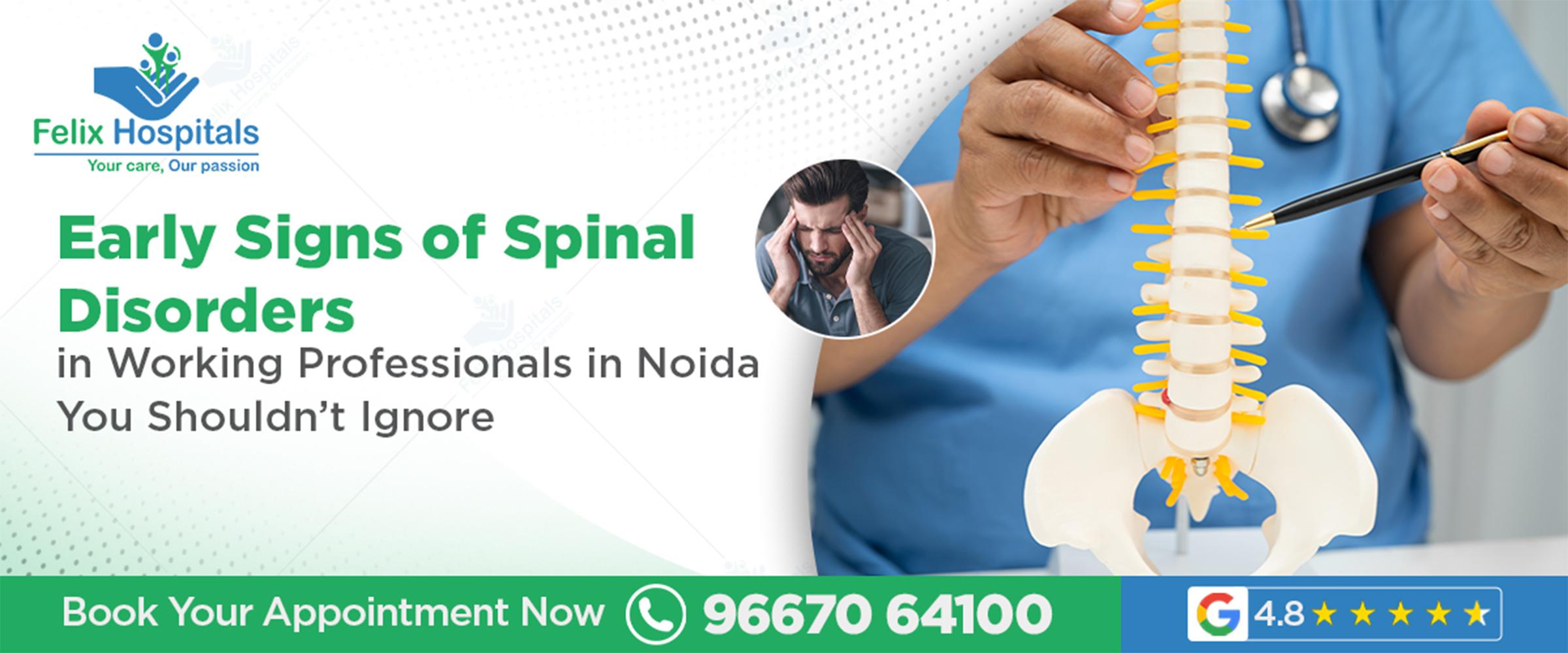
The culture of work today has entirely changed the way workers consume their days and unfortunately, the change has brought a massive challenge on back health. Long hours at desks, continuous screen exposure, minimal physical activity, and improper posture are increasingly contributing to early signs of spinal disorders among working professionals in Noida. Most individuals neglect pain in the neck or the back as a simple form of fatigue without knowing that the pain may be an early sign of more serious problems with the spinal system, which get more problematic with time unless treated. The first signs are easy to observe and identify before they lead to chronic pain, long-term disability, and even surgical intervention.
In case you have a long standing back or neck pain, seek the diagnoses of a spine specialist today to be diagnosed and treated properly. Book a spine assessment at +91 9667064100 to safeguard your future state of the spine.
The rise of corporate jobs, IT roles, and work-from-home culture has made spinal disorders in working professionals a growing health concern. Sedentary lifestyle causes compression of spinal discs, fatigability of core muscles and slows blood circulation in spinal tissue. This in the long-term causes structural stress, which causes degenerative changes. The workers and employees in Noida also face long commuting hours with the additional desk work hours, which compound the spinal strain. What initially presents itself as mild stiffness without early intervention may lead to disc herniation, compression of the nerves or degeneration of the spine in a chronic state.
One of the most common early symptoms of spine problems is persistent neck and shoulder pain that does not resolve with rest. This pain is normally associated with low monitor height, forward bending position of the head and excessive use of laptop. In case neck muscles are overused in the long-term, they lose their flexibility and power which impose an unreasonable burden on the cervical vertebrae. In the long term, the result can be cervical spondylosis or nerve irritation to create discomfort that transmits to the arms or upper back.
Common indicators include:
Tightness in neck muscles
Pain between shoulders which burns.
Reduced neck mobility
Frequent headaches
Lower back pain is one of the clearest spinal problems due to office work, especially among professionals who sit continuously without lumbar support. The sitting posture causes a decrease of the natural curvature in the lower spine, which results in a difference of pressure on the disc. The effect of repeated stress is the weakening of the structures of the spine that can expose the lower back to disc protrusions and muscle tension. This pain is shunned off by many professionals until it gets serious to the extent of restriction of movement and daily living.
Neurological symptoms are serious spine health issues in professionals that should never be ignored. The arms or the legs may experience tingling, numbness or weakness that usually indicates that the nerves have been compressed in the spine. This may be as a result of disc herniation, stenosis of spinal canal or long time irritation of nerves which is brought about by poor posture. Diagnosis should be timely since nerve compression that is untreated may cause permanent loss of functional ability and nerve damage.
Many professionals experience morning stiffness or difficulty bending, which are subtle spinal disorders due to desk job patterns. The intense sedentary lifestyle leads to decreasing the lubrication of the knee, elasticity in the muscles and changes the spine to become hard. With time, the stiffness is chronic and can increase the degenerative spinal disease. Not heeded, such symptoms tend to make one less mobile and experience discomfort over the long term, which disrupts work performance.
A key warning sign of spine problems in corporate employees is pain that intensifies during long sitting sessions or extended screen use. This kind of pains tends to do better with mobilisation, meaning mechanical stress on spinal and membranes. The spinal discs are still in the compressed state when the professionals sit in the office uninterrupted, leading to the rapid progression of the wear and tear. This can be done early on through correction of posture and medical examination which will help overcome chronic spine specifications.
The shift to remote work has increased work from home spine problems, mainly due to makeshift workstations and lack of ergonomic awareness. Furnishing such as dining table, sofas and beds are not made in a way that helps in spinal alignment. In the long run, a poor sitting posture causes neck, shoulder and lower back pains, causing imbalance in the posture. Home workers usually complain of more pains because of decrease in movement and prolonged screen time.
Headaches are recurrent and may not necessarily be stress in most cases, they are usually associated with the spine issues which are prevalent in employees. Strain of the neck may result in a tension headache which starts at the back of the skull and extends forward. The neglect of neck-associated headaches may also permit the degeneration of the spine to go unnoticed and there is a possibility of the occurrence of chronic pain disorders.
Slouched posture, rounded shoulders, and forward head position are visible indicators of early signs of spinal disorders. Poor posture over time will change the spinal orientation and put a strain on the muscles and ligaments. Patients with professional attention to changes of the posture are to be evaluated at the very beginning to avoid irreversible structural damages and irreversible degeneration of the spinal column.
One of the greatest errors that professionals make in cases of spinal discomfort is delaying the treatment. Timely spinal disorder treatment in Noida would help avoid its further development to severe forms of disease, which would necessitate surgical treatment. Initial medical care implies posture assessment and imaging when needed, as well as a specific pre-treatment plan including the pain and back stabilisation.
Spinal health requires regular work and change of lifestyle particularly in desk-based employees.
Prevention measures can be effective and they include:
Ensuring workstation ergonomics.
Taking breaks every 30-40 minutes
Making back and core muscles stronger.
Sitting in the right posture.
Regular spine check-ups
Without wasting time, the most appropriate best spine specialist near me will establish the right diagnosis and suitable treatment. Experts do not simply alleviate symptoms but get to the bottom of the problem. Vast majority of spinal disorders can be treated without further complications and related to long-term outcomes with due care provided in time.
To get professional help and high-quality care services, appoint an appointment with a qualified specialist in the field of the spine in Noida. Contact +91 9667064100 to receive individual spinal treatment.
Spinal disorders are no longer just a problem for older people; more and more young and middle-aged working adults in Noida are also having them. Not paying attention to early warning signs can cause long-term disability, chronic pain, and lower productivity. Recognising symptoms early, keeping good posture, and getting medical advice from a professional can all help keep your spine healthy and keep you pain-free at work.
Yes, sitting for long periods of time and bad posture are two of the most common causes of back pain among office workers.
If the pain lasts more than a few weeks or is accompanied by numbness or weakness, you should see a doctor.
Yes, furniture that isn't ergonomic and long periods of sitting put a lot of stress on the spine.
Most early problems with the spine can be fixed with the right treatment and changes to your lifestyle.
Most of the time, surgery is not needed if spinal problems are found and treated early.
Dr. Keshav Goel is an experienced Orthopedic Surgeon with 10+ years of expertise in joint replacement, sports injury treatment, arthroscopy, and comprehensive bone and joint care.
A spinal cord injury occurs when there is damage to the spinal cord, often resulting from trauma, disease, or degenerative conditions.

Spinal stenosis surgery is needed when severe pain, weakness, or numbness persists despite non-surgical treatment and affects daily activities.

Spinal fusion surgery is a procedure that joins two or more vertebrae in the spine to reduce pain, correct deformity, or improve stability.

Spinal cord injuries can impact brain function by disrupting nerve signals. Treatment in Noida includes expert neurology and rehabilitation care.


Subscribe to our
© Copyright 2026. All Rights Reserved by Felix Healthcare Private Limited
Design and development by :


 +(91)9667064100
 Emergency : +(91)9667064100