 Emergency:
  WhatsApp

Subscribe to our
When you walk through the corporate corridors of Noida’s Sector 125 or the busy IT hubs of Sector 62, you see thousands of people moving with purpose. But behind the glass buildings and the frantic pace of NCR life, there is a silent epidemic, Treatment-Resistant Depression (TRD).
At Felix Hospital, Noida, we meet people every day who have "done everything right." They’ve taken the SSRIs, they’ve sat through years of talk therapy, and they’ve tried every "wellness" trend on social media. Yet, the heaviness remains. If you are feeling like your brain has hit a wall, you aren't failing, your treatment might just be reaching its limit.
This is where Deep TMS (Transcranial Magnetic Stimulation) enters the picture. It’s not just an "alternative"; for many in Noida and Greater Noida, it is the first real solution that actually addresses the brain's physical "wiring".
To truly answer What Is Deep TMS Therapy?, we have to look at the brain not as a soup of chemicals, but as an electrical circuit.
Most people are familiar with "traditional" TMS. While effective, traditional TMS is like a flashlight, it hits the surface of the brain. Deep TMS, however, is like a spotlight that reaches the deeper, hard-to-access structures like the Anterior Cingulate Cortex.
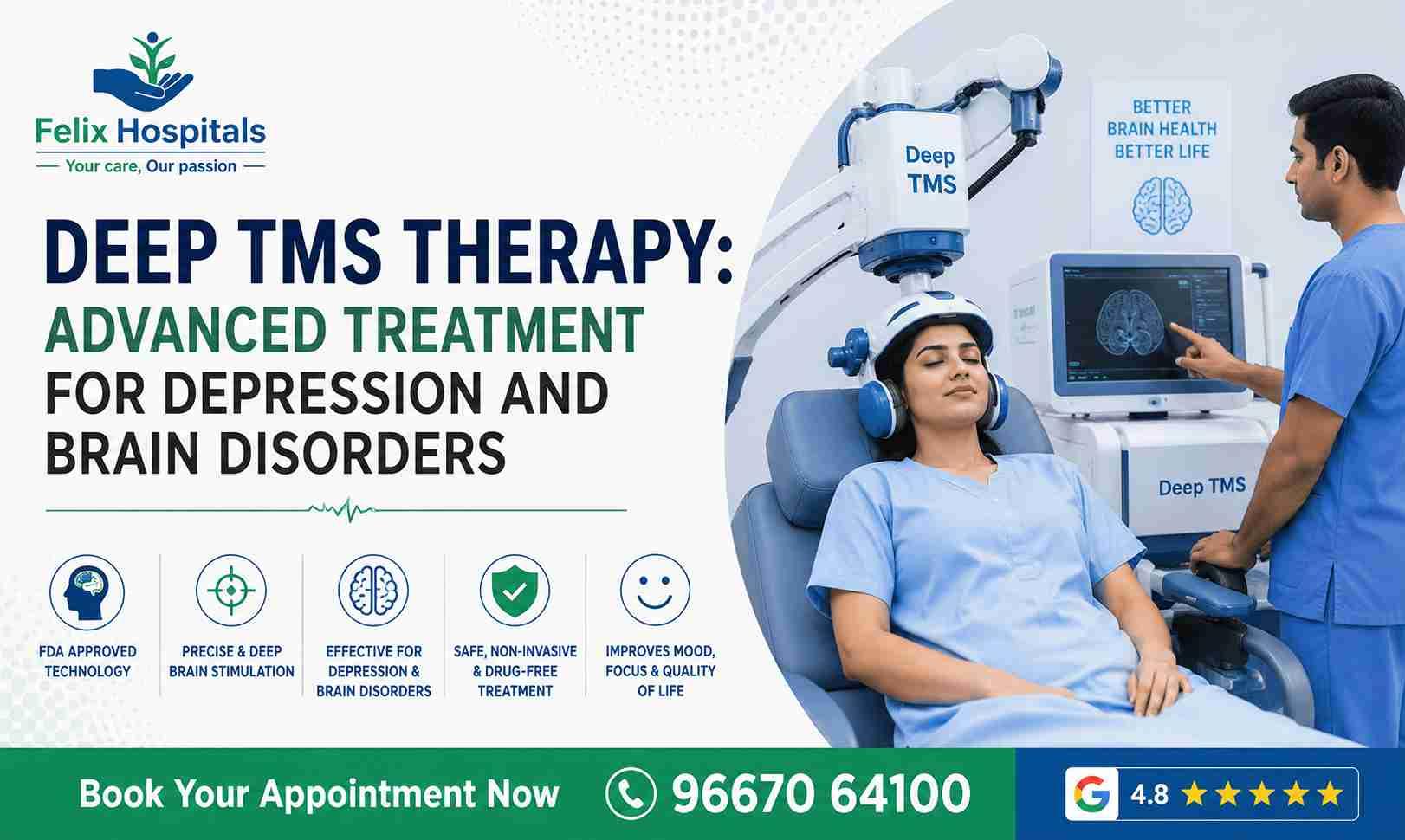
Using a patented H-Coil technology housed inside a cushioned helmet, Deep TMS sends magnetic pulses that penetrate roughly 4cm into the brain tissue. This isn't "shock therapy" (ECT). There are no seizures, no memory loss, and no anesthesia. It is a targeted, electromagnetic "reset" for the areas of your brain responsible for emotional regulation.
You might have heard the term "Neuroplasticity." It’s the brain’s ability to reorganize itself by forming new neural connections. How Deep TMS Works for Depression and Brain Disorders is by physically stimulating this process.
When you sit in the treatment chair at Felix Hospital, the H-coil generates a magnetic field. This field induces a tiny electrical current.
The Activation Phase: It "wakes up" dormant neurons that have become underactive due to chronic depression or OCD.
The Strengthening Phase: By repeating this over 4–6 weeks, those neurons start communicating more effectively.
The Result: The "fog" lifts. Patients often describe it as if a rusted gear in their head finally started turning smoothly again.
In the Best Psychiatry Hospital in Noida, we don't just advocate for one treatment. We compare them to find what fits your biology.
Feature | Antidepressants | ECT (Shock Therapy) | Deep TMS |
Primary Mechanism | Chemical (Systemic) | Electrical (Seizure-based) | Magnetic (Targeted) |
Invasiveness | Oral Medication | High (Requires Anesthesia) | Non-Invasive |
Memory Issues | Minimal | Common/Significant | None |
Weight Gain | Very Common | No | No |
Daily Routine | Unaffected | Requires Hospital Stay | 20 mins & Drive Home |
Success in TRD | Low to Moderate | High | High |
While we primarily use it for Major Depressive Disorder, the Conditions Treated with Deep TMS at our Noida facility are expanding as medical science evolves.
Obsessive-Compulsive Disorder (OCD): Traditional therapy for OCD is grueling. Deep TMS reaches the deeper circuits of the brain linked to obsessive thoughts, providing a physical "dampener" for those intrusive loops.
Smoking Cessation: Deep TMS is the first non-drug treatment to be FDA-cleared for helping people quit smoking by targeting the brain’s addiction-reward pathway.
Anxious Depression: For those in high-stress Noida jobs who feel "tired but wired," Deep TMS can calm the anxiety while lifting the mood.
Bipolar Depression: It offers a stable way to treat the "lows" of bipolar disorder without the systemic risks of certain mood stabilizers.
Determining Who Can Benefit from Deep TMS? requires a specialized consultation. Generally, if you have tried two or more antidepressants and they haven't worked (or the side effects like weight gain and sexual dysfunction are unbearable), you are an ideal candidate.
However, because the treatment uses magnetic fields, we cannot use it on patients with:
Metallic implants in the head (cochlear implants, aneurysm clips).
A history of epilepsy or seizures.
Many of our patients from Sector 137 and Greater Noida visit us during their lunch break. Here is a realistic Deep
TMS Procedure: What to Expect timeline:
The Mapping (Day 1): Our psychiatrist finds your "Motor Threshold ",the exact pulse strength needed to make your thumb twitch. This ensures the dose is perfect for your skull thickness and brain shape.
The Session: You sit in a comfortable chair. No gown, no needles. You wear a helmet.
The "Tapping": For 20 minutes, you’ll hear a "click-click-click." It feels like a light tapping on your forehead. You can talk to the staff, watch a video on your phone, or just relax.
The Departure: The helmet comes off. You check your hair in the mirror and drive back to work or home. There is no "hangover" or grogginess.
We believe in transparency. Safety and Side Effects of Deep TMS are minimal, but not zero.
Scalp Discomfort: During the first week, some people feel a bit of tenderness where the helmet sits.
Mild Headache: About 20% of patients get a mild tension headache after the first few sessions. Standard paracetamol usually handles it.
No "Zombie" Effect: Unlike heavy psychiatric meds, you don't feel "drugged." You feel like yourself, just… lighter.
Noida has many clinics, but Deep TMS is a specialized technology that requires a hospital-grade environment for the best results.
We are located right off the Noida-Greater Noida Expressway. For residents of Paras Tierea, Gulshan Vivante, or Advant Navis, world-class psychiatry is literally across the street. We understand the specific stressors of the Noida lifestyle,the long commutes, the corporate pressure, and the isolation of urban living.
We don't just offer a machine. Our psychiatry department works with:
Clinical Psychologists for CBT and DBT.
Neurologists to rule out organic brain issues.
Nutritionists to fix the gut-brain axis.
NABL & NABH Safety Standards
At Felix, we adhere to the highest clinical protocols in India. Our Deep TMS protocols are double-checked for safety, ensuring that every pulse delivered is within the exact therapeutic window.
Safety is the top priority at Felix Hospital.Safety and Side Effects of Deep TMS are remarkably mild compared to almost any other psychiatric intervention.
Common Side Effects: The most common is a mild headache or scalp discomfort during or immediately after the first few sessions. This usually disappears as your body gets used to the treatment.
No Memory Loss: Unlike ECT (Electroconvulsive Therapy), there is absolutely no impact on memory or cognitive function. In fact, many patients report that their "brain fog" clears up.
Low Risk: The risk of a seizure is extremely low (less than 0.1%), which is why we perform a detailed medical screening before we ever start.
Non-Drug: No chemicals entering your liver or kidneys.
FDA-Cleared: Backed by over 60 clinical trials worldwide.
Time-Efficient: Only 20 minutes per day.
High Remission: Even for "Treatment-Resistant" cases.
If you are struggling in silence, please know that the field of psychiatry has moved forward. You are no longer limited to just "pills and talk." Deep TMS Therapy is the bridge between advanced physics and human healing.
At Felix Hospital, Noida, we are proud to bring this technology to the heart of Uttar Pradesh. Whether you are coming from Noida City Center, Sector 18, or Pari Chowk, our doors are open. Don't wait for the "perfect time" to get help. The perfect time is when you decide you’ve had enough of the heavy cloud.
Don't let concern become a crisis because of delayed diagnosis. Call us at +91 9667064100 or walk into Felix Hospital, Sector 137, Noida.
Absolutely not. Shock therapy (ECT) uses electricity to induce a seizure under anesthesia. Deep TMS uses magnetic pulses (like an MRI) and is completely painless and non-invasive.
Yes. Duration of illness does not dictate the success of TMS. Many of our most successful cases are patients who have struggled for decades.
The cost varies based on the number of sessions required (usually 20–30). At Felix Hospital, we offer transparent pricing and packages to make this life-changing tech accessible.
Yes. Unlike many medical procedures, there is no sedation. You are fully alert and ready to drive or work immediately.

Effective stress management helps protect your brain and strengthen the nervous system. Learn practical tips to stay mentally balanced and healthy.
Discover how Brain Angiograms in Noida are revolutionizing the diagnosis and treatment of neurological conditions with advanced imaging technology and expert care.
Magnetic Resonance Imaging (MRI) plays a crucial role in detecting and diagnosing various brain disorders, including tumors, strokes, multiple sclerosis, and neurodegenerative diseases.
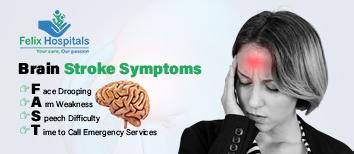
Recognizing the symptoms of a brain stroke is critical for getting prompt medical attention. The acronym F.A.S.T. is often used to remember the most common Brain stroke symptoms.

Subscribe to our
© Copyright 2026. All Rights Reserved by Felix Healthcare Private Limited
Design and development by :


 +(91)9667064100
 Emergency : +(91)9667064100