 Emergency:
  WhatsApp



Subscribe to our
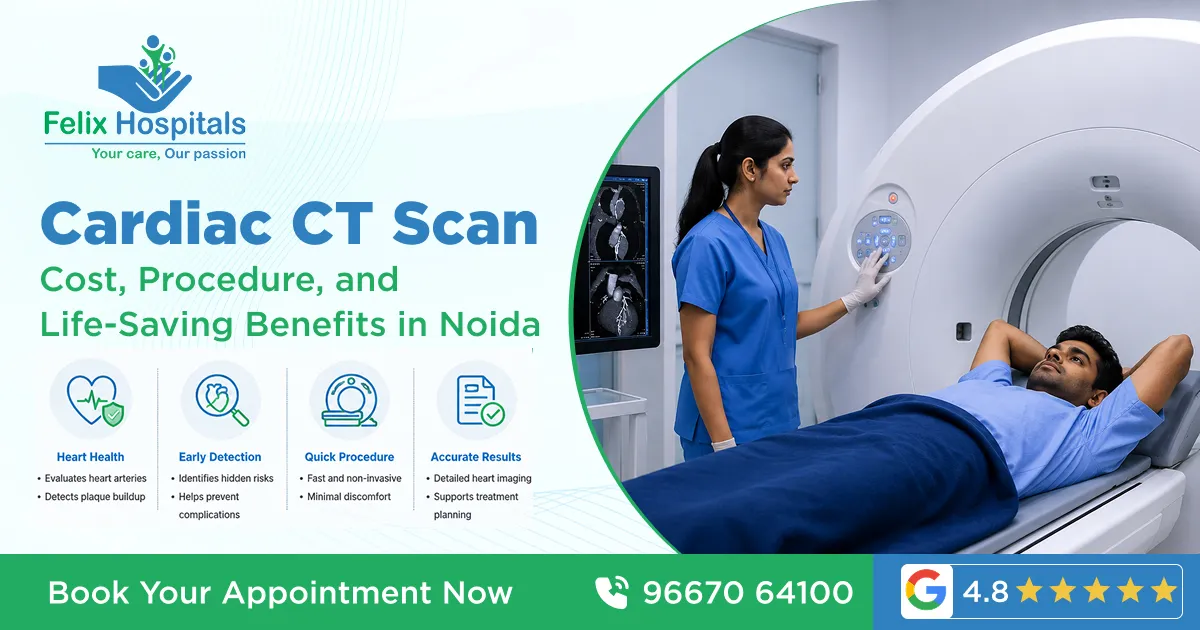
India is in the middle of a quiet cardiac crisis. Heart disease is now the leading cause of death in the country, and what makes it particularly dangerous is how silently it often progresses. Many patients who walk into Felix Hospital's cardiology department after a heart attack had no major warning symptoms in the weeks or months before. Their cholesterol was borderline. Their ECG was normal. They felt fine right up until they didn't.
This is precisely where the cardiac CT scan changes the conversation. It is one of the most powerful tools in preventive cardiology today, a non-invasive imaging test that can detect coronary artery disease, plaque buildup, and structural heart abnormalities years before they cause a clinical event.
If your cardiologist has recommended a cardiac CT scan, or if you are trying to understand whether you need one, this guide covers everything: what it involves, what it costs, and what the results mean for your heart health.
A cardiac CT scan is not a single test. It encompasses two main types of cardiac imaging, and understanding the difference matters for both clinical interpretation and cost planning.
The Calcium Score (CAC): A quick "risk check" that doesn't use needles or dyes.
A non-contrast CT that measures the amount of calcium deposited in the walls of the coronary arteries. It produces a number the calcium score that reflects the burden of atherosclerosis and helps stratify your risk of a future cardiac event. This simple, non-invasive procedure provides information about the coronary arteries without the need for needles, dyes, or medication. It is an effective tool for early detection and risk stratification for coronary artery disease, particularly in individuals who may not yet be experiencing symptoms.
The CT Angiography (CTCA): A detailed 3D map that shows exactly where blockages are.
A contrast-enhanced CT scan that produces detailed three-dimensional images of the coronary arteries, allowing the cardiologist to visualize the lumen of each artery and identify stenosis (narrowing), blockages, and the nature of any plaque present. A crucial strength of coronary CTA lies in its negative predictive value particularly in patients with low to intermediate pre-test probability of coronary artery disease. CTA can confidently exclude the presence of significant coronary artery stenosis, thereby avoiding the need for invasive diagnostic procedures.
We know that "heart tests" sound scary. At Felix Hospital, we make the process as smooth as a routine checkup.
The Setup: You'll lie on a comfortable table. We'll place small stickers (electrodes) on your chest to watch your heart rhythm. Our cardiac imaging team will also review your clinical history, current medications, kidney function, and any known allergies before the scan begins.
The "Beta-Blocker" Step: If your heart is racing, if you're nervous we may give you a small dose of medicine to slow it down. A heart rate below 60–65 beats per minute is the target for optimal image quality. This is the secret to getting those crystal-clear 3D images.
The "Warm" Feeling: If you're having a CTCA, we use a contrast dye injected through a small IV line in your arm. Pro-tip: You might feel a sudden warm flush or a metallic taste in your mouth for a few seconds. Don't worry this is completely normal and passes quickly.
The Breath Hold: The scanner moves fast. You'll be asked to hold your breath for about 10–15 seconds during image capture. This ensures the pictures are sharp and not blurry from your breathing. The actual scan takes under 10 minutes, though the full appointment including preparation runs 45–60 minutes.
After the Scan: You can eat, drink, and go back to your normal day immediately. Your cardiologist at Felix Hospital will review the images and discuss the results with you, typically on the same visit or within 24 hours.
Scan Type | Cost Range (Noida/Delhi NCR) |
Calcium Scoring (CAC) | ₹3,000 – ₹6,000 |
CT Coronary Angiography (CTCA) | ₹9,860 – ₹15,000 |
Cardiac CT with Functional Assessment | ₹12,000 – ₹20,000 |
Cardiac PET-CT | ₹14,000 – ₹28,000 |
Note: Felix Hospital accepts CGHS, ECHS, and Ayushman Bharat. Final costs may vary based on insurance coverage.
Several factors influence where your cost lands within these ranges. The type of CT scanner matters significantly; a 256-slice or 320-slice dedicated cardiac CT produces far better coronary images than a general-purpose 64-slice machine. Whether contrast dye is used also affects the price, as a calcium scoring scan uses no contrast and costs less than a full CTCA. A hospital setting like Felix Hospital provides immediate cardiologist consultation, same-day specialist review, and integrated emergency access which standalone diagnostic centres typically do not offer.
Score of 0: Your risk is very low. Your arteries are "clean." This is particularly reassuring at age 50 or older, and can support the decision to defer preventive medication in intermediate-risk patients.
Score 1–100: Mild plaque. It's time to look at your diet and exercise. Early coronary disease is present, but lifestyle modification at this stage can make a meaningful difference.
Score 101–400: Moderate plaque. Your cardiologist will likely discuss medication such as statins alongside lifestyle changes.
Score 400+: High risk. Aggressive risk management is required to prevent a future cardiac event. At this stage, the focus of treatment shifts to intervention and close monitoring, not just repeating the scan.
For patients undergoing CT Coronary Angiography, the report grades narrowing in each major coronary artery. Less than 50% narrowing is managed medically. Between 50–70% may require further functional testing. Above 70% typically warrants consideration of intervention. The report also describes whether plaque is calcified (more stable) or non-calcified (softer plaque carries a higher short-term rupture risk).
Your Felix Hospital cardiologist will review these findings in the context of your symptoms, risk factors, and overall clinical picture not as isolated numbers.
Consider booking a cardiac CT consultation at Felix Hospital if you are between 40 and 70 years old with one or more of the following: hypertension, diabetes, high cholesterol, a family history of early heart disease, a history of smoking, or obesity. It is also recommended if you experience chest discomfort or tightness particularly with exertion or unexplained breathlessness, palpitations, or dizziness.
Patients who have had a prior cardiac event such as a heart attack, angioplasty, or bypass surgery can use CTCA for non-invasive follow-up imaging. Those scheduled for major elective surgery may also need cardiac CT assessment to evaluate perioperative cardiac risk.
Do not wait for symptoms to seek a cardiac assessment. The defining characteristic of coronary artery disease is that it is often silent until it is not.
A cardiac CT scan is specifically designed to image the coronary arteries and heart structure using ECG gating synchronising image capture with your heartbeat for maximum clarity. A regular CT scan does not use this technique and cannot produce the coronary artery detail required for cardiac diagnosis. Cardiac CT either measures calcium in the arteries (CAC scoring) or visualises the artery lumen directly (CT coronary angiography).
No. The scan is completely non-invasive and painless. You lie still on the CT table while the scanner rotates around you. If contrast dye is used, you may feel a brief warm flushing sensation and a metallic taste both of which pass within seconds and are entirely harmless.
A score of zero indicates no detectable calcified plaque and a very low short-term risk of a cardiac event. Scores above 100 indicate moderate disease, and scores above 400 indicate extensive coronary calcification requiring aggressive risk management. A zero score at age 50 or older is particularly reassuring and can influence the decision around preventive medication.
The scan itself takes under 10 minutes. The total appointment including preparation, heart rate management, IV line placement for contrast, and post-scan monitoring typically takes 45 to 60 minutes. You can return to normal activities immediately afterward.
A coronary artery calcium scoring scan typically costs ₹3,000 to ₹6,000 in Delhi NCR. A full CT coronary angiography ranges from ₹9,860 to ₹15,000 depending on the hospital, machine quality, and whether specialist cardiologist interpretation is included. At Felix Hospital, pricing is transparent with no hidden charges.
Yes, in most cases when ordered for a specific clinical indication. Felix Hospital accepts CGHS, ECHS, Ayushman Bharat, and major private health insurers including cashless facilities. Contact +91 9667064100 to verify your specific policy coverage before booking.
Adults between 40 and 70 with cardiovascular risk factors hypertension, diabetes, high cholesterol, family history of early heart disease, smoking, or obesity are the primary candidates. It is also recommended for patients with unexplained chest pain, those in intermediate-risk categories where standard risk scoring is inconclusive, and patients needing non-invasive follow-up after prior coronary interventions.
The radiation dose from a cardiac CT scan is clinically acceptable and used only when medically indicated. A calcium scoring scan uses a very low dose. Modern scanners at Felix Hospital use dose-reduction algorithms to keep radiation exposure to the minimum required for diagnostic quality. The benefit of the diagnostic information obtained far outweighs the small radiation risk in patients who meet clinical criteria for the test.
A conventional coronary angiogram is an invasive procedure where a catheter is threaded through an artery in the wrist or groin into the coronary arteries, where contrast dye is injected directly. It remains the gold standard for definitive assessment and allows simultaneous treatment. A cardiac CT angiogram is non-invasive, performed from outside the body, and is ideal for diagnosis and risk stratification particularly in patients who are unlikely to need immediate intervention.
Yes this is precisely what makes it clinically valuable. By identifying coronary artery calcium and plaque before they cause symptoms, the cardiac CT scan allows cardiologists to intervene with lifestyle changes, medication, and close monitoring before a cardiac event occurs. It detects the disease in its subclinical stage when treatment is most effective and outcomes are best.
Dr. Hari Om Prakash is a highly experienced radiodiagnostic specialist, renowned for his accurate diagnoses across various advanced imaging modalities including MRI, MDCT, angiography, ultrasound, and mammography, significantly aiding in precise treatment planning.
Explore affordable and advanced CT scan packages with this complete city-wise guide for Delhi, Noida, Greater Noida, Ghaziabad, and Gurgaon.

Discover the updated list of Ayushman Bharat (PMJAY) hospitals in Dadri for 2026.

Looking for an Ayushman Bharat hospital near hapur? Felix Hospital offers quality healthcare services, cashless treatment, and advanced medical facilities under the Ayushman Bharat Yojana in 2026.

Subscribe to our
© Copyright 2026. All Rights Reserved by Felix Healthcare Private Limited
Design and development by :


 +(91)9667064100
 Emergency : +(91)9667064100