 Emergency:
  WhatsApp





Subscribe to our
It usually starts with a simple sore throat. You or your child might have had a fever, a few days of discomfort, and then it seemed to go away. But weeks later, new symptoms emerge—lingering joint pain, unexplained fatigue, or even a slight swelling in the ankles.
At Felix Hospital, Noida, our diagnostic team frequently sees patients from across Sector 137 and the Noida-Greater Noida Expressway who are confused by these secondary symptoms. When we suggest an ASO blood test, the first question is usually, "Is this just another test for a sore throat?"
The answer is no,this test is a deep dive into your body's immune history. In this guide, we will break down the test ASO meaning, why your doctor ordered it, and how to interpret those "titre" numbers.
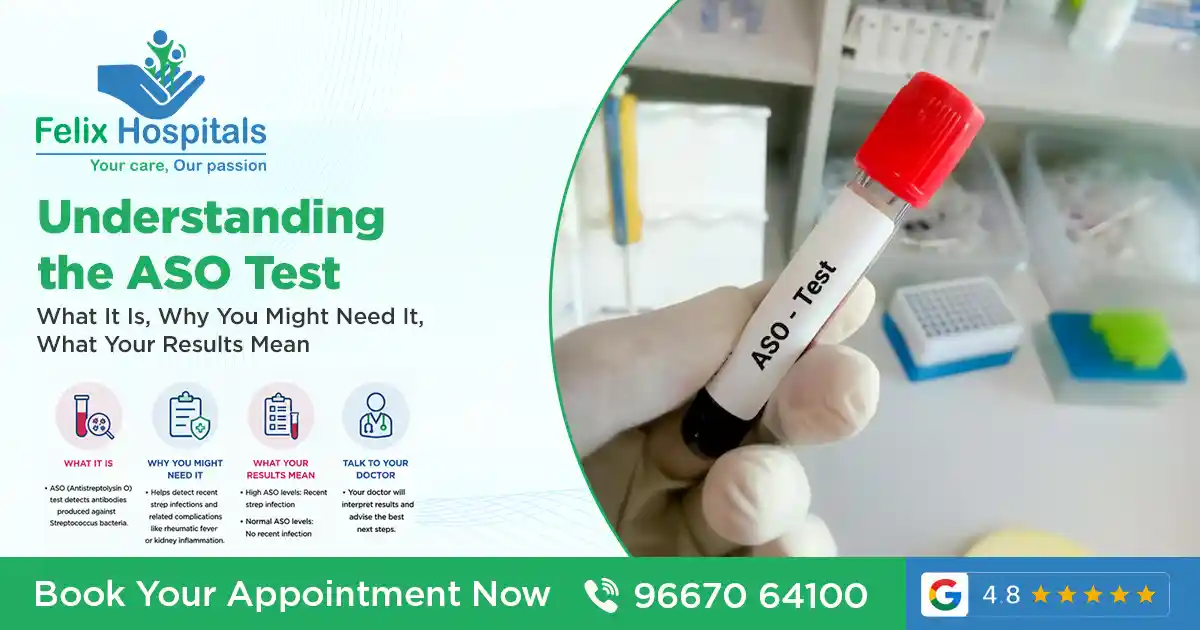
The ASO blood test (Anti-Streptolysin O) measures the level of antibodies your body has produced against Streptolysin O, a toxin released by Group A Streptococcus bacteria.
Think of it this way: When "Strep" bacteria attack your body, they release a poison called Streptolysin O. Your immune system, being a smart soldier, creates a specific defense called "Anti-Streptolysin O" antibodies to neutralize that poison.
The ASO titer test doesn't tell us if you have a sore throat right now. Instead, it tells us if you had a Strep infection in the recent past that your body is still reacting to.
"Titer" (or Titre) simply means strength or concentration. A high titre means your immune system had a major battle with Strep recently. A "rising titre" between two tests is a clear signal of an active, ongoing immune response that needs medical intervention
A doctor usually orders a lab test ASO when they suspect that a recent, perhaps untreated, Strep infection has triggered a more serious complication.
Group A Strep is a "tricky" bacteria. If it isn't fully cleared by antibiotics, it can trick the immune system into attacking the body's own tissues. This can lead to:
If you are visiting our Noida facility with joint swelling or heart palpitations following a fever, this test helps us confirm if Strep was the culprit.
The aso test procedure is a standard venipuncture (blood draw). At Felix Hospital, we ensure the process is quick and stress-free:
Interpreting an ASO titer test is about more than just a single number.
ASO Level | General Interpretation |
Normal (< 200 IU/mL) | No recent Group A Strep infection detected. |
Elevated (> 200 IU/mL) | Suggests a recent Strep infection (usually within the last 1–3 months). |
Note for Parents: In children, the "normal" range is often slightly higher (up to 250 or 300 IU/mL) because they are more frequently exposed to Strep in schools and play areas across Noida.
This is a common point of confusion.
If you have a sore throat today, an ASO test might come back normal because it takes 1–3 weeks for the antibodies to build up.
Untreated Strep is a silent risk. In India, many cases of childhood Rheumatic Heart Disease start with a simple sore throat that was ignored. By performing a lab test ASO early, we can catch the immune overreaction before it permanently damages the heart valves or kidneys.
You should consult a specialist at Felix Hospital for an ASO test if you notice these symptoms 2–4 weeks after a sore throat:
At Felix Hospital, Noida, we don't just give you a report.
The goal of the ASO test isn't just diagnosis—it's prevention. By identifying a "Strep-memory" in your blood, we can prevent the progression of Rheumatic Heart Disease, which remains a significant health burden in the NCR region.
A high ASO result can be scary, but it’s actually a roadmap to safety. It allows your doctor to see what is happening beneath the surface and protect your heart and kidneys for the future.
Don't ignore the signs. If you or your child have lingering symptoms after a sore throat, visit Felix Hospital, Sector 137, Noida, or call us at +91 9667064100 to book your ASO titre test today.
For adults, it’s usually under 200 IU/mL. For children under 12, the range can be up to 250–300 IU/mL.
Yes. A high titre only means you had an infection. Many people clear the bacteria without developing complications. Treatment is usually only started if symptoms or rising titres are present.
Antibody levels peak around 3–6 weeks after the initial infection and can remain elevated for 6–12 months.
No, fasting is not required for a test aso. You can eat and drink normally.
CRP is a general marker of any inflammation in the body. ASO is specific only to a recent Strep infection.
Yes. If you took antibiotics early during your sore throat, your body might not produce a high level of ASO antibodies.
It is most accurate for Strep throat. It is less reliable for Strep skin infections (like impetigo).
It means the infection was very recent and antibody production is still increasing. This is a stronger clinical indicator than a single high result.
Yes, it is very common in pediatrics. Normal ranges are slightly higher in children because of frequent exposure.
The main risks are permanent heart valve damage (Rheumatic Heart Disease) and chronic kidney disease.
The cost usually ranges from ₹400 to ₹800. At Felix Hospital, Noida, we offer competitive pricing with same-day digital reports.
Dr. Shuchita Sharma has over 11 years of experience in pathology, specializing in diagnostic pathology, cytopathology, and molecular pathology. She is skilled in analyzing tissue samples and laboratory reports to provide accurate and timely diagnoses, ensuring reliable support for patient treatment and medical investigations.
The primary goal of the Treadmill Stress Test is to evaluate how well the heart responds to increased physical activity


Subscribe to our
© Copyright 2026. All Rights Reserved by Felix Healthcare Private Limited
Design and development by :


 +(91)9667064100
 Emergency : +(91)9667064100