 Emergency:
  WhatsApp



Subscribe to our
Step outside in Noida on any morning between October and January. The air has a particular quality to it , not just the cold, but a thickness. AQI readings of 300, 350, sometimes touching 400. If you have asthma, you already know what that means before you check your phone. Your chest tells you first.
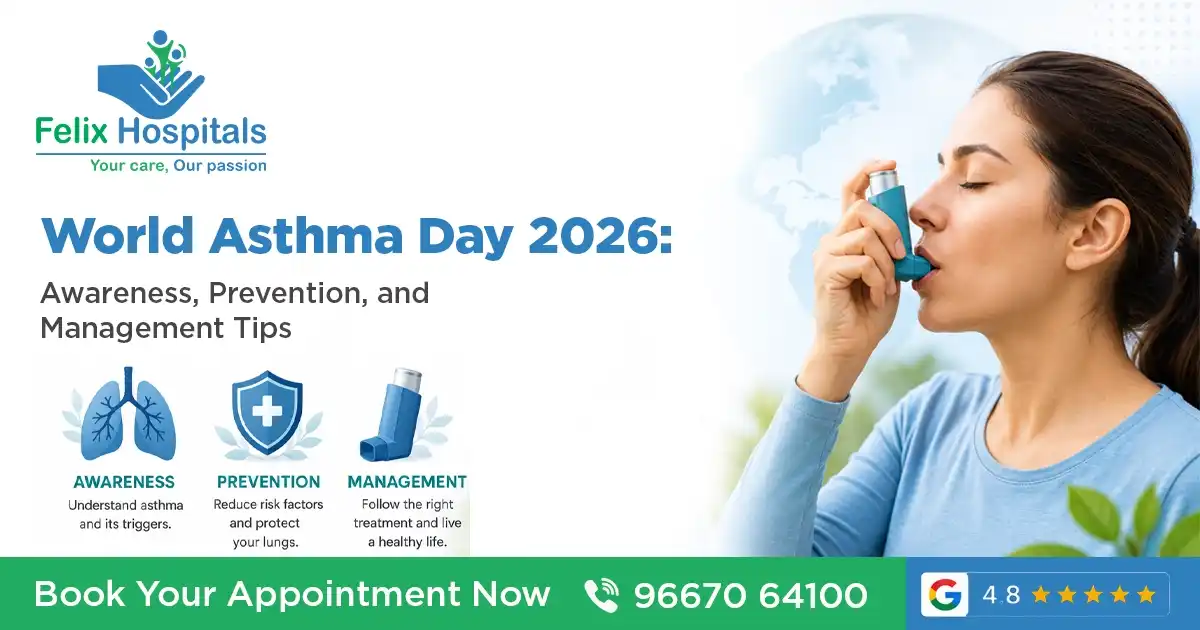
Every year on the first Tuesday of May, the global medical community marks World Asthma Day. In 2026, the theme continues to build on a simple, uncomfortable truth: asthma is under-diagnosed, under-treated, and deeply misunderstood , especially in urban India, where pollution, construction dust, and crowded living conditions make every breath a negotiation.
At Felix Hospital, our Pulmonology department sees this firsthand. Patients arrive describing symptoms they've been managing for years , a persistent morning cough, shortness of breath on the stairs, tightness after a commute , without ever connecting them to asthma. Many of them have been treating it as "seasonal allergies" or "weakness." It isn't.
The significance of World Asthma Day 2026 isn't ceremonial. It's corrective.
India carries one of the largest asthma burdens in the world , over 34 million people affected, according to the Global Burden of Disease study. Yet the gap between how many people have it and how many are correctly diagnosed remains wide. In the Delhi-NCR specifically, two factors make this worse: air quality that is consistently among the worst globally, and a cultural tendency to normalize breathing difficulty as a side effect of "city life."
It isn't normal. Struggling to breathe on a morning walk in Sector 50 is not the cost of urban living. It is a medical condition with identifiable triggers, effective treatments, and , with the right management , a life that doesn't revolve around your inhaler.
Asthma is not simply "breathlessness." It is chronic inflammation of the airways , the tubes that carry air in and out of your lungs. In an asthma patient, these airways are in a near-constant state of irritability. When they encounter a trigger , cold air, dust, smoke, exercise, even strong emotions , they swell, fill with mucus, and the muscles around them tighten. The result is the classic triad: wheezing, coughing, and the sensation of breathing through a wet cloth.
What makes asthma particularly relevant to Noida residents is the nature of local triggers:
Construction particulate matter , Noida is a city perpetually under development. PM2.5 particles from active construction sites penetrate deep into the lungs, bypassing the body's natural filtration.
Vehicular exhaust on arterial roads , The Expressway and Sector 18 intersections expose daily commuters to nitrogen dioxide and ozone levels that directly irritate inflamed airways.
Indoor mould in monsoon season , High-rise apartments in Noida's older sectors often develop damp walls between July and September. Mould spores are a primary asthma trigger that most families overlook entirely.
Cold morning air , Between November and February, the sharp drop in temperature causes airway constriction in susceptible individuals. That 6am walk in Sector 93 that your cardiologist recommended? It needs to be approached carefully if you have asthma.
The challenge with asthma is that its symptoms are easily explained away , until they can't be.
A dry, persistent cough that's worse at night or in the early morning is the most commonly missed signal. It often arrives months before the first obvious "attack." Other warning signs include a whistling sound when you breathe out, a tightness in the chest that you've been calling acidity or stress, and shortness of breath doing activities that previously felt effortless , climbing two flights in your society building, walking from the parking lot to your office.
If you need to stop mid-sentence to catch your breath, if you're waking at 3am because your chest feels locked, or if you've started planning your commute around air quality forecasts , these are not quirks. These are your lungs asking for a clinical evaluation.
Asthma cannot always be cured, but its triggers can be systematically reduced.
At home: Dust mite covers on mattresses and pillows are one of the highest-impact, lowest-cost interventions available. In Noida's humidity, mattresses accumulate dust mite colonies rapidly. A HEPA air purifier running through the night in your bedroom is not a luxury , for an asthma patient, it's closer to a medical device.
During your commute: Keep your car windows up and recirculate interior air on bad AQI days. If you commute by two-wheeler, an N95 is not optional , a cloth mask does nothing for particulate matter at 350 AQI.
At the office: Air-conditioned offices provide some protection, but shared carpets, printer toner, and aerosol cleaning sprays are common office-based triggers. If you notice your symptoms are worse on certain days at work, pay attention to what changed , the cleaning staff's schedule, a new air freshener, a colleague's perfume.
Smoking: This needs no elaboration except one point that often surprises patients , passive exposure to a smoker in a shared flat or car can be as significant a trigger as smoking yourself. This is not a lifestyle preference; it's a clinical reality.
Asthma treatment in 2026 is not what it was fifteen years ago. The days of simply relying on a blue Salbutamol inhaler and hoping for the best are behind us.
Current management follows a stepwise protocol built on two categories of medication: relievers (short-acting bronchodilators for acute symptoms) and controllers (inhaled corticosteroids and long-acting bronchodilators taken daily to prevent inflammation from building up in the first place). The single most common mistake we see at Felix Hospital is patients using their reliever inhaler daily while never starting the controller , treating the fire repeatedly instead of removing the fuel.
Newer options like biological therapies (monoclonal antibodies such as Dupilumab and Omalizumab) are now available for severe, treatment-resistant asthma , patients who have cycled through multiple inhaler regimens without adequate control. These aren't experimental; they're approved, effective, and now accessible in Noida.
Equally important is lung function monitoring. A spirometry test , a simple, non-invasive breathing test that takes under ten minutes , tells us exactly how much airflow is obstructed and how well your current treatment is working. Many patients with poorly controlled asthma have never had one. They've been adjusting medications based on how they feel, not what their lungs are actually doing.
See a specialist if any of the following apply:
You're using your reliever inhaler more than twice a week. Your symptoms wake you at night more than once a month. You've had a visit to a casualty or emergency department for breathing difficulty in the past year. Your asthma has caused you to miss work or reduce physical activity. Or simply , you've never had a formal diagnosis despite years of "chest issues."
These aren't emergencies in isolation, but they are signals that your current management , whether that's self-management or a prescription from a general physician , needs expert review.
The honest answer to why patients choose Felix Hospital is specificity. Our pulmonologists aren't treating generic asthma from a textbook , they're treating asthma in a city with an AQI problem, a construction boom, and a population that commutes on the Expressway twice a day.
We run complete pulmonary function testing including spirometry and FeNO measurement (which detects airway inflammation directly), have an NABL-accredited lab for allergy panel testing to identify your specific triggers, and coordinate with our allergy and immunology team for patients whose asthma has a significant allergic component.
More practically , if you walk in during an acute episode, we have the infrastructure to manage it immediately. You don't need a referral chain.Call us at +91 9667064100
Not in the conventional sense , but it is highly controllable. Many patients with well-managed asthma lead completely normal, active lives with minimal symptoms.
Yes. Adult-onset asthma is increasingly common, and Noida's air quality is a known contributing factor. A new cough or breathlessness in an adult with no childhood history still warrants evaluation.
No. This is one of the most persistent and damaging myths in Indian healthcare. Inhaled corticosteroids , used correctly , are far safer than the repeated oral steroid courses many patients accept instead.
Possibly. Viral-induced wheezing in children is the most common presentation of early asthma. A formal assessment by a paediatric pulmonologist will clarify whether preventive treatment is needed.
Asthma typically begins earlier, is often reversible with treatment, and is driven by inflammation and triggers. COPD is predominantly caused by smoking or long-term pollutant exposure and involves permanent structural damage to the lungs. They can coexist, and distinguishing them requires lung function testing.
Felix Hospital's Pulmonology department offers full diagnostic workup including spirometry, FeNO testing, and allergy panels, alongside senior consultants with specific experience in pollution-related respiratory disease in the NCR region.
Dr. Priyadarshi Jitendra Kumar is an experienced General Practitioner with 20+ years of expertise in diabetes, thyroid disorders, hypertension, and infectious diseases. Recognized as a Best Pulmonologist in Noida, he specializes in respiratory emergencies, sleep disorders, and advanced pulmonology care.
Dr. Priyadarshi Jitender Kumar stands out as a leading expert in diagnosing and treating pulmonary embolism.

Winter can trigger asthma attacks, but timely treatment in Noida helps prevent breathing problems.


Subscribe to our
© Copyright 2026. All Rights Reserved by Felix Healthcare Private Limited
Design and development by :


 +(91)9667064100
 Emergency : +(91)9667064100