 Emergency:
  WhatsApp

Subscribe to our
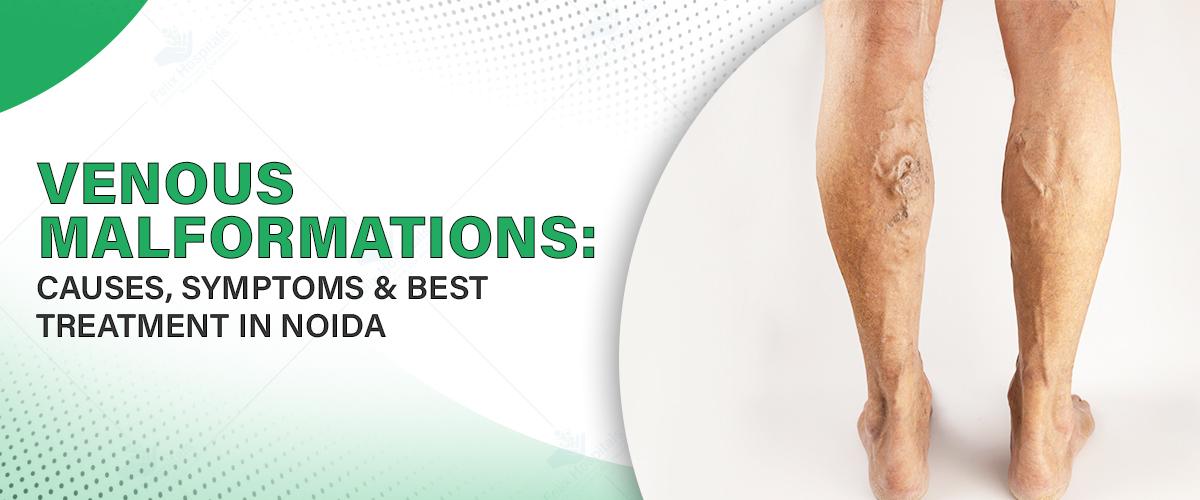
Among all vascular illnesses, venous malformations (VMs) rank among the most prevalent yet underdiagnosed. They are not only aesthetic but can be painful, lead to swelling, and cause complications if they are not treated. Patients do not have to look far from home to receive specialist treatment with access to the newest facilities. For families looking for dependable treatment, the best vascular surgery hospital in Noida offers medical expertise and newest technology to provide secure and effective results.
Looking for the best way to treat venous malformations in Noida? Call +91 9667064100 to talk to the specialists
Venous malformations are abnormal groups of veins that occur when blood vessels do not properly develop during fetal development. In contrast to varicose veins, which tend to be a function of lifestyle or age, venous malformations are either congenital or born, but not necessarily evident at birth.
These malformations may appear anywhere in the body: on the skin, in the muscles, or even in internal organs. They range from appearance to symptoms depending on size and location. Some malformations remain constant and are not noticeable, while others grow larger with age or hormonal changes such as puberty, pregnancy, or menopause.
Simply put, venous malformations are abnormally formed veins that are unlike normal veins and, therefore, cause faulty blood flow and stagnation in the region.
Venous malformations occur as a result of vascular development failure during pregnancy. Gene mutations in TIE-2 or PIK3CA genes are implicated in these malformations. Venous malformations are inherited in certain families or occur sporadically without family history.
It should be remembered that these malformations are not induced by drugs, maternal exposure, or maternal lifestyle during pregnancy. They are developmental structural defects.
The symptoms of venous malformations range from benign to severe:
Bluish or purplish swelling visible under the skin
Soft, yielding masses that increase with activity, crying, or straining
Pain and discomfort, especially if there are clots in the malformation
Swelling or heaviness of the involved limb or body part
Functional impairment when placed near joints or critical structures
Cosmetic concerns, particularly in the case of lesions on the face or neck
The severity is generally dependent on whether or not the malformation is superficial. Superficial ones will have areas of color changes, while deeper lesions will only be detected by a mass without color change.
Since venous malformations can imitate other vascular diseases, accurate diagnosis is obviously justified. Both clinical evaluation and advanced imaging techniques are employed by physicians.
Diagnostic Techniques are:
Physical Examination – Physicians note the swelling, compressibility, and postural changes.
Ultrasound with Doppler – Picks up blood flow and can identify arteries and veins.
MRI (Magnetic Resonance Imaging) – Produces a very good map of the malformation, especially useful for deep or complex lesions.
CT Scan – Used sometimes when bones are involved.
X-rays – Can show phleboliths (tiny calcified thrombi) in the malformation.
An accurate diagnosis of venous malformation surgery in Noida ensures that the treatment strategy is tailored to the patient to avoid futile or unnecessary interventions.
While not life-threatening in most cases, venous malformations can cause serious complications if untreated:
Throbbing blood clots (phleboliths) within the lesion
Long-term inflammation that leads to reduced mobility
Ulcers or skin breakdown caused by poor blood flow
Bleeding risks in case malformations are situated near mucosal surfaces or visceral organs
Deep vein thrombosis (DVT) in a few cases, which can be fatal if the clots reach the lungs
That's why early consultation with a Noida venous malformation specialist is highly important.
Treatment depends on the size, symptoms, and complications of the malformation. Some require observation, but others must be treated to prevent further damage.
1. Observation and Supportive Care
Minute, asymptomatic lesions are simply recorded.
Compression wear avoids swelling and pain on the limbs involved.
Low-dose aspirin can decrease thrombosis in superficial malformations.
2. Sclerotherapy
One of the most frequent therapies, sclerotherapy consists of directly injecting a chemical (sclerosant) into the malformation. It inflames and causes the abnormally shaped veins to contract eventually. Several sessions are usually needed for long-term result.
3. Laser Therapy
Used mostly for superficial skin lesions, laser treatment improves appearance and reduces pain. It could be a repeated treatment.
4. Endovenous Laser and Embolization
For more severe malformations, endovenous laser therapy or coil or glue embolization may be used to shut down diseased veins. Both are less invasive and reduce the recovery period.
5. Surgical Excision
Surgical treatment can be attempted in the case of localized malformation that can be accessed. Large venous malformations are usually only partially respectable. Surgery is usually combined with sclerotherapy for optimal result.
6. Medications and Combination Therapies
Anticoagulants (e.g., rivaroxaban, enoxaparin) are employed to manage clots and pain. In more severe instances, a combination of sclerotherapy, laser, and surgery offers the optimal outcome. All of these go well together, with cosmetic and functional benefits.
While treatment can even improve quality of life, patients must also be cautious in managing their condition themselves:
Wearing compression stockings if advised
Prevention of trauma or injury to the involved area
Physical exercise and healthy weight
Making regular follow-ups to evaluate changes
Calling for prompt treatment of acute pain, swelling, or bleeding
With proper treatment and lifestyle change, patients can enjoy active, healthy lives in spite of their diagnosis.
Felix Hospitals provides end-to-end Venous Malformation Treatment. Equipped with the latest diagnostic equipment, minimally invasive techniques, and patient-centric care, Felix provides every patient with personalized treatment. Felix has long experience in managing routine and complex cases of Venous Malformation and thus is a safe destination for individuals worried about hernia surgery cost without sacrificing safety, accuracy, and long-term outcomes.
Don't ignore skin that is swollen or has blue spots on it. Call +91 9667064100 to set up an appointment for treatment of venous malformation.
Venous malformations are more than a cosmetic issue—venous malformations can impact daily functioning, mobility, and overall quality of life. Knowing what venous malformations are, being empathetic to their causes and symptoms, and seeking early diagnosis is crucial to receiving appropriate care. Consulting the best vascular surgeon in Noida ensures accurate evaluation and effective treatment options, including sclerotherapy, laser therapy, or minimally invasive surgery, to manage venous malformations safely and improve overall quality of life.
Q1. When should I see a specialist in Noida for venous malformations?
Ans: If the swelling hurts, gets bigger quickly, gets in the way of your daily activities, or changes how you look, you should see a doctor. Going to the best vascular surgery hospital in Noida early on will help make sure that you get the right diagnosis and treatment plan.
Q2. What kinds of treatments are there for venous malformations?
Ans: The treatment depends on how bad the problem is and may involve sclerotherapy (injections to shrink the veins), laser therapy, or surgery in more difficult cases. A vascular surgeon in Noida will help you find the safest and most effective option.
Q3. Does laser treatment work for venous malformations?
Ans: Yes, laser treatment for venous malformation in Noida can help with swelling and discolouration, especially on the surface of the skin. For best results, it is often used with other treatments.
Q4. Can venous malformations come back after treatment?
Ans: Although treatments can help with symptoms and make things look better, they don't always work, so it's important to keep an eye on things over time with a specialist.
Q5. How long does it take to heal after surgery for a venous malformation in Noida?
Ans: The size and location of the lesion affect how long it takes to heal. Most patients can go back to their normal activities in a few weeks, but they should see their doctor regularly to make sure they are healing properly.
Q6. Why should you go to Felix Hospital in Noida for treatment of venous malformation?
Ans: Felix Hospital is one of the best vascular surgery hospitals in Noida. It has modern diagnostic tools, experienced vascular surgeons, and new treatment options like laser treatment and minimally invasive procedures that put the patient first.
By working closely with experienced vascular surgeons and following their guidance, patients can achieve positive outcomes and enjoy a better quality of life.
Vascular surgery is an essential procedure to treat circulatory system issues, but its cost can be a concern for many patients. Understanding the factors that influence the cost, finding ways to reduce expenses, and choosing the right hospital for it.
Vascular surgery is an essential procedure to treat circulatory system issues, but its cost can be a concern for many patients. Understanding the factors that influence the cost, finding ways to reduce expenses, and choosing the right hospital for it.

Subscribe to our
© Copyright 2026. All Rights Reserved by Felix Healthcare Private Limited
Design and development by :


 +(91)9667064100
 Emergency : +(91)9667064100