 Emergency:
  WhatsApp


Subscribe to our
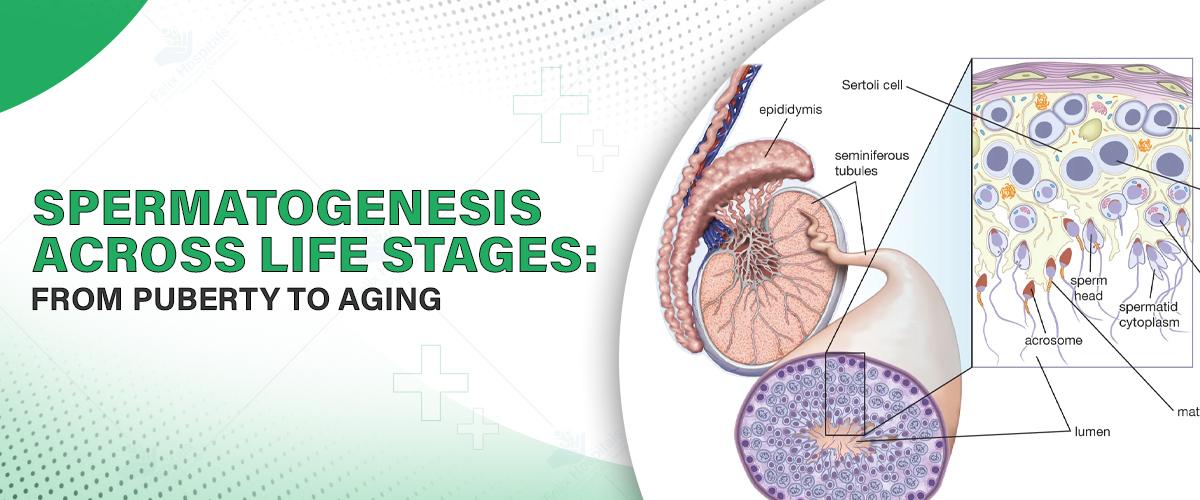
When it comes to men’s reproductive health, choosing the Best Urology Hospital in Greater Noida will be the right choice for proper diagnosis and treatment. Spermatogenesis, the sperm production process can vary during different periods of life and influences the fertility of the human body between puberty and old age. The specialist urologists in Greater Noida, offer thorough care of male reproductive health, fertility issues as well as age-related issues and it provides the correct advice at all the various ages in life.
Early detection makes the difference—book your male fertility check-up now: +91 9667064100.
Spermatogenesis is the biological process occurring in the testes to produce mature male gametes (spermatozoa). It is a cyclic process that occurs in a sustained, closely regulated process, and occurs throughout the life of a man as an adult, although it varies much at various periods of life, beginning with puberty and ending with old age.
Stages of spermatogenesis, occurs in the seminiferous tubules of the testes and could be subdivided into three key stages:
Spermatocytogenesis (Mitosis): Diploid (46-chromosome) spermatogonia are immature germ cells, which are located close to the periphery of the seminiferous tubules. These cells reproduce through a process called mitosis to reproduce themselves thus ensuring that sperm production is not affected. A portion of the spermatogonia differentiate into primary spermatocytes, the cells to undergo meiosis.
Spermatidogenesis (Meiosis): Each diploid primary spermatocyte undergoes 2 rounds of meiotic division, producing 23-chromosome spermatids. The process of meiosis is critical and ensures that the young ones are different in genetics. The cells are connected by cytoplasmic bridges and this enables the cells to grow together.
Spermiogenesis (Differentiation): The final process is in which the rounded, immature spermatids are transformed into streamlined moving spermatozoa (sperm cells). These involve the creation of a tail to move.

The acrosome is a cap-like structure that helps the sperm get into the egg.
Shedding of excess cytoplasm.
After this process, mature sperm are released and they travel to the epididymis to gain motility and full fertilizing capacity.
The quality and quantity of spermatogenesis and overall male fertility are influenced by age. Male fertility across life stages is described below.
Puberty marks the beginning of a man's reproductive journey, typically starting between the ages of 10 and 14. It is initiated by hormones from the brain that stimulate the testes to produce testosterone and, for the first time, mature sperm.
Testicular growth: The first sign of puberty is often the enlargement of the testes and scrotum. This occurs as the seminiferous tubules, where sperm are made, and developed.
Fertility isn't instant: First ejaculation may occur about a year after testicular growth begins, but the boy is not fully fertile at this point. It takes longer for sperm production to become consistent and of a high enough quality to achieve conception.
Male fertility peaks lie in the late 20s and early 30s of the age span. It is at this time that the sperm quality, motion and semen volume is the highest.
Ideal sperm parameters: In these years, the men usually produce sperm of the best quality with excellent motility and morphology and this increases the opportunities of conception.
Issues with lifestyle: Lifestyle issues play an important role in determining sperm health in adulthood. Diet, physical activity, stress management and avoidance of toxic substances such as tobacco and alcoholism are all key factors in staying at peak fertility.
The decline in male fertility is far slower compared to the steep drop in female fertility that is terminated by menopause. Nevertheless, there are major transformations in it although the transformations are after the age of 40.
Reduced sperm quality: The testes still are able to produce sperm, but at reduced rate and with an increased percentage of the sperm being abnormally morphologic and with reduced motility.
DNA fragmentation: As the man gets older, the fragmentation of sperm DNA is increased and may increase the likelihood of miscarriage and genetic disorders in the newborn child such as autism and schizophrenia. This is partly because there is the build up of mutations in the germline through the continued division of cells over a lifetime.
Hormonal changes: The slow decline in the body testosterone levels after the age of 40 may influence the production of sperm and libido and sexual dysfunction.
Although it is possible that men can make children as old as they are in their 60s and even 70s or older, this is coupled with extra complications.
More time to conceive: The older man tends to take a longer time to conceive a child irrespective of whether the partner is young.
Increased numbers of risks in increasing health risks of offspring: The probability of genetic syndromes such as achondroplasia and schizophrenia is increased in children born to older males.
Aging brings about more progressive and less conclusive changes on male fertility than female decline, yet some changes do happen:
Reduced sperm quality and quantity: As spermatogenesis proceeds, there is a slowed rate of sperm production and sperm quality, motor activity (movement) and morphology (shape) are both reduced.
Heightened DNA fragmentation: Aging promotes the probability of DNA degradation and fragmentation in sperm. It may result in increased chances of miscarriage and increased birth defects and genetic diseases in newborn children.
Hormonal changes: There are progressive declines in testosterone levels, and supportive Sertoli and Leydig cells within the testes are likely to become dysfunctional thereby disrupting the hormones environment necessary to cause spermatogenesis.
Spermatogonial alterations: The spermatogonial stem cell pool and testicular microenvironment are altered with age, which may lead to a compensatory response of some of the cell types and a loss of overall efficiency.
Concerned about fertility or reproductive health? Speak to urology experts today at +91 9667064100.
Although there is no exact marker of male fertility, it is unlimited. The knowledge of the impact of age on the development of spermatogenesis and sperm quality is significant to the men who are making family planning decisions at various phases of their lives. Through a healthy lifestyle, men have an opportunity to keep themselves in reproductive health and make a sound decision concerning their reproductive future. The Best Urology Hospital in Greater Noida will be the right choice for proper diagnosis and treatment.
Q1: What can be done in case sperm count is extremely low?
Ans: Alternatives such as hormonal therapy, microsurgical sperm retrieval, and assisted reproductive techniques (IVF/ICSI) exist. Felix has customized treatment plans.
Q2: Does testosterone replacement therapy enhance fertility in the elderly man?
Ans: Not necessarily- sometimes it may inhibit natural sperm production. With care, to preserve fertility, Felix experts adjust hormonal therapy.
Q3: Is varicocele (swollen veins in the scrotum) associated with impaired spermatogenesis?
Ans: Yes, it may lower the quality of sperm. In an effort to revitalize the fertility potential, Felix Hospital also provides minimally invasive varicocele surgery.
Q4: What is the frequency of fertility health check-ups among men?
Ans: After reaching 20s (baseline) and with each 5-10 years and again in case of fertility concerns.
One of the best hospitals for urinary tract treatment in Noida offers comprehensive urology care, featuring expert urologists and advanced diagnostic and treatment facilities.
One of the best hospitals for urinary tract treatment in Noida offers comprehensive urology care, featuring expert urologists and advanced diagnostic and treatment facilities.

Experiencing tingling in your hands or feet? It could signal a nerve-related issue. Consult our expert neurologists at Felix Hospitals to find the cause and get the right treatment today.


Subscribe to our
© Copyright 2026. All Rights Reserved by Felix Healthcare Private Limited
Design and development by :


 +(91)9667064100
 Emergency : +(91)9667064100