 Emergency:
  WhatsApp

Subscribe to our
Hernia is a typically prevalent health disorder impacted by internal structure or the tissue pushing into damaged muscles or immediate features, which unavoidably results in pain and apparent swelling. When it is time to find out the hospital that provides some specialized care, one must place the correct choice. Felix Hospital is recognized as the best hospital in Noida for hernia care, offering advanced diagnostic and surgical options tailored to individual patient needs. Having professional doctors in Noida that specialize in hernia repairs, patients have experienced global-care and positive results.
Hernias may occur anywhere but the ones around the abdomen and the groin are very prevalent. Most typical symptoms entail swellings that become more pronounced when a person exercises, pain, and discomfort. Denying the presence of symptoms can further endanger an individual by exposing them to risks of strangulation, choking or a blocked airway that needs immediate clinic attention. Understanding the types of hernias and knowing when to consult a hernia specialist doctor in Noida ensures prompt treatment, often minimally invasive and with swift recovery.
Book your appointment now for expert hernia diagnosis and personalized care. Call +91 9667064100.
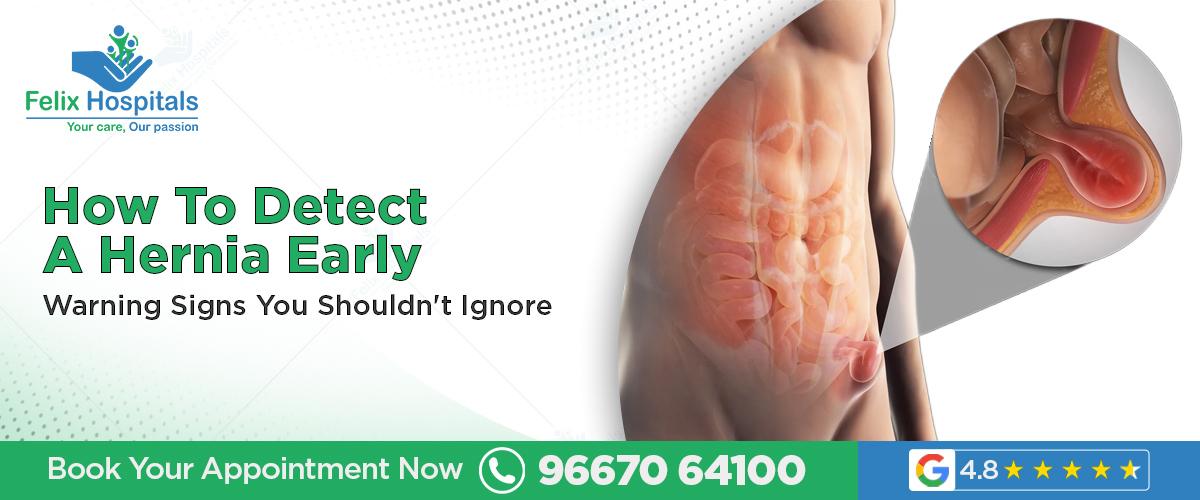
A hernia forms when an internal organ or tissue pushes through a weak part of the muscle or nearby structure. Most often, this shows up as a bulge in the abdomen or groin. You might see it appear when you stand up, cough, or lift something heavy.
When lying down, it usually becomes less visible. Hernias are not all the same. Understanding the different types helps guide medical decisions and determine if a hernia surgery is required and Hernia warning signs. Some may stay mild for years. Others, if ignored, could grow or become dangerous.
Inguinal Hernia - This is the most frequent type [especially among men]. It appears in the groin and often shows up as a visible bulge. You might feel pain when lifting objects, coughing, or even while walking. The swelling can come and go at first, but with time, it may become constant.
Umbilical Hernia - Seen near the belly button, this form is seen in children and adults. In adults, it often results from abdominal pressure during pregnancy, obesity, lifting weights or fluid buildup. It tends to present as a soft lump that increases with movement, coughing, or straining.
Hiatal Hernia - grows in the body without an external swelling. It is a health condition that is caused when part of the stomach protrudes into the chest. Such symptoms can be heartburn, acid refluxing as well as pains at the chest following the meals. In other instances, individuals might have difficulty in swallowing or getting bloated after eating.
Incisional Hernia- This is located at the point where there is an old surgical incision. In cases where the abdomen wall fails to heal an internal tissue might push at the weak point. You may notice a lump which increases when you stand, strain and even when you do anything that requires physical exertion.
Article risks and symptoms differ in each of these forms of hernia. Their awareness allows one to diagnose them and act quickly.
It is very important to know the early symptoms of hernia
Most people first notice some sort of a bulge. Sometimes it feels tender. Often, it’s not painful, but it doesn’t feel normal either. You press on it, it sinks in. But it comes back when you cough, laugh, or lift a bag of groceries.
It’s not just the bulge though. Many feel an odd tightness in the area, like your body is asking you to take it easy. A few hours on your feet and you might feel a dull ache setting in. Others describe a strange pulling sensation, like pressure from the inside pushing out.
In some hernias, like hiatal ones, nothing shows up on the outside. You just feel off! There’s reflux, discomfort after eating, and at night, a sour taste in the mouth. You wake up not rested. You think it's just gas or something you ate. But it keeps happening. That’s when many realise it’s more than just indigestion. It's the kind of thing Surgeons would spot quickly if seen in time.
How to detect a hernia early typically starts with a physical examination. A surgeon checks for a bulge while you stand and may ask you to cough to observe changes in pressure. Further evaluation involves imaging tests.
An ultrasound can detect the presence of tissue pushing through muscle layers, especially in inguinal or femoral hernias. In the case of hiatal hernia, its necessary to examine the stomach and oesophagus by barium X-ray or endoscopy. In other cases, CT/MRI scan is conducted to measure the size and the massiveness of the hernia especially when hernias are suspected in multiple cases or when diagnosis is still obscure.
A hernia is not always painful, but that does not mean it is harmless. Ignoring the early hernia symptoms can delay recovery and increase the chance of needing emergency care. Knowing how to spot signs early and learning about the types of hernia allows you to act before it becomes serious.
Signs of hernia in men and women are different :
Groin bulge: a groin bulge is a protrusion that is observed in the groin area, particularly in inguinal hernias which are more frequent in men.
Sharp pain: Pain is habitually more concentrated and sharp in the groin region.
Absence of visible bulge: Women not all women have an overt bulge and some of the hernias prevalent in women, such as the femoral hernia, may be deeper in the upper thigh.
Diffused pain: Pain can also be diffuse and spread over the lower abdomen or pelvis.
Nausea and vomiting: This may indicate a more serious problem known as strangulation that is more dangerous in the case of hernias of the femur.
Experiencing symptoms of a hernia? Consult the best hernia specialist doctor in Noida at +91 9667064100 today.
When facing symptoms of a hernia, timely consultation with a reputed hernia specialist doctor in Noida is essential for proper diagnosis and effective management. Felix Hospital stands out as the best hospital in Noida for hernia surgeries, offering a complete package of advanced laparoscopic, robotic, and open surgical techniques backed by an experienced multidisciplinary team. Early surgery results in fewer complications and better quality of life and increased recovery. Put your hernia treatment in the care of Felix Hospital because it adores you with empathetic care and recent technology and offers comprehensive personal care.
Q1: Will I be able to determine whether I probably have a hernia?
Ans: Seek painful swelling in the area of the abdomen or the groin and it is aggravated by movement.
Q2: What are the surgeries types that Felix Hospital provides in hernias?
Ans: Depending on the state of condition, open, laparoscopic, and robotic repair of hernias is an option.
Q3: Is hernia surgery painful?
Ans: Minimal surgical interventions result in low pain and rapid recovery and pain control is granted.
Q4: Are there recurrences of hernias?
Ans: It is uncommon with the right technique of surgery and follow-up treatment, however, it may occur in certain instances.

Felix Hospitals is the leading hospital for hernia surgery in Noida and Delhi NCR.


Subscribe to our
© Copyright 2026. All Rights Reserved by Felix Healthcare Private Limited
Design and development by :


 +(91)9667064100
 Emergency : +(91)9667064100