 Emergency:
  WhatsApp



Subscribe to our
If you have ever woken up at 2 AM with a sharp, stabbing pain in your lower back that radiates toward your groin, you know the pure desperation that kidney stones cause. It is a pain that makes it impossible to sit, stand, or lie down. In medical circles, it’s often compared to the intensity of childbirth.
In the Noida-Greater Noida belt, we see an unusually high number of these cases. Why? Because the geography we live in,the "Hard Water Belt" of the NCR,is a factory for kidney stones.
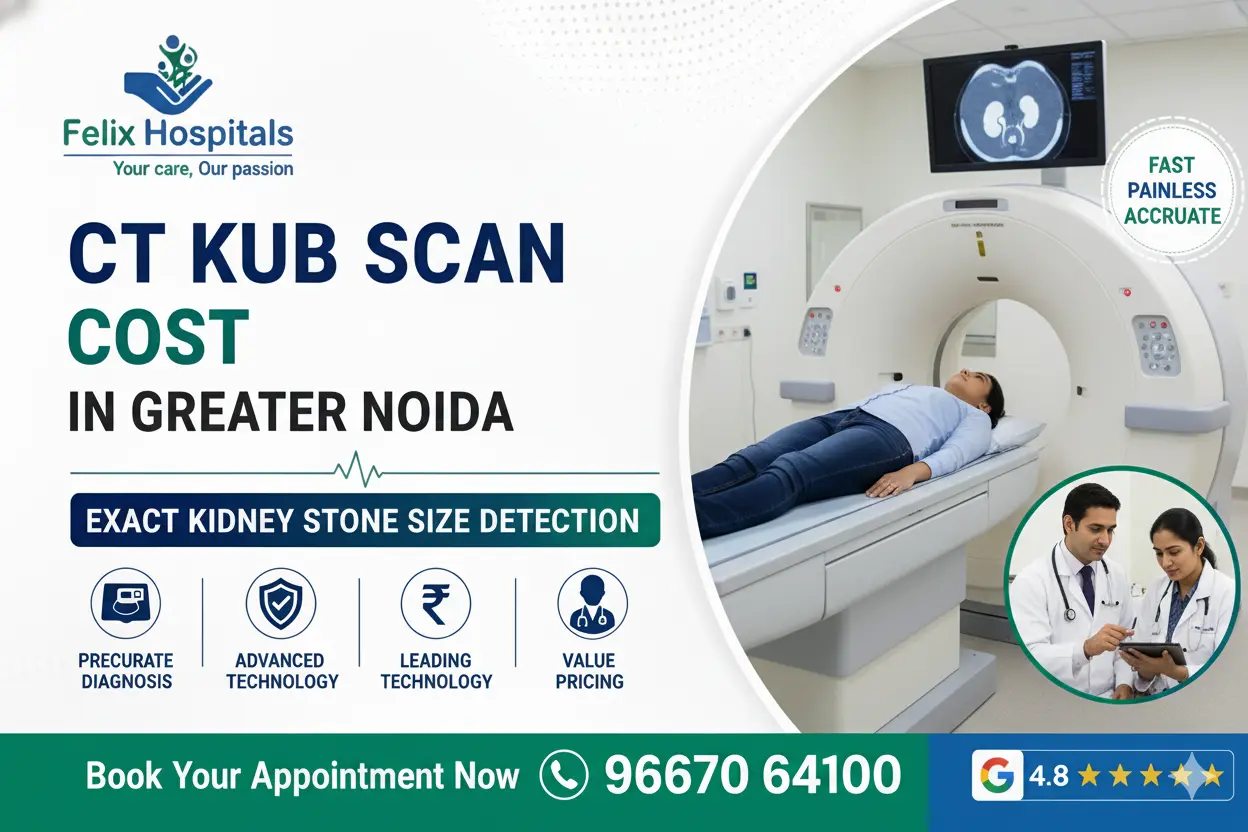
At Felix Hospital, Noida, we believe that when you are in that much pain, the last thing you should worry about is an ambiguous test result or a massive hospital bill. That is why we have standardized our NCCT KUB (Kidney, Ureter, and Bladder) Scan at just ₹2,499.
If you’ve been told you have a "shadow" on an ultrasound and need more clarity, this guide will explain why the CT KUB is the final word in stone detection.
A CT KUB stands for Computed Tomography of the Kidneys, Ureters, and Bladder. Unlike a regular X-ray, which gives a flat, 2D image, a CT scan uses a series of X-ray beams from different angles to create a 3D map of your entire urinary system.
Most importantly, for kidney stones, we perform an NCCT KUB (Non-Contrast Computed Tomography). This means no needles and no "dye" (contrast) are required. The stones are naturally dense and show up as bright white spots on the scan.
At our diagnostic wing in Sector 137, we use high-speed multi-slice scanners that can capture the entire KUB region in under 60 seconds. For a patient in acute pain, this speed is a lifesaver.
In the world of urology, the difference between a 4mm stone and a 7mm stone is the difference between a glass of water and a surgical procedure.
Stones under 5mm: These have a 90% chance of passing naturally through urine with proper hydration.
Stones 5mm to 10mm: These are in the "grey zone." They might pass, or they might get stuck in the narrow ureter, causing a blockage.
Stones over 10mm: These almost always require medical intervention like Lithotripsy (ESWL) or Laser surgery (URSL).
An Ultrasound often "guesses" the size or misses stones tucked behind the pelvic bone. A CT KUB at Felix Hospital gives your urologist the Exact Size, Exact Location, and the Density (Hounsfield Units) of the stone. This "Density" tells the doctor if the stone is soft (easy to break) or hard (requires a laser).
We have to talk about the local context. Residents of Sector 137, Sector 143, and Pari Chowk often complain about the quality of groundwater. The water in the Greater Noida region is notorious for its high Total Dissolved Solids (TDS).
Even with high-end RO systems, many residents aren't getting the right mineral balance. The high calcium and oxalate levels in the local water, combined with the extreme heat of the NCR summers (which causes chronic dehydration), create a "perfect storm" for stone formation.
This is why we see "Recurrent Stone Formers", patients who clear one stone only to develop another six months later. For these patients, having an affordable, high-precision scan like the ₹2,499 CT KUB is essential for long-term health management.
It is a common story at our hospital: "Doctor, I had an Ultrasound in a local lab, and they said everything was normal, but my pain is still there."
There are three reasons why an Ultrasound can "miss" a kidney stone:
The Ureter Problem: The ureter (the tube connecting the kidney to the bladder) is very narrow and often hidden by intestinal gas. An ultrasound cannot see through gas.
Pelvic Bone Interference: If a stone has moved down toward the bladder, it often hides behind the pelvic bone, where ultrasound waves cannot reach.
The "Shadow" Illusion: Small stones don't always create a "shadow" on an ultrasound, making them look like normal tissue.
A CT KUB is not affected by gas or bone. It sees the stone wherever it is hiding, with 99% sensitivity.
If you check the prices at major diagnostic chains in Delhi or Noida Sector 18, an NCCT KUB can cost anywhere from ₹4,500 to ₹7,500.
At Felix Hospital, we have disrupted this pricing. By offering the scan at ₹2,499, we ensure that even a student from the nearby universities or a middle-class family in Paras Tierea or Gulshan Vivante can access world-class diagnostics without a second thought.
High-Resolution NCCT KUB Scan.
Senior Radiologist Reporting: Each report is verified for accuracy.
Immediate Film and Digital Access: Get your results on WhatsApp to share with your urologist.
Specialist Consultation: Meet our internal medicine team to discuss the findings.
Preparation for a CT KUB is much easier than a standard "Whole Abdomen" scan:
No Fasting Required: Since we aren't using contrast dye, you don't need to be on an empty stomach.
The Full Bladder Myth: Unlike an ultrasound, you do not need an uncomfortably full bladder for a CT KUB. However, having some fluid in the bladder helps us see the junction where the ureter meets the bladder.
Metal-Free Clothing: Try to wear pajamas or leggings without metal zippers. We will provide a hospital gown if your clothes have metal buttons.
Duration: The scan itself takes about 5-10 minutes. The total time spent in our Sector 137 facility is usually under 30 minutes.
When you receive your report from Felix Hospital, you will see a few key technical terms. Here is what they mean in plain English:
Nephrolithiasis: Stones inside the Kidney.
Ureterolithiasis: Stones in the Ureter (the tube). This is usually what causes the most pain.
Hydronephrosis: This means the kidney is "swelling" with urine because a stone is blocking the exit. This needs immediate attention.
Hounsfield Units (HU): This is the "Hardness Score." A stone with 400 HU is soft; a stone with 1200 HU is hard like a diamond.
Located right at the Sector 137 Metro Station, we are the most accessible multi-specialty hospital for the Noida-Greater Noida Expressway community.
Low-Dose CT Technology: We use the latest "As Low As Reasonably Achievable" (ALARA) protocols, ensuring you get the sharpest image with the lowest possible radiation exposure.
Integrated Urology Team: We don't just give you a report and send you away. Our Department of Urology is available in the same building to provide immediate treatment, whether it’s medical management or advanced laser surgery.
Emergency Response: Kidney stone pain can be an emergency. Our diagnostic wing is open 24/7 for emergency scans.
Local Trust: We are an NABH & NABL accredited facility, which means our quality of reporting meets the highest national standards.
Once we detect and treat your stone, our nutrition team at Felix Hospital suggests these local lifestyle changes to prevent a recurrence:
The "Lemon Water" Habit: Citrate in lemons helps prevent calcium from clumping into stones.
TDS Awareness: Check your RO water TDS. It should ideally be between 100-150. Too low is bad for your bones; too high is bad for your kidneys.
Reduce Salt (NCR Street Food): High sodium intake increases calcium in your urine. If you’re a fan of local chaat and momos, keep an eye on your salt intake.
Stay Hydrated: In the scorching Greater Noida heat, 3-4 liters of water is the minimum. If your urine isn't crystal clear, you aren't drinking enough.
While many stones pass with medication, some situations require an immediate visit to the Felix Hospital Emergency Wing:
Fever and Chills: This indicates an infection behind the stone, which can lead to sepsis.
Inability to Pass Urine: This means a complete blockage.
Intractable Vomiting: If you cannot keep fluids down due to pain and nausea.
Blood in Urine: While common with stones, heavy bleeding needs an urgent checkup.
A kidney stone doesn't have to be a multi-week saga of pain and expensive hospital visits. The first step to a pain-free life is a clear, accurate diagnosis.
With the Felix CT KUB Package at ₹2,499, you get the exact size, location, and hardness of your stone, allowing you and your doctor to make the best decision for your health.
Don’t live in pain. Get the clarity you deserve today. Call us at +91 9667064100
Yes. While Ultrasound is good for a quick look, a CT KUB is the "Gold Standard." It is much more accurate at seeing small stones and stones in the ureter.
No, a standard CT KUB for stones is a Non-Contrast (NCCT) scan. Contrast is rarely needed for kidney stones, but if your doctor requests it for other reasons, there will be a different protocol.
A CT KUB is a focused scan. At Felix Hospital, we use low-dose technology that makes the radiation exposure very minimal and safe for adults.
We offer digital reports via WhatsApp within 4-6 hours, and physical reports can be collected shortly after.
Absolutely. There are no side effects, no injections, and no "downtime." You can resume your normal routine immediately.
Yes, Felix Hospital has a full-time Department of Urology. You can book a consultation immediately after receiving your scan report.
Yes, CT brain scans can detect brain tumours, especially larger ones. However, for smaller or more subtle tumours, an MRI brain with contrast provides greater detail and is often the preferred follow-up imaging.
Our mission is to make diagnostic excellence a community standard. By keeping our CT KUB at ₹2,499, we ensure early detection and better outcomes for our neighbors in Noida and Greater Noida.
Dr. Hari Om Prakash is a highly experienced radiodiagnostic specialist, renowned for his accurate diagnoses across various advanced imaging modalities including MRI, MDCT, angiography, ultrasound, and mammography, significantly aiding in precise treatment planning.


Subscribe to our
© Copyright 2026. All Rights Reserved by Felix Healthcare Private Limited
Design and development by :


 +(91)9667064100
 Emergency : +(91)9667064100