 Emergency:
  WhatsApp






Subscribe to our
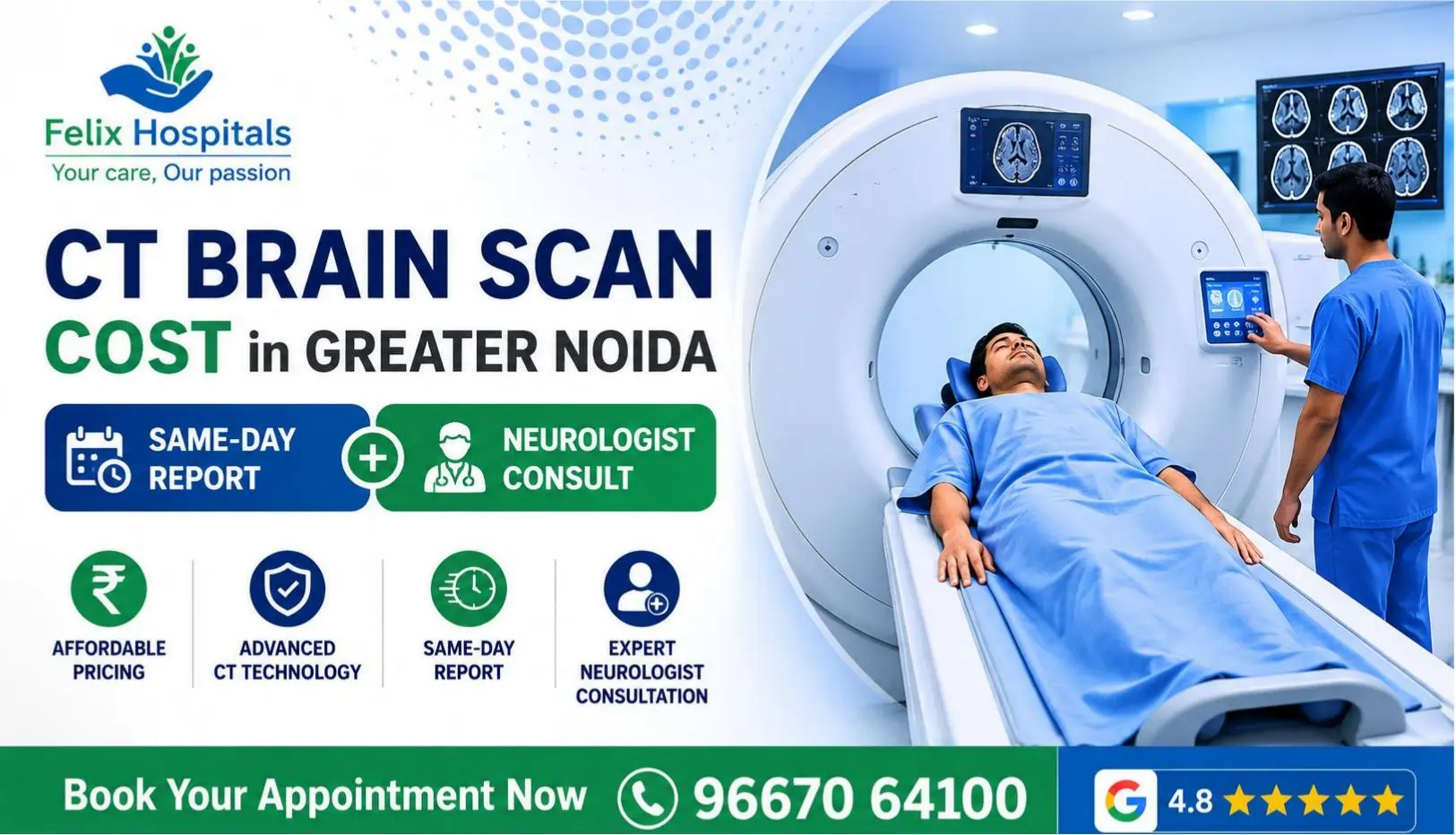
At Felix Hospital, barely a week goes by without someone walking into our neurology OPD holding a phone to their ear, having just Googled: "CT scan brain cost in Greater Noida" Sometimes they've been having headaches for three weeks. Sometimes a family member had a sudden fall. Sometimes their child had a seizure and they just want answers — fast.
If that's where you are right now, this guide is for you.
A CT brain scan is one of the most important diagnostic tools in modern medicine. At Felix Hospital, Sector 137, Noida, we offer it at ₹1,799* — with a same-day report and the option to consult a neurologist on the same visit. No waiting days for results. No running between a scan centre and a specialist's clinic across town.
Here's everything you need to know.
A CT scan of the brain is a noninvasive diagnostic imaging procedure that uses special X-ray measurements to produce horizontal, or axial, images — often called slices — of the brain. Brain CT scans can provide more detailed information about brain tissue and brain structures than standard X-rays of the head, thus providing more data related to injuries and diseases of the brain.
Computed Tomography, more commonly known as a CT or CAT scan, combines an X-ray machine and a unique computer to create pictures of bones, organs, and tissues from different angles, producing three-dimensional views. CT scanning is fast, painless, non-invasive, and accurate. In emergency cases, it can reveal internal injuries and bleeding quickly.
Think of a CT brain scan as your doctor's first clear look inside your skull — without a single incision, without general anaesthesia, and without a long wait for an appointment.
Your neurologist or treating physician may order a CT brain scan when you present with symptoms that suggest something is happening inside the skull or brain. A doctor may suggest a CT scan of the brain if one experiences symptoms indicating a problem in the brain such as seizures or epilepsy, altered or double vision, memory loss, and loss of sensation of touch.
At Felix Hospital, our neurology team commonly orders a CT brain scan for:
Sudden, severe headache — especially one described as "the worst headache of my life," which can signal a subarachnoid haemorrhage
Head trauma — after a road accident, fall, or any blunt impact to the skull
Suspected stroke — sudden weakness on one side, slurred speech, facial drooping, or difficulty walking
First-time seizure — to rule out structural brain abnormalities
Loss of consciousness or unexplained blackout
Persistent dizziness or balance problems
Sudden vision changes or double vision
Memory loss or sudden behavioural change
Pre-surgical planning — before any neurosurgical procedure
This is where the CT brain scan earns its reputation as the first responder of neurological imaging. A CT brain scan can offer meaningful insight into silent strokes, bleeding, tumours, and treatable conditions like hydrocephalus.
Specifically, a CT brain scan can detect:
Bleeding in the brain (Haemorrhage) A non-contrast head CT is the test of choice for detecting acute haemorrhage in the brain. It is an excellent test for patients with acute CNS symptoms such as severe headache, acute visual symptoms, or traumatic head injury.
Stroke CT brain plain scans are instrumental in identifying strokes in their early stages, where quick treatment can make a significant difference. In stroke care, every minute matters — and the CT scan delivers results in minutes, not hours.
Traumatic Brain Injury (TBI) Fractures of the skull, contusions (brain bruising), and intracranial bleeding following accidents or falls are clearly visible on a CT scan.
Brain Tumours CT scanning can detect larger tumours or masses that require further attention and guide the decision for biopsy or surgical intervention.
Hydrocephalus Hydrocephalus is a buildup of fluid in the brain that can cause memory problems, difficulty walking, and confusion — yet is often very treatable when detected early.
Infections Abscesses (pockets of infection) within the brain tissue are visible on a contrast-enhanced CT scan.
Sinus and skull abnormalities Non-contrast CT is also used to assess sinus conditions and complex fractures.
This is one of the most common questions our patients ask — and it's a good one.
Both CT and MRI scans look at brain structure, but they work in different ways and at different speeds. A CT scan uses X-rays to create cross-sectional images of the brain. It's fast, widely available, and excellent at detecting bleeding, fractures, and major structural changes. In emergency settings, speed is critical — when a patient arrives with sudden confusion, head trauma, or a possible stroke, a CT scan is often the first step because it can be completed within minutes.
CT is much faster than MRI, making it the study of choice in cases of trauma and other acute neurological emergencies.
Here's a simple comparison to guide you:
Feature | CT Brain Scan | MRI Brain |
Speed | Very fast (5–15 minutes) | Slower (30–60 minutes) |
Best for | Bleeding, trauma, stroke, fractures | Tumours, MS, nerve conditions, soft tissue |
Uses radiation | Yes (low dose) | No |
Cost in India | ₹1,799 – ₹5,000 | ₹5,000 – ₹25,000 |
Availability | Widely available | Less widely available |
Emergency use | First choice | Rarely used in emergencies |
Claustrophobia concern | Minimal | More common |
If the concern is active bleeding or a skull injury, CT usually comes first. If the concern involves nerve pathways, small lesions, or complex tissue changes, MRI offers greater clarity.
Your neurologist at Felix Hospital will advise which scan is appropriate for your specific symptoms. In many cases, a CT scan is the right starting point — and it may be all you need.
Many people feel anxious before their first CT scan. Here's the honest, straightforward version of what actually happens:
Step 1 — Arrival and registration Check in at the Felix Hospital radiology desk. If you have a doctor's referral, bring it along. If not, our neurologist can assess you first and issue the request.
Step 2 — Preparation You'll be asked to remove jewellery, glasses, hearing aids, and any metal objects. If you're having a contrast scan, an IV line will be placed in your arm.
Step 3 — Positioning You lie flat on a motorised table that slides into the CT scanner — a large, doughnut-shaped machine. The scanner will rotate around your head and capture images from different angles. During the scan, you need to remain still. A head CT scan usually takes 10–30 minutes.
Step 4 — The scan The machine is noisy but the procedure is completely painless. You may be asked to hold your breath briefly at certain moments. The table moves slowly through the scanner ring while images are captured.
Step 5 — Report and consultation At Felix Hospital, your report is prepared by an experienced MD radiologist and delivered the same day. You can then consult our neurologist to interpret the findings and plan next steps — all in one visit.
Preparation for a CT brain scan is minimal. Generally, to take a CT scan, you can continue with your regular activities — it does not require any special arrangements or diet before the scan.
However, if you are having a contrast CT scan, there are a few additional steps:
Do not eat solid foods for 4 hours prior to the intravenous contrast injection.
Inform your doctor if you have kidney disease, diabetes, or a known allergy to iodine or contrast dye
If you are over 50, a recent creatinine blood test result may be required before contrast is administered
Inform the technician if you are pregnant or suspect you may be pregnant
For a plain (non-contrast) CT brain scan — the most common type — you simply arrive, remove metal objects, and lie down. That's it.
Your doctor will specify which type of CT scan is needed based on your symptoms.
Non-Contrast CT Brain (NCCT) A CT brain plain scan is performed without any contrast dye. It's ideal for quickly assessing acute conditions like trauma, strokes, or bleeding, where time is of the essence. This type is preferred in emergency settings because it's fast, non-invasive, and doesn't carry the risk of allergic reactions associated with contrast agents.
Contrast-Enhanced CT Brain (CECT) A CT brain contrast scan involves injecting a special dye into the bloodstream before the scan begins. This dye increases the visibility of blood vessels and certain tissues, making it easier to detect tumours, infections, or vascular malformations. It provides better delineation of the brain's soft tissue structures, which can be crucial for diagnosis.
Your provider may order a scan with contrast if your symptoms suggest a possible tumour, abscess, or growth in the brain, or to help understand more about blood vessel health and conditions such as aneurysms or blockages.
In simple terms — non-contrast for emergencies and bleeding; contrast for tumours, infections, and vascular conditions. Your Felix Hospital neurologist will determine which is right for you.
Let's be straightforward about what CT brain scans cost across Noida and Greater Noida.
CT scan cost in Greater Noida ranges from ₹1,800 to ₹10,200. The actual cost depends on the body part, scan type (NCCT, CECT, or CT Angiography), and the CT scan centre.
Here's how Felix Hospital compares:
Scan Type | Market Range (Greater Noida) | Felix Hospital |
NCCT Brain (Plain) | ₹1,800 – ₹3,500 | ₹1,799 |
CECT Brain (with contrast) | ₹3,500 – ₹6,000 | Competitively priced |
CT Brain Angiography | ₹5,000 – ₹10,200 | Available — speak to our team |
Neurologist consultation | ₹500 – ₹1,500 (separate) | Included in the ₹1,799 offer |
The key difference at Felix Hospital is not just the price — it's what's bundled into it. A same-day report and a neurologist consultation included in a single visit at ₹1,799 is genuinely uncommon in the Greater Noida and Noida market, where most centres charge separately for the scan, the radiologist report, and the specialist consultation.
When someone has had a sudden headache, a blackout, or a head injury, waiting 24–48 hours for a scan report is not just inconvenient — it can be genuinely dangerous.
When someone arrives at the emergency department after head trauma, doctors need to know immediately if there's bleeding in the brain. A non-contrast head CT reveals fresh blood within minutes. Delayed reporting delays treatment — and in neurological emergencies, the window for effective intervention can be very short.
At Felix Hospital, our in-house radiology team processes CT brain scans on the same day. Your MD radiologist-verified report is ready before you leave the hospital — not couriered to you the following morning. And because our neurology department is in the same building, the neurologist can review your images immediately, explain the findings in plain language, and prescribe a treatment plan — all in the same appointment.
This integrated approach is what makes the difference between a scan centre and a hospital.
There are many places in Greater Noida and Noida where you can get a CT scan done. Here's why patients keep coming back to Felix Hospital:
Advanced CT Scanner Our radiology department is equipped with a multi-slice CT scanner that produces high-resolution images of the brain quickly and with a low radiation dose. Image quality matters — a blurry or low-resolution scan can miss subtle findings that change a diagnosis.
On-Site Neurology Department This is the single biggest advantage of getting your CT brain scan at Felix Hospital over a standalone diagnostic centre. Our neurologists are based in the hospital — they can review your images in real time, correlate them with your symptoms, and advise on the same day.
Same-Day Reports, Every Day Whether you come in on a Monday morning or a Saturday afternoon, your CT brain report is delivered the same day. No waiting, no uncertainty overnight.
Emergency Availability Brain emergencies don't follow a 9-to-5 schedule. Our radiology and neurology teams are available around the clock for emergency CT scans — stroke, trauma, sudden neurological collapse. If you or a family member needs emergency neurological imaging, call +91 9667064100 immediately.
Transparent Pricing ₹1,799 for the CT brain scan and neurologist consultation, clearly stated before you begin. No hidden charges, no surprise bills at the end.
Felix Hospital's neurology and radiology departments work in close integration, giving patients a seamless diagnostic experience:
Stroke diagnosis and management (acute and chronic)
Seizure and epilepsy evaluation
Headache clinic
Memory and cognitive disorder assessment
Parkinson's disease and movement disorders
Peripheral neuropathy
Neuroinfections (meningitis, encephalitis)
Neuromuscular disease management
Multi-slice CT scanner (brain, spine, chest, abdomen, pelvis)
MRI (brain, spine, joints)
Digital X-ray
Ultrasound and Doppler studies
Interventional radiology
EEG (Electroencephalography) for seizure evaluation
Nerve Conduction Studies (NCS)
Electromyography (EMG)
A CT brain scan is a tool — but the neurologist is the one who interprets what it means for you, based on your symptoms, history, and examination findings.
Come to Felix Hospital's neurology department — with or without a prior CT scan — if you are experiencing:
A headache that is sudden, severe, or different from any you've had before
Weakness or numbness in the face, arm, or leg — especially on one side
Sudden difficulty speaking, understanding speech, or swallowing
Vision changes — double vision, loss of vision, or visual disturbances
A seizure or convulsion — for the first time or a change in pattern
Unexplained memory loss or sudden confusion
Dizziness, loss of balance, or difficulty walking without a clear cause
Tremors or involuntary movements
Loss of consciousness or a blackout episode
These are not symptoms to manage with a painkiller and a good night's sleep. They deserve a proper evaluation — and often, a CT brain scan is the first step.
A CT brain scan is not something most people plan for. It's ordered when something happens — a fall, a severe headache, a concerning symptom that won't go away. In those moments, what you need is speed, clarity, and expert guidance in one place.
At Felix Hospital, that's exactly what the ₹1,799 CT Brain Scan + Neurologist Consult offer delivers. Same-day report. Same-day specialist review. Same-day answers.
Don't let concern become a crisis because of delayed diagnosis. If you or someone in your family needs a CT brain scan in Greater Noida or Noida, call us at +91 9667064100 or walk into Felix Hospital, Sector 137, Noida. Our team is ready.
The CT brain scan is available at Felix Hospital for ₹1,799*, which includes the scan, a same-day radiologist-verified report, and a neurologist consultation — all in one visit.
Not at all. A CT brain scan is completely painless. You simply lie still on a table that moves through the scanner. The machine makes some noise, but you won't feel anything. The entire procedure takes between 10 and 30 minutes.
NCCT (Non-Contrast CT) is done without any dye and is used for emergencies like bleeding, trauma, or stroke. CECT (Contrast-Enhanced CT) involves injecting a dye to make blood vessels and certain tissues more visible — used when a tumour, infection, or vascular condition is suspected.
Your report is delivered the same day. Our in-house radiologist verifies the images and prepares the report before you leave, so you can review it with the neurologist in the same visit.
While a referral from your treating doctor is ideal, you can also walk into Felix Hospital and be assessed by our neurologist first, who will then order the CT scan if indicated. Call +91 9667064100 to schedule.
For a plain (non-contrast) CT brain scan, no fasting is required. If you are having a contrast CT scan, you should avoid solid food for 4 hours before the procedure.
Yes, CT brain scans can detect brain tumours, especially larger ones. However, for smaller or more subtle tumours, an MRI brain with contrast provides greater detail and is often the preferred follow-up imaging.
Does it involve radiation? CT scans use low-dose X-ray radiation. The amount used in a brain CT is considered safe and is recommended only when medically necessary. MRI, by comparison, uses no radiation — but takes longer and costs more.
Go to Felix Hospital's emergency department immediately — or call +91 9667064100 — if you experience sudden severe headache, face or limb weakness on one side, slurred speech, loss of consciousness, vision loss, or a seizure. These are potential stroke or neurological emergency symptoms and cannot wait.
Yes. CT brain scans are performed on patients of all ages, including children and infants, when medically indicated. Our paediatric neurology team works alongside radiology to ensure the procedure is done safely and with the minimum necessary radiation dose for young patients.
Dr. Hari Om Prakash is a highly experienced radiodiagnostic specialist, renowned for his accurate diagnoses across various advanced imaging modalities including MRI, MDCT, angiography, ultrasound, and mammography, significantly aiding in precise treatment planning.

Subscribe to our
© Copyright 2026. All Rights Reserved by Felix Healthcare Private Limited
Design and development by :


 +(91)9667064100
 Emergency : +(91)9667064100