 Emergency:
  WhatsApp


Subscribe to our
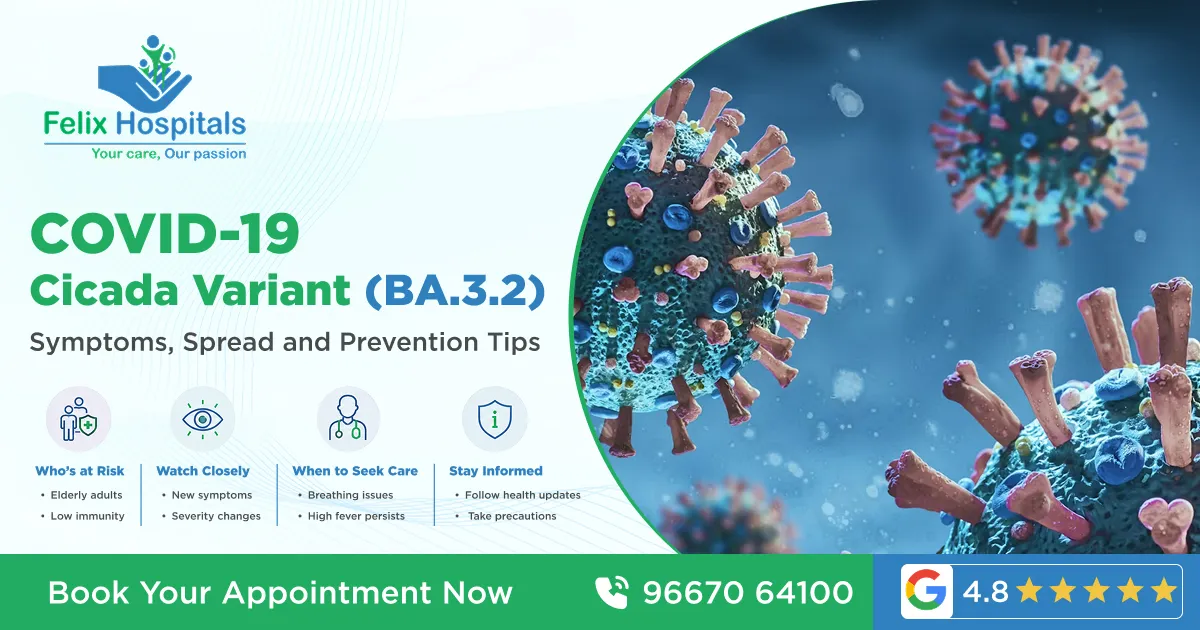
Every few months, a new COVID variant name surfaces online and the cycle is familiar by now headlines about mutations, social media panic, conflicting advice, and a general sense that nobody quite knows what to do. The Cicada variant, officially BA.3.2, is currently going through that cycle.
At Felix Hospital, our General Medicine team has been fielding questions about it for a long time. So here is the honest, clinical answer without the alarm and without the dismissiveness.
BA.3.2 was first identified in South Africa in November 2024. The name "Cicada" is not arbitrary. Like the insects, the variant has a pattern of disappearing and then reemerging months later. Scientists think that for two years, BA.3 infected a single person who didn't have enough immune function to completely fight off evolving silently inside one host before re-emerging with significantly more mutations than its predecessor.
BA.3.2 has over 50 mutations in its spike protein compared to its immediate ancestor, and more than 70 mutations when compared to the original Wuhan strain. That number sounds alarming. It requires context.
Mutations in SARS-CoV-2 are not inherently dangerous; they are the normal result of a virus replicating inside a human body over time. What matters is what those mutations do: do they make the virus spread faster? Cause more severe disease? Slip past existing vaccine-induced immunity? On all three questions, the current answer for BA.3.2 is: possibly some immune escape, but no evidence of increased severity.
WHO classified BA.3.2 a Variant Under Monitoring on 5 December 2025 one of five Omicron subvariants that currently has this status. That classification means it is being watched carefully, not that it has been found to be dangerous.
As of today, no major outbreak has been linked to BA.3.2 in India. Indian health authorities are tracking it, not managing a crisis.
This is where the Cicada variant is most straightforward: BA.3.2 does not appear to cause new or unusual symptoms. The symptoms are similar to earlier Omicron variants.
In our OPD, patients presenting with COVID in 2026 typically describe a combination of the following fever, sore throat, fatigue, dry cough, body aches, headache, and in some cases nasal congestion. Loss of taste and smell, which was a hallmark of the original Omicron waves, appears less consistently now.
These symptoms are often indistinguishable from the symptoms of influenza and respiratory syncytial virus, which are still circulating. "Unfortunately, there is not really a distinct trait between these respiratory illnesses," according to Dr. Greeta Sood, an epidemiologist at Johns Hopkins Bayview Medical Center. Testing is crucial to get diagnosed and treated properly.
This is a point we emphasise to every patient who walks in with a respiratory illness: the symptoms alone cannot tell you whether you have COVID, flu, or RSV. Treatment decisions particularly around antivirals for high-risk patients depend on knowing which one it is. A test is not optional.
BA.3.2 spreads the same way every COVID variant has spread since 2020 through respiratory droplets and aerosols in close contact, and through touching contaminated surfaces and then touching the face.
Early data suggests the BA.3.2 "Cicada" variant may spread easily from person to person, similar to other recent Omicron subvariants.
As of early February 2026, BA.3.2 was detected in nasal swabs from travellers, airplane wastewater samples, clinical samples from patients, and wastewater samples from 25 U.S. states. As of April 13, 2026, BA.3.2 has been detected in at least 33 countries.
For Noida specifically, the risk transmission points are predictable: crowded metro coaches on the Aqua Line during rush hour, shared office spaces with poor ventilation in Sector 62 and Sector 125 buildings, and high-density residential societies where common areas gyms, lifts, and corridors act as the same kind of fomite environments we discussed during peak COVID years.
The virus hasn't changed its routes. Neither should your precautions.
Early evidence suggests this Omicron offshoot is not currently driving large waves of infection or more severe disease. Overall, available evidence suggests that BA.3.2 poses low additional public health risk compared with other circulating Omicron descendant lineages.
It has spread internationally and been detected in multiple countries, but mostly at low or moderate levels, rather than driving large global waves. This suggests it is not currently outcompeting dominant subvariants.
The honest clinical position in May 2026 is this: BA.3.2 is worth monitoring because of its unusual mutation profile and its potential for some immune escape. It is not worth panic because it has not demonstrated the ability to cause more severe illness. Those are two different things, and conflating them in either direction produces bad decisions.
The risk stratification for BA.3.2 is essentially the same as it has been throughout the pandemic. The patients in our OPD who need the most careful management are those who are above 60 years of age, immunocompromised including those on chemotherapy, long-term steroids, or with poorly controlled diabetes have chronic lung disease, cardiac conditions, or chronic kidney disease, or are in the early or late stages of pregnancy.
A heavily mutated variant of the virus appears to be affecting primarily children, scientists say, though it's not causing more severe disease in kids or in adults. The pattern of children being affected more than older adults is an unusual characteristic of BA.3.2 that researchers are still studying. Parents should be watchful, but the clinical data so far does not indicate that children are at risk of severe outcomes.
One group that tends to underestimate their risk in Noida: working professionals in their thirties and forties with uncontrolled hypertension or borderline diabetes who consider themselves "basically healthy." Metabolic comorbidities significantly raise the risk of a complicated COVID course, even with Omicron-descendant variants.
There is no Cicada-specific vaccine or treatment protocol. What works is what has always worked.
Ventilation over everything else: The single most effective structural change you can make is improving air circulation in indoor spaces. Keep windows open. In office meeting rooms in Sector 142 where eight people are sitting for an hour, that's not a small thing. Poorly ventilated, crowded indoor spaces are where COVID has always transmitted most efficiently.
Masking in specific situations : You do not need to mask outdoors or in well-ventilated private spaces. You should consider masking in crowded, enclosed settings the metro, hospital waiting areas, crowded markets particularly if you are in a higher-risk category or live with someone who is.
Hand hygiene still relevant : The virus reaches your respiratory system when you touch a contaminated surface and then touch your face. Twenty seconds of soap and water remains as relevant for COVID as it is for every other respiratory illness circulating right now.
Vaccination : Current COVID vaccines targeting the JN.1 lineage still offer protection against severe disease from BA.3.2, though they may be less effective at preventing infection. Health experts strongly recommend staying vaccinated as vaccines continue to protect against hospitalization and serious illness. If you have not had a booster in over a year, that conversation is worth having with your physician particularly if you are in a higher-risk group.
Antivirals for high-risk patients : Antiviral drugs like Paxlovid remain effective against the Cicada variant. These medicines work best when taken early after a positive test, particularly for people at high risk of severe disease. This means testing early matters not waiting three days into symptoms to confirm what you already suspect.
Test if you have fever, sore throat, cough, or body aches especially if you have been in a crowded setting, have travelled recently, or are in contact with a confirmed case. Don't wait for symptoms to worsen before testing. The window for antiviral treatment is narrow.
Come to us immediately don't manage at home if your fever exceeds 39°C and is not responding to paracetamol after 48 hours, if you are experiencing shortness of breath at rest or with minimal activity, if you have chest tightness or persistent chest pain, if you are confused or unusually drowsy, or if you are in a high-risk category and your symptoms are worsening after day three rather than improving.
Self-medicating with leftover antibiotics which we addressed in the context of other infections applies equally here. Antibiotics do not treat viral infections. They do not treat COVID. They do contribute to antibiotic resistance in your gut flora and in the community. If you are testing positive and you are not in a high-risk category, the treatment is rest, hydration, and monitoring. If you are high-risk, come in.
Our General Medicine team has been managing COVID presentations through every variant wave since 2020. We understand the local patterns what's circulating in Noida right now alongside BA.3.2 (influenza A is still active, RSV is still active), how to differentiate clinically, and when watchful waiting is appropriate versus when antiviral treatment should begin.
We have rapid testing available, an NABL-accredited lab for confirmatory PCR, and senior physicians who will give you a straight answer rather than a generic protocol.
If you are sick, or if someone in your household is in a high-risk category and has symptoms don't wait to see if it gets better on its own. Come in early, when the options are still open.
📞 +91 9667064100 📍 Felix Hospital, Sector 137, Noida
Same-day consultations available for respiratory and fever presentations.
As of April 2026, no major outbreak linked to BA.3.2 has been confirmed in India. However, the variant has spread to 23+ countries globally and is being monitored. Indian health authorities are tracking the situation and advising awareness without panic.
Not based on current evidence. It carries more mutations than recent strains, but has not been associated with more severe disease or higher hospitalisation rates.
Yes. Standard rapid antigen tests and PCR tests remain reliable for detecting BA.3.2 infection.
There is no BA.3.2-specific vaccine currently. Existing vaccines continue to offer meaningful protection against severe disease. If you are overdue for a booster, speak to your physician.
BA.3.2 appears to be affecting children more than previous variants, but is not causing more severe disease in them. Standard precautions apply.
Felix Hospital's General Medicine department offers rapid testing, antiviral prescribing for eligible patients, and senior physician consultations with same-day appointments for active respiratory illness.
Dr. Ravi Sharma is a senior physician with 42+ years of experience, known for compassionate and comprehensive patient care in Noida.
For those experiencing such symptoms, seeking care from the best hospital for pulmonology treatment in Noida ensures you receive timely and expert diagnosis and treatment.
Felix Hospital in Noida is esteemed as a leading institution for general medicine, particularly renowned for its excellence in treating cold and cough

Winter viral fever is common in children during cold months. Early care from the best pediatrician in Noida helps ensure fast and safe recovery.

Looking for the best physician for viral fever treatment in Noida


Subscribe to our
© Copyright 2026. All Rights Reserved by Felix Healthcare Private Limited
Design and development by :


 +(91)9667064100
 Emergency : +(91)9667064100