 Emergency:
  WhatsApp


Subscribe to our
There are medical emergencies that give you hours to respond. And then there are the ones that give you minutes.
It is one of the most catastrophic cardiovascular events a human body can experience, sudden, violent in its onset, and fatal in a significant number of cases before the patient ever reaches a hospital. Yet for all its severity, aortic dissection remains poorly understood by the general public. Most people have never heard of it until it happens to someone they know.
This guide changes that. If you live with high blood pressure, have a family history of aortic disease, or simply want to understand one of the most serious conditions in cardiovascular medicine read this carefully.
At Felix Hospital, is one of the leading cardiology hospitals in Noida, our cardiovascular team manages complex cardiac emergencies including aortic dissection with a protocol-driven, time-critical approach. Knowing what aortic dissection is, what it feels like, and what to do about it could be the difference between life and death for you or someone near you.
The aorta is the largest artery in the human body. It originates directly from the left ventricle of the heart, arches upward through the chest, and then descends through the abdomen before branching into the arteries that supply the legs. Every heartbeat pushes blood through it at significant pressure. Over a lifetime, the aortic wall handles billions of such pulses.
That wall is made of three layers: the intima (innermost), the media (middle, muscular layer), and the adventitia (outermost). In a healthy aorta, these layers move together as one.
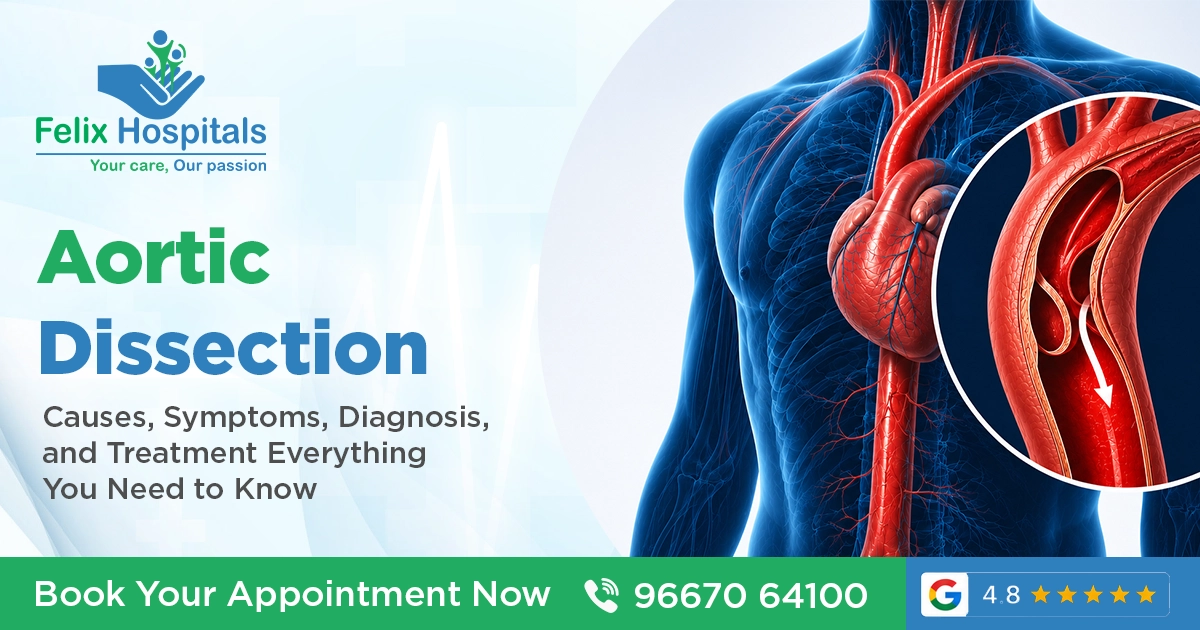
In an aortic dissection, a tear forms in the innermost layer the intima. Blood under high arterial pressure surges through that tear and forces its way between the intima and the media, creating a false channel called a false lumen running alongside the true lumen. As blood continues to pump into this false channel with every heartbeat, the dissection propagates sometimes within seconds along the length of the aorta.
The consequences depend on how far the dissection travels and which vessels it compromises. If it cuts off blood supply to the coronary arteries, the result is a heart attack. If it reaches the arteries supplying the brain, stroke follows. If it ruptures through the outer wall of the aorta entirely, massive internal haemorrhage usually fatal occurs.
This is why aortic dissection is a true surgical emergency. Every minute matters.
Aortic dissections are classified using two primary systems: the Stanford Classification and the DeBakey Classification. Stanford is more commonly used in clinical practice today.
Type A Involves the ascending aorta This is the more dangerous and more common type. The tear originates in or extends into the ascending aorta, the portion of the aorta that rises from the heart before the arch. Type A dissections carry a mortality rate of approximately 1 to 2 percent per hour in the first 24 to 48 hours without surgical treatment. Emergency open-heart surgery is almost always required.
Type B Involves the descending aorta only The tear is confined to the descending aorta beyond the left subclavian artery and does not involve the ascending aorta. Type B dissections are typically managed medically in the first instance, though complicated cases (involving organ ischaemia, rupture, or rapid expansion) require endovascular or surgical intervention.
Type I Originates in the ascending aorta and extends to the descending aorta (or beyond)
Type II Confined to the ascending aorta
Type III Originates in the descending thoracic aorta (IIIa: confined to thorax; IIIb: extends to abdomen)
Understanding which type a patient has is the first critical step in determining their treatment pathway and it must happen fast.
Aortic dissection does not happen randomly to otherwise healthy arteries. In virtually every case, there is an underlying reason why the aortic wall was vulnerable enough to tear.
Chronic hypertension (high blood pressure) is by far the most common cause. Sustained high pressure especially when poorly controlled progressively degenerates the media layer of the aortic wall over years. When the wall weakens sufficiently, even a normal blood pressure spike can trigger a tear. Approximately 70 to 80 percent of aortic dissection patients have a history of hypertension.
Connective tissue disorders particularly Marfan syndrome and Ehlers-Danlos syndrome directly affect the structural integrity of the aortic wall. People with Marfan syndrome are tall, long-limbed, have a characteristic appearance, and carry a significantly elevated lifetime risk of aortic dissection, often at a younger age. This is the group in whom dissections occur in their 30s and 40s, sometimes without warning.
Bicuspid aortic valve a congenital abnormality where the aortic valve has two leaflets instead of the normal three is associated with abnormal aortic wall structure and an increased risk of both aortic aneurysm and dissection.
Aortic aneurysm a persistent bulging and dilation of the aortic wall is itself a precursor to dissection. The larger the aneurysm, the greater the wall tension and the higher the risk of dissection or rupture.
Blunt chest trauma severe injuries to the chest, such as those sustained in high-speed road accidents, can cause acute aortic injury including dissection.
Cocaine and stimulants use these to cause sudden, dramatic spikes in blood pressure and heart rate that can stress even a relatively healthy aortic wall enough to cause a tear.
Pregnancy aortic dissection during pregnancy is rare but recognised, particularly in the third trimester and peripartum period, and is more common in women with underlying connective tissue disorders.
Inflammatory aortitis including giant cell arteritis and Takayasu arteritis can weaken the aortic wall structurally.
Previous aortic surgery or cardiac catheterisation iatrogenic dissection, though uncommon, is a recognised complication of procedures involving the aorta.
Understanding who is at risk allows for targeted screening, lifestyle modification, and preventive medical therapy all of which genuinely reduce the risk of an event.
The key risk factors include:
Uncontrolled or poorly controlled hypertension the single largest modifiable risk factor
Age incidence peaks between 60 and 70 years in patients without connective tissue disease
Male sex men are affected approximately two to three times more frequently than women
Family history of aortic dissection or aortic aneurysm
Marfan syndrome, Ehlers-Danlos syndrome, Loeys-Dietz syndrome, or other connective tissue disorders
Bicuspid aortic valve a congenital abnormality present from birth
Pre-existing aortic aneurysm particularly when the aortic diameter exceeds 5 to 5.5 cm
Atherosclerosis plaque buildup in the aortic wall disrupts wall integrity
If you carry two or more of these risk factors particularly hypertension alongside a connective tissue disorder or family history a cardiovascular evaluation at a specialist centre is not optional. It is a priority.
If there is one thing about aortic dissection symptoms that every person should know, it is this: the pain is unlike anything else.
Patients and physicians who have seen aortic dissection consistently describe the presenting pain the same way: sudden, severe, tearing or ripping in character, felt in the chest, the back between the shoulder blades, or both simultaneously. It often begins at maximum intensity immediately, not building gradually like a muscle cramp or a typical headache, but arriving at full force in an instant.
This "thunderclap" quality of onset is one of the most important clinical features. When someone describes chest or back pain that began with this sudden, maximal quality especially in a person with known hypertension or a connective tissue disorder aortic dissection must be considered until proven otherwise.
Common symptoms include:
What aortic dissection does not typically feel like and this distinction matters is a gradual, dull ache. This is not a pain that builds over hours. When it arrives, it announces itself fully and immediately.
Speed and accuracy are equally important in diagnosing aortic dissection. The clinical picture and imaging must align fast enough to guide a treatment decision surgical or medical within the first hour of presentation whenever possible.
Clinical assessment: The history particularly the sudden, severe, tearing quality of the pain and the presence of risk factors guides immediate suspicion. A blood pressure differential between arms, a new aortic regurgitation murmur, or neurological signs all heighten clinical concern.
ECG: An electrocardiogram is done immediately primarily to distinguish aortic dissection from acute myocardial infarction (heart attack), since both can present with severe chest pain.
The critical difference: most aortic dissections do not show the typical ST-elevation of a heart attack. Treating a dissection with thrombolytics (clot-busting drugs given for heart attacks) can be catastrophic.
Chest X-ray: May show a widened mediastinum (the space in the centre of the chest), a classic though not universally present finding. A normal chest X-ray does not rule out dissection.
CT Angiography (CTA) of the aorta: This is the investigation of choice in most emergency settings. A contrast-enhanced CT scan of the entire aorta from the chest to the pelvis can visualise the intimal flap, the true and false lumens, the extent of the dissection, and involvement of branch vessels. It is fast, highly accurate, and widely available. At Felix Hospital, CT angiography is available around the clock.
MRI of the aorta: Offers the best anatomical detail and no radiation exposure, but takes longer than CT making it less practical in acute settings. More useful for follow-up imaging.
Transoesophageal Echocardiography (TOE/TEE): An ultrasound probe passed into the oesophagus gives excellent views of the ascending aorta and aortic valve. Particularly useful in haemodynamically unstable patients who cannot be moved to the CT scanner, or when CT findings are equivocal.
D-dimer blood test: A normal D-dimer level has a high negative predictive value and can help rule out dissection in low-to-intermediate probability cases though it cannot confirm the diagnosis.
Aortic dissection is a race against time. Treatment begins the moment the diagnosis is suspected not after it is confirmed.
Regardless of whether surgery is planned, the first priority is to reduce the heart rate and blood pressure as rapidly as possible. This reduces the force of each heartbeat against the torn wall and slows the propagation of the dissection.
Type A aortic dissection requires emergency open-heart surgery in virtually all cases. This is not a decision that waits for the morning, for a specialist to arrive, or for the patient's condition to stabilise. Surgery involves:
Surgical mortality for Type A dissection has improved significantly with advances in technique and anaesthesia, but it remains a high-risk operation reflecting the severity of the underlying event.
Uncomplicated Type B dissections where there is no evidence of organ ischaemia, rupture, or rapid aortic expansion are initially managed medically with strict blood pressure and heart rate control. Patients are admitted to the intensive care unit and monitored closely.
Complicated Type B dissections involving malperfusion of organs, threatened rupture, uncontrolled pain, or haemodynamic instability require intervention:
Beyond the acute emergency, medications play a critical role in long-term management both for patients who undergo surgery and for those managed non-operatively.
Beta-blockers remain the cornerstone of long-term medical therapy. They reduce aortic wall stress with every heartbeat and have been shown to slow aortic dilation over time. Patients with Marfan syndrome are often started on beta-blockers proactively even before any dissection event occurs.
Angiotensin receptor blockers (ARBs) particularly losartan have shown benefit in Marfan syndrome patients, reducing the rate of aortic root dilation. ARBs are increasingly used alongside or instead of beta-blockers in genetically mediated aortic conditions.
Calcium channel blockers used when beta-blockers are not tolerated help control blood pressure and heart rate.
ACE inhibitors may be used for blood pressure control in Type B patients, particularly those with hypertension as the primary risk factor.
Statins while primarily used for cholesterol, statins have anti-inflammatory effects on the arterial wall and are frequently part of the long-term management plan in patients with aortic disease.
Strict blood pressure targets are non-negotiable for life. Every patient who has experienced an aortic dissection regardless of whether they had surgery must maintain blood pressure consistently below 130/80 mmHg, with many guidelines recommending even lower targets. Home blood pressure monitoring, regular follow-up, and medication compliance are not optional extras. They are core to survival.
Lifelong imaging surveillance typically CT or MRI of the aorta at regular intervals is required to monitor for aneurysm formation, disease progression, or late complications. The frequency of imaging is determined by the treating cardiovascular team.
Prevention is always preferable to emergency and in aortic dissection, the steps that reduce risk are the same steps that improve overall cardiovascular health.
Control blood pressure rigorously and consistently. This is the single most important thing a person can do. Not occasionally, not when they remember, but every day. Take prescribed medications without gaps. Monitor blood pressure at home regularly. Know your numbers. If your blood pressure runs high even "borderline" high treat it seriously.
Do not smoke. Smoking damages the structural integrity of arterial walls throughout the body, including the aorta. It accelerates atherosclerosis and is an independent risk factor for aortic disease. Quitting smoking regardless of how long or how much reduces cardiovascular risk measurably within months.
Manage weight and diet. Excess weight elevates blood pressure. A diet high in sodium drives blood pressure up. A heart-healthy diet low in processed foods, high in vegetables, fruits, whole grains, and lean proteins is protective. Reducing sodium intake to below 2 grams per day is specifically recommended for people with hypertension.
Exercise wisely. Regular moderate aerobic exercise (walking, swimming, cycling) is beneficial for blood pressure control and cardiovascular health. However, heavy isometric exercise particularly heavy weightlifting and competitive powerlifting generates acute blood pressure spikes of extreme magnitude (systolic pressures exceeding 300 mmHg have been recorded during maximal lifts). For people with known aortic disease or connective tissue disorders, this type of exercise carries real risk and should be discussed with a cardiologist before continuing.
Know your family history. If a first-degree relative parent, sibling, child has had an aortic aneurysm or dissection, your personal risk is meaningfully elevated. A proactive echocardiogram or aortic imaging study to assess your baseline aortic dimensions is a sensible step. This is particularly important for people with Marfan syndrome or other connective tissue disorders, where surveillance imaging is standard practice.
Attend regular cardiovascular check-ups. Blood pressure, cholesterol, blood sugar these do not produce symptoms when they are quietly damaging your blood vessels. A routine annual cardiovascular review catches the conditions that, left untreated, eventually produce events like aortic dissection.
If you are on medication take it. The number of cardiovascular events that occur in patients who were prescribed medication but stopped taking it is, from a clinical standpoint, heartbreaking. Antihypertensive medications are not a course of treatment with an end date. For most people, they are lifelong protection.
If you or someone near you develops any of the following, call an ambulance or get to the nearest emergency department immediately. Do not drive yourself. Do not wait to see if it passes.
Time is tissue. In aortic dissection, the window for surgical survival narrows by the minute.
Felix Hospital, is among the best cardiology hospitals in Noida equipped with a full-service cardiac centre capable of managing complex cardiovascular emergencies including aortic disease.
Our cardiovascular team offers:
If you have a history of high blood pressure, a known connective tissue disorder, a family history of aortic disease, or a previously identified aortic aneurysm speak to our cardiology team before an emergency forces the conversation.
Call Felix Hospital: +91 9667064100
A consultation today is considerably easier than an emergency tomorrow.
It is a tear in the inner wall of the aorta, the body's main artery that allows blood to force its way between the layers of the aortic wall. This creates a dangerous false channel and can cut off blood supply to vital organs. It is a life-threatening emergency that requires immediate medical attention.
Most patients describe a sudden, severe pain in the chest or back that comes on immediately at full intensity often described as tearing, ripping, or like being stabbed. It does not build gradually. This characteristic sudden onset is one of its most recognisable features.
For Type A dissection, every hour without surgery significantly increases mortality. For Type B dissection, immediate medical stabilisation is critical even if surgery is not immediately required. This is a condition where hours sometimes minutes determine the outcome.
While not always preventable particularly in those with genetic connective tissue disorders the risk can be significantly reduced by controlling blood pressure rigorously, not smoking, avoiding extreme heavy lifting, attending regular cardiovascular check-ups, and managing all cardiovascular risk factors proactively.
No. A heart attack occurs when a coronary artery supplying the heart muscle is blocked. Aortic dissection involves a tear in the aortic wall. Both are cardiac emergencies, and both present with chest pain which is part of why distinguishing them quickly in an emergency setting is so important. Treating one as the other can be fatal.
People with uncontrolled hypertension, Marfan syndrome or other connective tissue disorders, bicuspid aortic valve, known aortic aneurysm, a family history of aortic disease, and those who are heavy smokers. The peak age of incidence is 60 to 70 years, and men are affected more frequently than women.
Call +91 9667064100 to book an outpatient cardiology consultation. Felix Hospital is located at Sector 137, Noida. The cardiology emergency department is available 24 hours a day, seven days a week.
Dr. Rahul Arora is an experienced Interventional Cardiologist with 21+ years of expertise in advanced cardiac care, specializing in personalized, evidence-based treatment for heart diseases and improved patient outcomes.

Angiography is an important diagnostic test used to detect blockages or narrowing in blood vessels, especially in heart patients.
Experiencing frequent chest pain, shortness of breath, or irregular heartbeats? These may be warning signs that you need an angiography.


Subscribe to our
© Copyright 2026. All Rights Reserved by Felix Healthcare Private Limited
Design and development by :


 +(91)9667064100
 Emergency : +(91)9667064100